
Inside the UK app development market: choosing the right partner
The UK app development sector attracts startups, scale-ups, and enterprises looking for dependable technical partners. Demand comes from fintech, health, education, logistics, retail, and SaaS, all of which require stable, secure, and well-designed mobile products. Choosing the right partner is not a superficial decision. It affects product quality, speed to market, regulatory compliance, and long-term costs.
The UK market stands out due to strong engineering standards, clear legal frameworks, and mature digital infrastructure. Clients benefit from predictable contracts, transparent communication, and accountability. At the same time, the wide range of agencies and individual specialists makes selection difficult without a clear evaluation framework.
This article examines how the UK app development market operates, what distinguishes local providers, and how to assess potential partners using practical and measurable criteria.

Understanding the Role of a Mobile Application Company in the UK
A mobile application company in the UK typically provides a full delivery cycle rather than isolated development tasks. The focus is on building stable products that align with business goals, regulatory requirements, and user expectations.
Core responsibilities
Most UK-based companies structure their services around the following areas:
Product discovery – requirements analysis, user research, and technical feasibility checks
UX/UI design – interface logic, accessibility standards, and platform guidelines
Development – native or cross-platform coding, API integration, and backend setup
Quality assurance – manual and automated testing across devices and OS versions
Deployment and support – app store submissions, monitoring, updates, and fixes
This approach reduces fragmentation and lowers the risk of misalignment between strategy and execution.
Compliance and security expectations
UK providers operate under strict data protection rules, including GDPR and industry-specific regulations such as FCA guidance for fintech or NHS Digital standards for health products. Security practices often include:
Encrypted data storage and transfer
Secure authentication and access control
Regular vulnerability testing
Clear data ownership terms
These safeguards matter for businesses handling personal, financial, or health-related data.
Long-term product accountability
A defining trait of established UK firms is long-term responsibility. Contracts often include maintenance, performance monitoring, and feature expansion. This model suits businesses planning multi-year product growth rather than one-off releases.
What Sets Mobile App Developers UK Apart from Global Alternatives
Working with mobile app developers UK brings structural and operational benefits that are difficult to replicate with offshore or loosely distributed teams.
Communication and workflow efficiency
Shared language, business culture, and time zones reduce friction. Daily stand-ups, planning sessions, and reviews happen without delays. This leads to:
Faster feedback cycles
Fewer misunderstandings in specifications
Clearer accountability for deliverables
For products with evolving requirements, these factors directly affect delivery speed and quality.
Quality standards and technical depth
UK developers are trained within mature engineering ecosystems. Many have experience with regulated industries, large-scale platforms, and high-traffic applications. Common strengths include:
Strong architecture planning
Clean, maintainable codebases
Consistent testing practices
Documentation that supports future scaling
This depth lowers technical debt and reduces costly rebuilds later.
Legal protection and commercial clarity
UK contracts are governed by established commercial law. Clients benefit from clear terms covering:
Intellectual property ownership
Confidentiality
Payment schedules
Dispute resolution
Compared to international outsourcing, enforcement and recourse are more predictable.
Comparison: UK vs offshore development
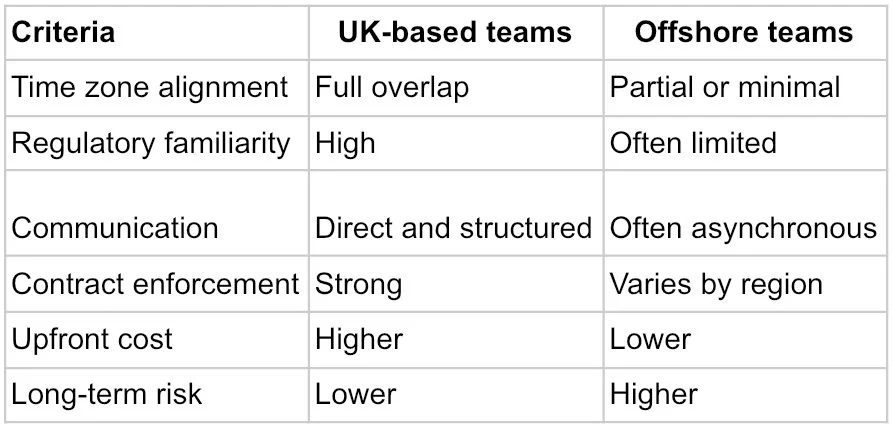
Cost differences exist, but total project risk often balances the equation.
Key Considerations When Hiring App Developers in the UK
Hiring app developers in the UK requires a structured assessment process. The goal is not to find the cheapest option but the most reliable and suitable one for the project scope.
Engagement models
UK providers usually offer three main models:
Project-based delivery – fixed scope, timeline, and cost
Dedicated team – ongoing collaboration with allocated developers
Staff augmentation – specialists integrated into an internal team
Each model suits different stages of product maturity.
Cost expectations
Pricing varies by experience, location, and complexity. Typical ranges include:
Junior developers: £40–£60 per hour
Mid-level developers: £60–£90 per hour
Senior developers: £90–£120+ per hour
Agencies charge more than freelancers but include management, QA, and accountability.
Technical fit and platform expertise
A strong partner demonstrates platform-specific knowledge rather than generic skills. Evaluation should cover:
Native iOS and Android experience
Cross-platform frameworks when applicable
Backend architecture and cloud services
Third-party integrations
Code samples and case studies provide better insight than marketing claims.
Evaluation checklist
When comparing candidates, assess them against consistent criteria:
Relevant industry experience
Clear development process
Transparent pricing structure
Security and compliance practices
Post-launch support terms
This reduces bias and supports objective comparison.
Common hiring mistakes
Selecting based on cost alone
Skipping technical interviews
Ignoring maintenance requirements
Underestimating product discovery time
Avoiding these errors saves time and budget over the product lifecycle.
The UK app development market offers reliability, technical depth, and commercial clarity for businesses building mobile products. Success depends on selecting a partner with the right experience, delivery model, and accountability standards. UK-based companies and developers stand out through structured processes, regulatory awareness, and long-term commitment to product quality. A disciplined evaluation approach leads to stronger outcomes and fewer surprises during development and beyond.
FAQ
How much does it cost to hire app developers in the UK?
Rates typically range from £40 to £120 per hour, depending on experience, role, and engagement model.
Are UK app development companies suitable for startups?
Yes. Many UK firms work with early-stage companies and offer phased delivery to manage budget and risk.
What industries do UK app developers commonly serve?
Common sectors include fintech, healthcare, education, eCommerce, logistics, and SaaS.
How long does it take to build a mobile app in the UK?
Simple apps may take 3–4 months, while complex platforms can require 6–12 months or longer.
Should businesses choose agencies or freelancers?
Agencies provide structure and continuity, while freelancers suit small, well-defined tasks with internal oversight.





































Handmade in Ghana, our aprons offer a unique design with a front pocket perfect for kitchen utensils or your phone and tie neck straps each made from recycled material. The perfect gift for any cooking enthusiasts!
Our aprons have been named after markets in Ghana and London. This apron has been named after street food hub Maltby Street Market.