
Review: Seeds of Hate and Hope at the Sainsbury Centre, Norwich
As you ascend the winding staircase into the upper galleries of the impressive, Norman Foster-designed Sainsbury Centre, a red light begins to flicker. It belongs to Mona Hatoum’s iconic Hot Spot: a globe constructed from steel rods, on which the outlines of every continent gleam in an ominous neon red, representing the perma-status of unrest in which we find ourselves. Created in 2006, Hot Spot holds the same potency nearly twenty years later, tragically enriched by new and ongoing conflicts and countless lives lost. In fact, according to the wall text, “the occurrence of global conflicts has almost doubled in the last five years.” As that alarming statistic reveals, the world is becoming a more unstable and dangerous place. The question that therefore arises is: what role does art play in all this?

Mona Hatoum, Hot Spot, 2006. Stainless steel, neon tube. Courtesy of the David and Indrė Roberts Collection. © Mona Hatoum. All rights reserved, DACS 2025. Image courtesy of White Cube. Photo: Stephen White
During our guided tour, co-curator Tafadzwa Makwabarara emphasises that the artworks chosen for Seeds of Hate and Hope steer away from shock value and instead offer an array of creative reflections and responses to global atrocities. No images of violence are on display here, and at a quick glance, a visitor might not even be able to guess the subject matter of the exhibition. Instead, the projects on display require, and definitely reward, close looking. A particularly thought-provoking work is Gideon Rubin’s Black Book (2017), which redacts every page of Adolf Hitler’s Mein Kampf. With a thick black marker, the artist has painstakingly crossed out and shaded in every word and picture in the book, leaving just the outlines of paragraphs and illustrations visible.
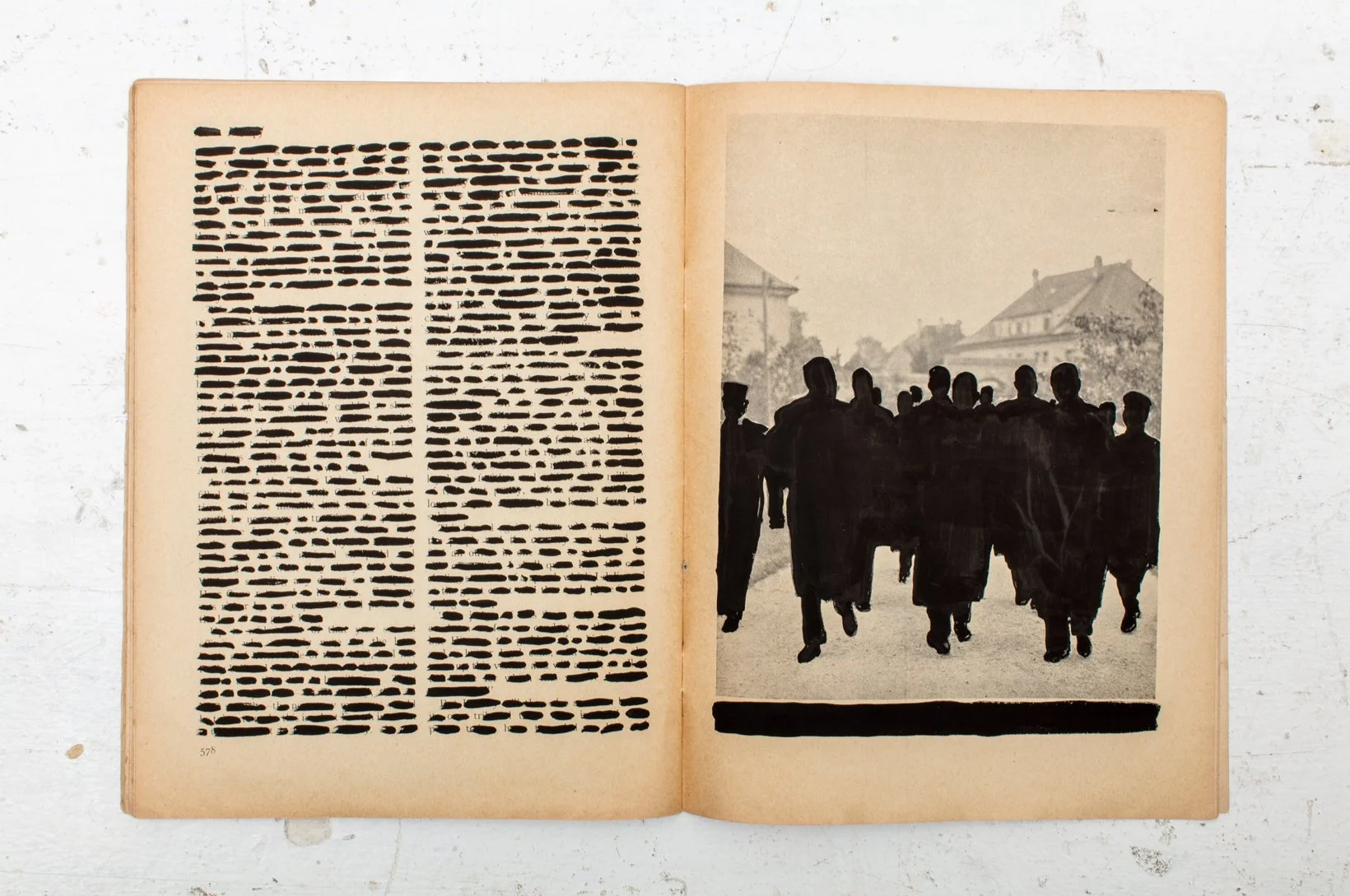
Gideon Rubin, Black Book, Adolf Hitler covered over, gouache on printed paper (p.16), 2017
Rubin’s work prompts us to reflect on how ideologies are transmitted, and the ways in which words infiltrate the world beyond the page. Considering this from an almost inverse position, Alfredo Jaar’s series Untitled, Newsweek is a visceral demonstration of media indifference during the 1994 genocide in Rwanda. It becomes clear from these examples alone that art has a unique ability to critique dangerous narratives propagated in text and the media. This is key to the exhibition’s aim of uncovering how seeds of both hate and hope may be planted during conflicts, and it justifies the curatorial decision to focus on events of the previous century rather than contemporary ones.
Many of the exhibited artworks demonstrate how the impacts of mass atrocities extend far beyond the events themselves, and how reparative and restorative work can take decades. In William Kentridge’s animated film Ubu tells the truth, the artist confronts the legacies of Apartheid by blending fact and fiction to absurd effect. He combines archival footage of protests and police brutality in South Africa with cartoon drawings, photographic material, and animations relating to Alfred Jarry’s seminal play Ubu Roi. The result is disorientating and topical in the supposed “post-truth” era we find ourselves in. The idea of an objective truth in the context of conflict is particularly thorny, and yet often plays a significant role in individuals’ and nations’ identity-building. British artist David Cotterrell explores this phenomenon in his double-screen video work Mirror IV: Legacy, in which six Rwandan actors of the post-genocide generation read the same monologue aloud. However, half have been told that their character’s father was a victim, and the other half that their character’s father was a perpetrator. As viewers, we become intensely attuned to any movement in the actors’ faces, attempting to read inherited guilt or victimhood into every twitch. The result is decidedly uneasy and forces us to consider the mechanisms through which generational trauma persists.
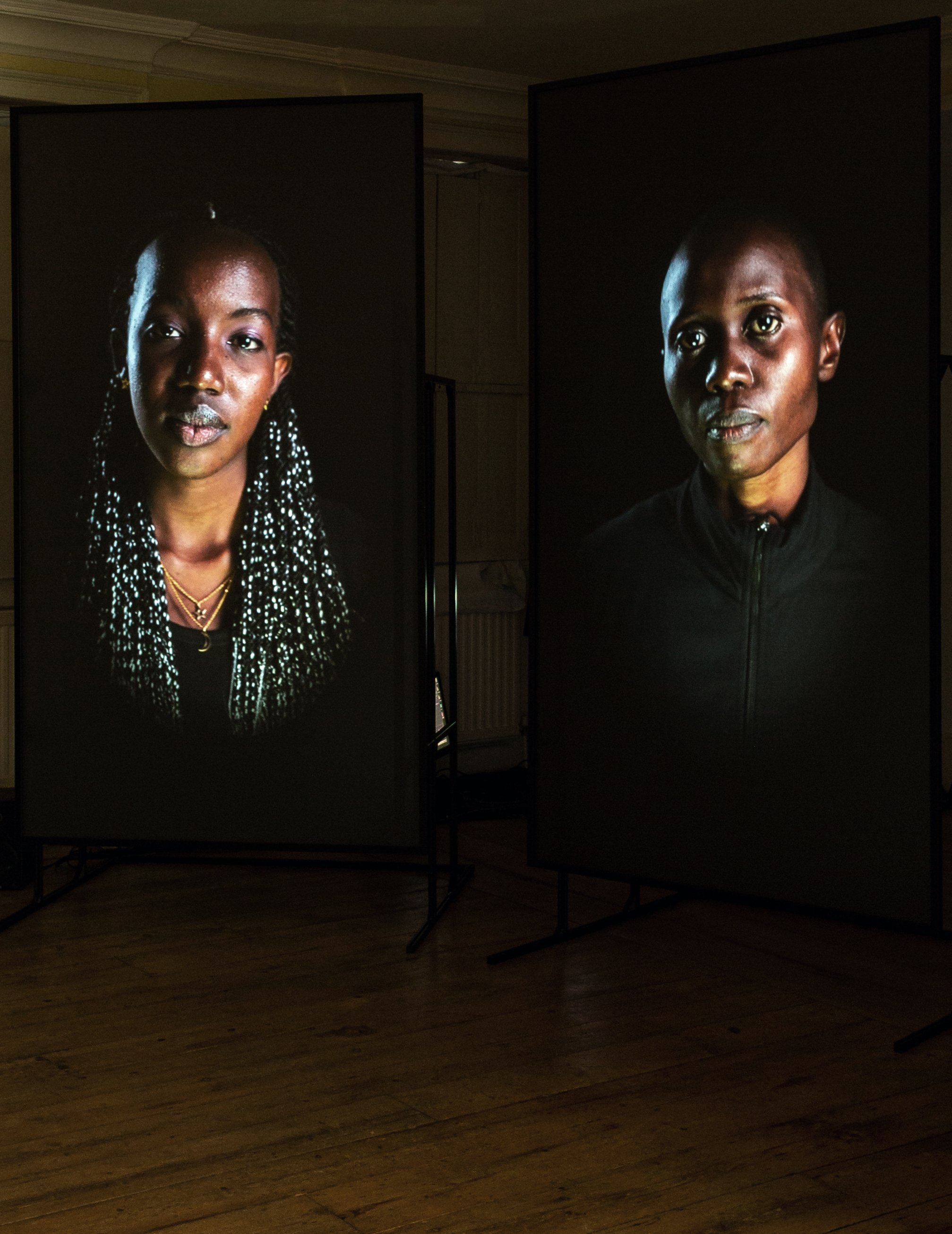
David Cotterrell, Mirror IV: Legacy, 2015, video. © David Cotterrell, 2018. Image courtesy of the artist.
This exhibition forms part of a broader programme at The Sainsbury Centre which asks vital, fundamental questions. Seeds of Hate and Hope was one of several shows curated in light of the question: Can we stop killing each other? While global events continue to put forward a negative answer to that question, this exhibition successfully proposes art as a crucial tool for understanding history and restoring a sense of shared humanity in the face of such horrors.
Date: 28 November - 17 May 2026. Location: Sainsbury Centre, University of East Anglia, Norwich, Norfolk, NR4 7TJ. Price: Pay If and What You Can. sainsburycentre.ac.uk
Review by Sofia Carreira-Wham










Handmade in Ghana, this beautiful green apron offers a unique design with a front pocket perfect for kitchen utensils or your phone and tie neck straps each made from recycled material. The perfect gift for any cooking enthusiasts!
Our aprons have been named after markets in Ghana. This apron has been named after Kintampo Market located in the Bono region of Ghana it is noted for their sales of yam tubers.