
Top benefits of reverse Osmosis for industrial water treatment
Water purity directly affects product quality, equipment reliability, and operational costs in industrial environments. Reverse osmosis filters have become one of the most widely adopted technologies for achieving consistently high purity across diverse sectors. This article covers how RO systems function in industrial contexts, what benefits they deliver, and why the investment returns measurable operational value.
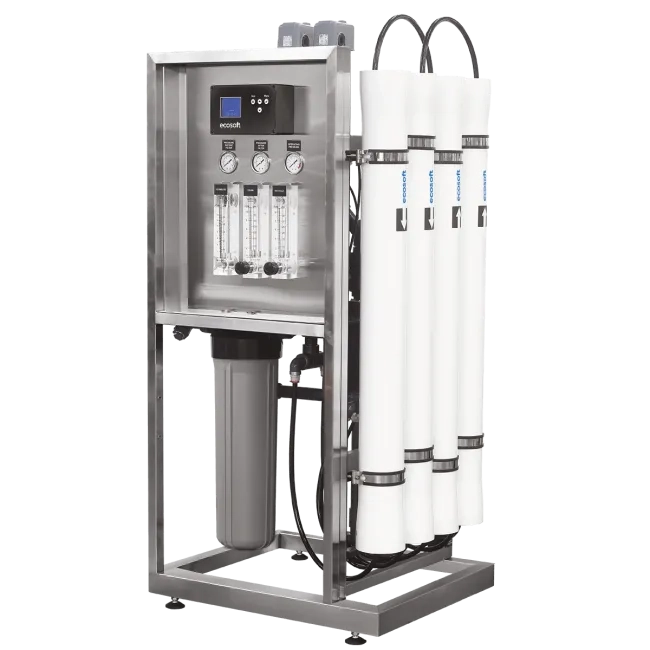
Why Industries Need RO Systems
Industrial water treatment requirements go far beyond what a standard municipal supply provides. Manufacturing, pharmaceuticals, food processing, and energy generation all depend on water that meets strict purity thresholds.
Source water carries dissolved salts, heavy metals, organic compounds, and microbiological contaminants. These interact with equipment, affect chemical reactions, and compromise end-product integrity. A dedicated RO system addresses this at the intake stage, before water enters the production loop.
Process water treatment is particularly demanding in sectors like semiconductor fabrication, where even trace ion concentrations affect yields, or in steam generation, where dissolved solids cause scaling in boilers.
How Industrial Reverse Osmosis Works
Membrane filtration is the core mechanism. Water is forced under pressure through semi-permeable membranes with pore sizes around 0.0001 microns, small enough to block dissolved salts, bacteria, viruses, and most organic molecules.
The process involves several stages:
Pre-filtration removes suspended solids and protects the RO membrane from fouling.
The membrane stage separates purified permeate from concentrated reject water.
Post-treatment, such as remineralisation or UV disinfection, adjusts the output to application requirements.
Desalination of brackish water and seawater uses the same membrane principle, scaled to handle higher salinity inputs. Manufacturers like Ecosoft supply industrial-grade RO equipment designed for continuous operation and adaptable to variable source water quality.
Benefits for Production and Equipment
Industrial filtration at the RO level protects downstream assets in ways that conventional treatment cannot match. Purified water reduces the frequency of cleaning cycles, prevents mineral deposits on heat transfer surfaces, and extends the service life of pumps and valves.
Key operational benefits include:
consistent input water chemistry simplifies process control and reduces variability in finished products;
lower mineral load in boiler feedwater decreases blowdown frequency and energy loss from scale;
cooling systems experience reduced fouling, lowering maintenance intervals.
Well-designed RO systems integrated at the facility level create a reliable foundation for production consistency - their impact extends well beyond the water treatment room.
Water Quality Improvements
Water quality after RO treatment is defined by what is removed. Typical industrial RO membranes reject 95‒99% of dissolved salts, along with heavy metals, nitrates, chlorine byproducts, and suspended particles.
Contaminant removal at this level supports measurable outcomes. Boiler feedwater with low total dissolved solids runs at higher cycles of concentration, reducing water and chemical consumption. Clean water entering food or beverage production does not alter taste profiles or introduce off-flavours. In pharmaceutical manufacturing, RO-purified water meets the baseline for Purified Water (PW) as defined by major pharmacopoeias.
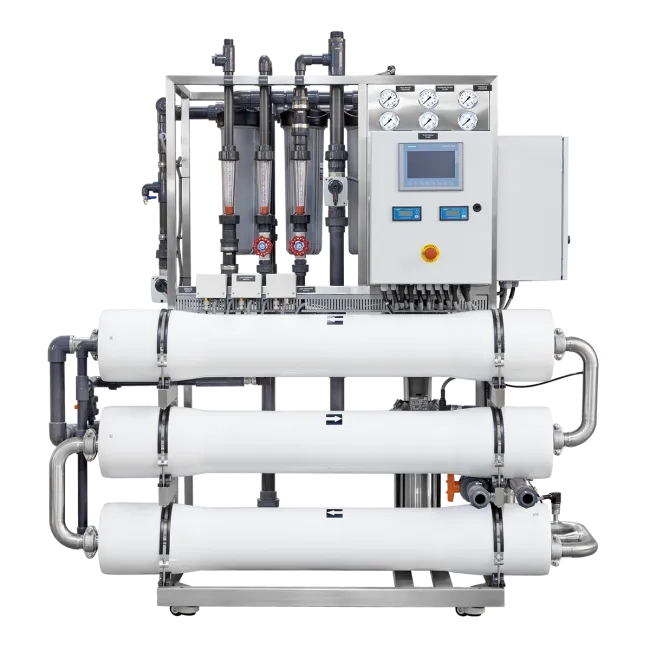
Cost Efficiency in Industry
Water system efficiency improves across multiple cost categories when RO is properly integrated. Reduced chemical consumption, fewer cleaning cycles, and longer equipment service intervals all contribute to lower operating expenditure.
Water purification system economics also include energy savings. Studies in industrial settings show that even 1 mm of scale on a heat exchange surface can increase energy consumption by 7‒10%. Reject water from the RO process can be partially recovered through recirculation, improving overall water utilisation and reducing discharge volumes.
Reverse osmosis delivers verified improvements in water purity, equipment protection, and resource efficiency at the industrial scale. Its versatility across sectors, from energy to food processing to pharmaceuticals, makes it a dependable foundation for any facility where water quality determines operational outcomes. A site-specific water analysis is the practical starting point for selecting the right system configuration and capacity.





































Handmade in Ghana, our aprons offer a unique design with a front pocket perfect for kitchen utensils or your phone and tie neck straps each made from recycled material. The perfect gift for any cooking enthusiasts!
Our aprons have been named after markets in Ghana and London. This apron has been named after street food hub Maltby Street Market.