
Review: Hammershøi: The Eye that Listens, Museo Nacional Thyssen-Bornemisza
A new retrospective of Danish painter Vilhelm Hammershøi (1864-1916) at the Thyssen-Bornemisza National Museum in Madrid reveals a radical side to the Scandinavian master, whose impressive body of work and unique style merits wider recognition.
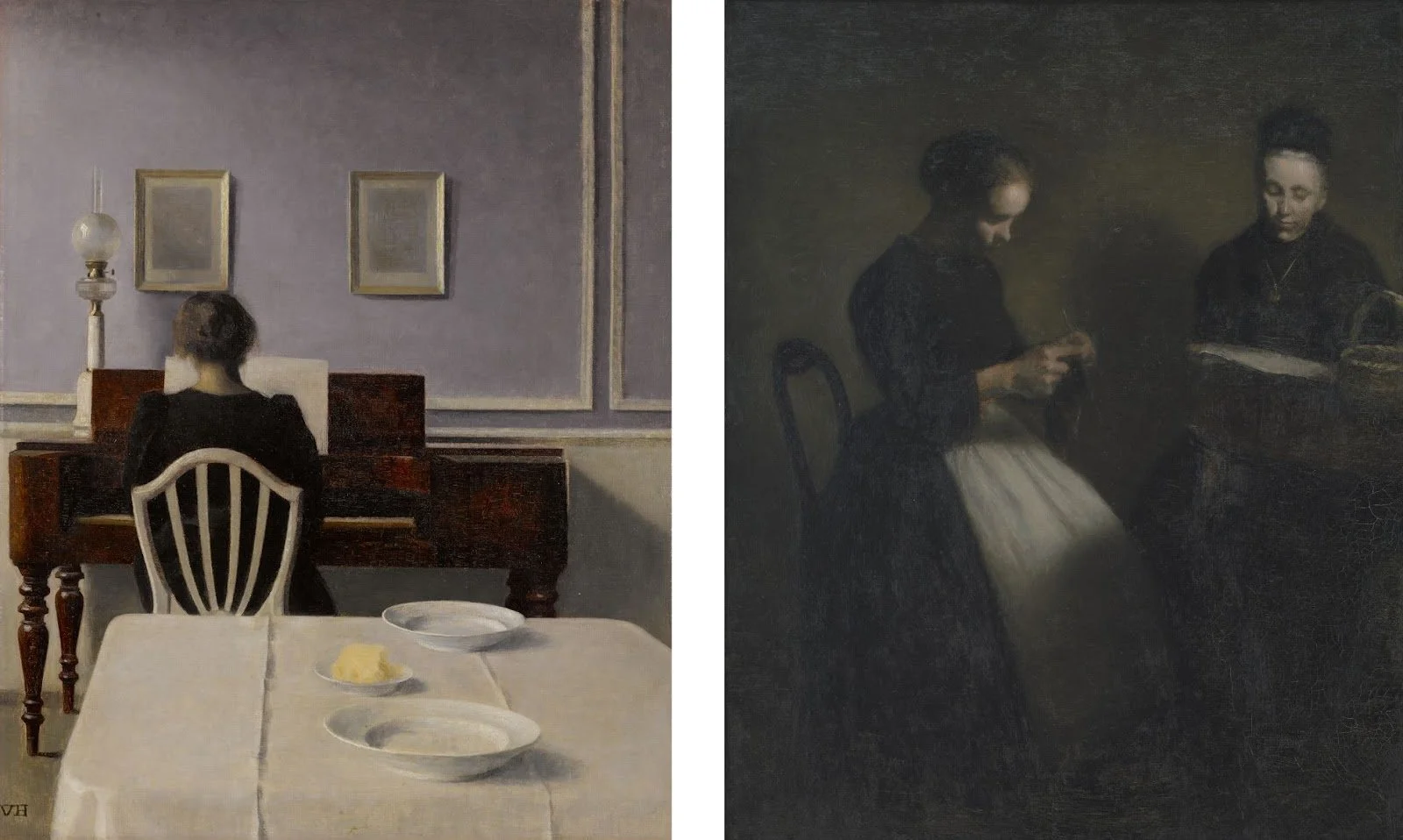
Left: Interior with Woman at Piano, Strandgade 30 (1901). Private collection. Photo: ©Bruno Lopes. Right: Evening in the Drawing Room. The Artist's Mother and Wife (1891). SMK, National Gallery of Denmark, Copenhagen.
At first glance, Hammershøi’s paintings are humble in both size and subject matter. The vast majority depict the simple interior of his home in Copenhagen, alongside a smattering of portraits of his wife and inner circle. Adding to this initial impression of homogeny, the artist treats his subjects with a restricted palette, confined almost exclusively to tones of white, beige, brown and black. Viewed at close quarters, however, Hammershøi’s understated canvases come to life with richly textured brushwork and luminous, lavishly applied oils. The artist’s brushstrokes are vigorously applied and convey a sense of urgency and immediacy, in contrast to the restrained scenes which they capture. This tantalising disparity creates a source of intrigue as to the artist’s nature and artistic intentions.
The broad strokes of Hammershøi’s life are well documented, he was born in Copenhagen in 1984 to a merchant father and wealthy mother. His artistic studies began at the age of eight, studying drawing and painting throughout his youth before attending the Royal Danish Academy of Fine Arts. His technical prowess is evident in the sketches included in the exhibition, revealing an instinctive, confident approach to capturing the world around him. Hammershøi preferred not to comment on the meaning of his work, a position that has inspired varied interpretations of his work through history. Sound and, conversely, silence, are commonly cited themes, as referenced in the Thyssen’s exhibition title “The Eye that Listens”. Hammershøi’s passion for music and deep respect for musicians is encapsulated by his 1893 painting The Cello Player. Portrait of Henry Bramson. He captures Henry utterly engrossed in his craft, eyes closed and hands deftly caressing the bow and strings. The body becomes increasingly amorphous, to the point where it entirely blends in with the background and focuses the viewer’s attention towards the cello, which has a sculptural, luminescent quality. The elevation and foregrounding of instruments recurs throughout Hammershøi’s practice, with the music room in his apartment in Copenhagen a favourite subject. In Interior. The Music Room, Strandgade 30 from 1907, the piano, cello and violin echo human sitters posing for a family portrait: poised, proper and rendered with great care.
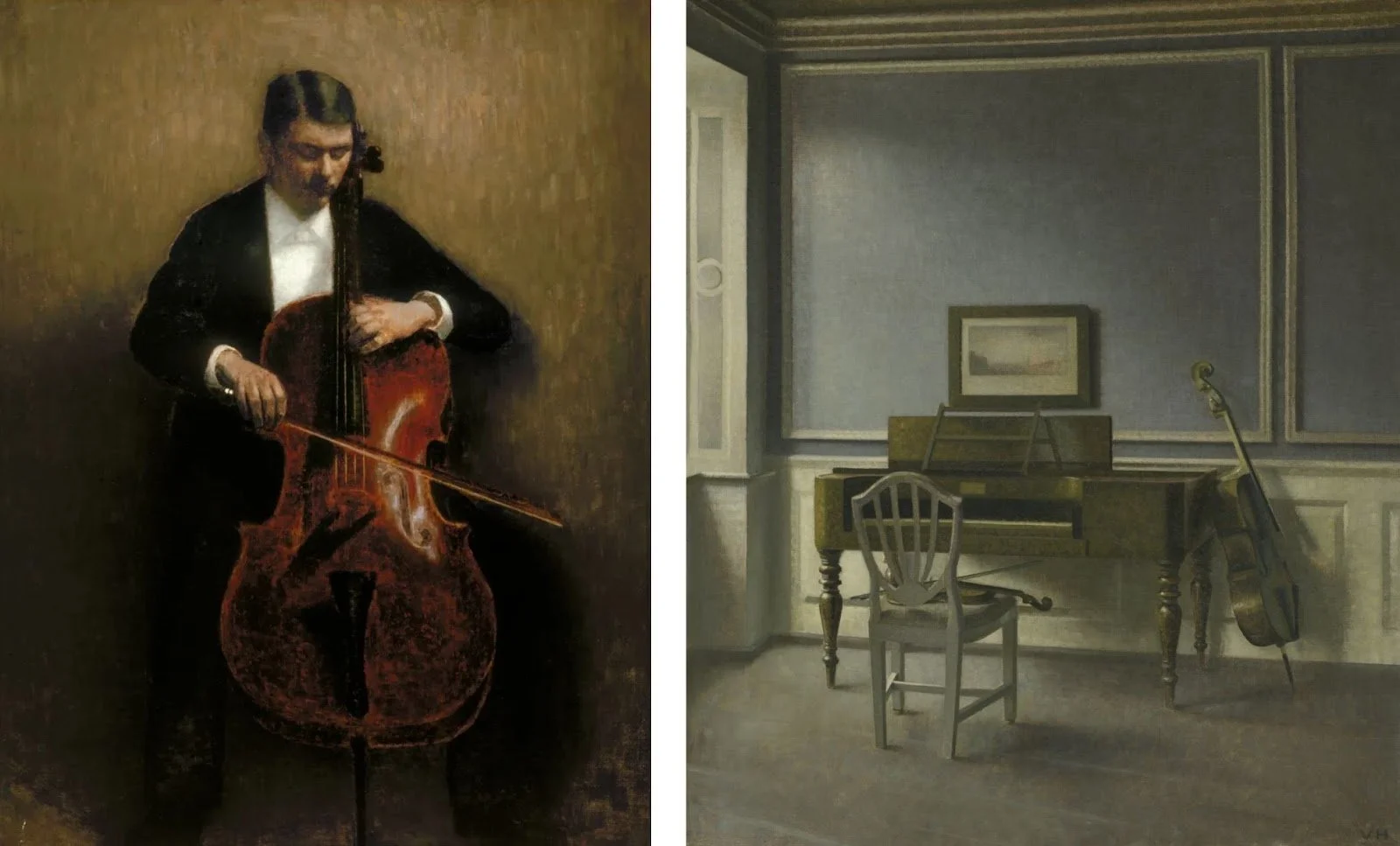
Left: The Cello Player. Portrait of Henry Bramsen (1893), Vilhelm Hammershøi. Kunstmuseum Brandts, Odense. Photo: © Kunstmuseum Brandts. Right: Interior. The Music Room, Strandgade 30 (1907), Vilhelm Hammershøi. The Art Institute of Chicago, Joseph Winterbotham Collection, Chicago. The Art Institute of Chicago / Art Resource, NY/ Scala, Florence.
By contrast, Hammershøi’s human figures are often intentionally ambiguous, with their faces cast in shadow or their backs turned to the viewer. A number of portraits, particularly of his wife Ida Ilsted, are exceptions to this rule, but there is an undeniable proclivity towards the architectural over the human in Hammershøi’s work. A curatorial strength of the exhibition lies in highlighting this gradual transition from populated interiors to increasingly empty, experimental scenes which lack traditional points of interest. In the absence of spatial markers such as people and furniture, Hammershøi’s interiors take on a spectral, almost supernatural quality. Our attention is drawn time and again towards doors and windows, often rendered in brilliant white tones that offer a thrilling counterpoint to their muted surroundings. The impossibly bright light that shines through the window in Sunbeams or Sunlight (1900) is awe-inspiring, suggesting infinite possibilities pertaining to the outside world, while reinforcing the serenity and security of the indoors. The simplicity of the room serves to amplify the suggestive potential of this portal to the exterior, although details of what lies beyond are purposefully nebulous.
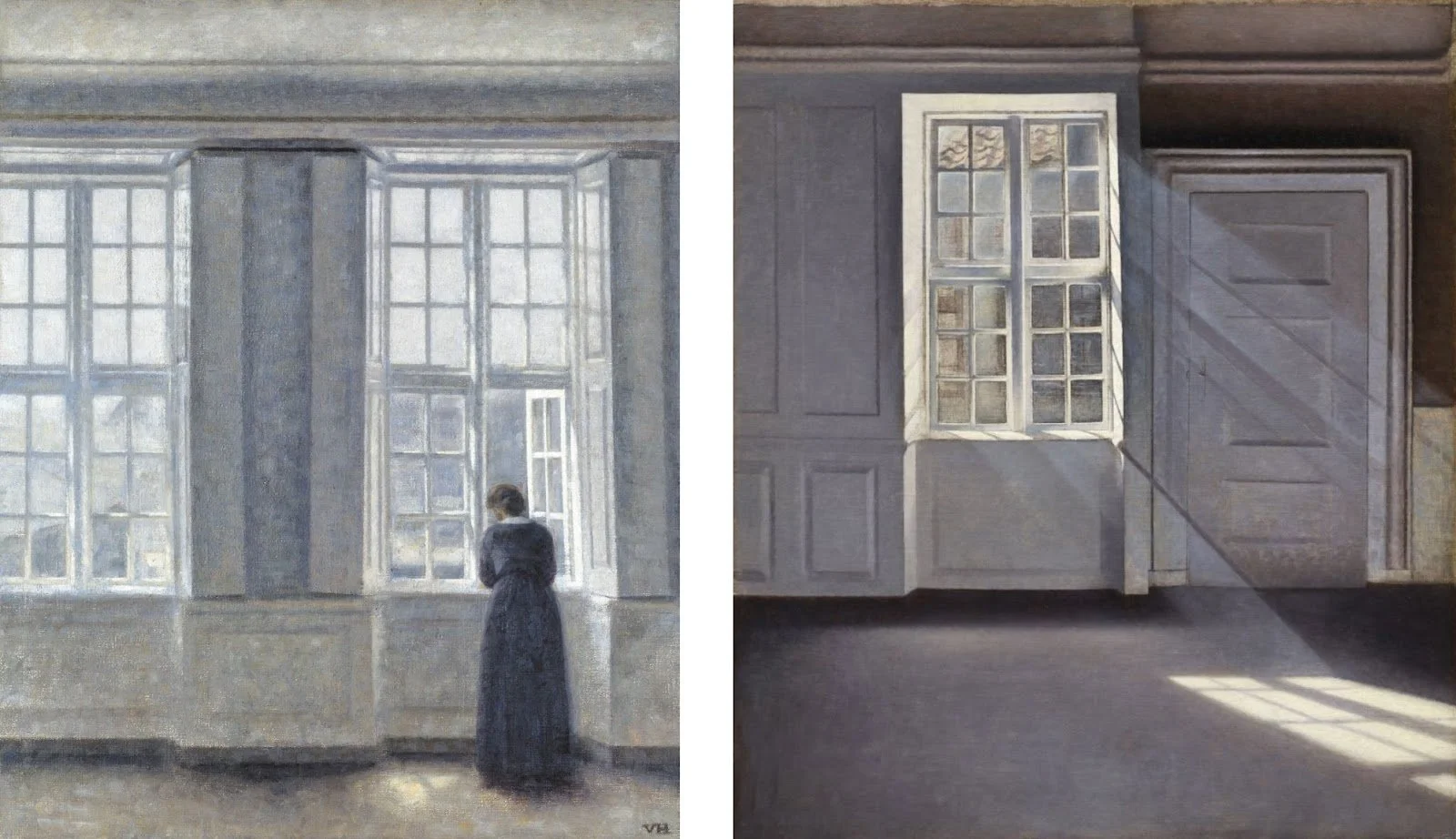
Left: The Tall Windows (1913). Ordrupgaard, Copenhagen.Right: Sunbeams or Sunlight. Dust Motes Dancing in the Sunbeams. Strandgade 30 (1900). Ordrupgaard, Copenhagen. © Photo: Anders Sune Berg.
Hammershøi’s partiality for repeatedly painting the same spaces encourages a special attentiveness in the viewer, and I increasingly found myself identifying and relishing minor deviations between paintings. The exhibition layout at the Thyssen lends itself well to this, with many paintings hung in each room, enabling comparison. The inclusion of works by several of the artist’s contemporaries, such as James McNeill Whistler, further helps to contextualise the world of Hammershøi and the painting styles of his era for today’s audience. The explanatory texts are kept to a minimum, and while they serve to convey key facts and themes, I found myself craving deeper insights into the artist’s life, work and reception. An exhibition catalogue has been published for those looking to dive further into Hammershøi’s practice, and the show will travel to the Kunsthaus Zurich in July 2026 following its run in Madrid.
In this age of content over-saturation, Hammershøi’s work is particularly resonant. It encourages a slower, more conscious form of looking, and certainly rewards those who do.
Date: 17 February - 31 May 2026. Location: Museo Nacional Thyssen-Bornemisza, Paseo del Prado, 8, 28014 Madrid, Spain. Price: Adult ticket €19, concessions available. Free entry from 9-11pm on Saturdays, sponsored by Uber. Book now
Review by Sofia Carreira-Wham















Handmade in Ghana, this beautiful green apron offers a unique design with a front pocket perfect for kitchen utensils or your phone and tie neck straps each made from recycled material. The perfect gift for any cooking enthusiasts!
Our aprons have been named after markets in Ghana. This apron has been named after Kintampo Market located in the Bono region of Ghana it is noted for their sales of yam tubers.