
Rose Wylie at the Royal Academy of Arts, London review
The first solo exhibition by a British female artist in the Royal Academy’s main galleries does not disappoint (at least not in terms of the art - the curatorial framework, however, is another matter).
When you first walk in, you are shown early memories, with a quote written in the artist’s own voice, pulling you into her experiences shaped by wartime Britain in the 1940’s: “It is the things I remember that I’m interested in. The memory may not be accurate but if I have a fond memory of something, the work I make gives me a chance to relate the work to the memory”. The works in the first room follow that thread, with doodlebug silhouettes (the German V-1 flying bomb that was used in assaults on London in 1944), swastika patterns woven into repeated motifs, and the colour palette showing a darker intensity than other pastel-hued works we see throughout the rest of the exhibition (which, due to the Royal Academy’s architecture, one can see juxtaposed when peering through the arched doorway into the next room). As a starting point for the entire exhibition, there is something quite unsettling about wartime imagery combined with Wylie’s playful, naïve painting style.
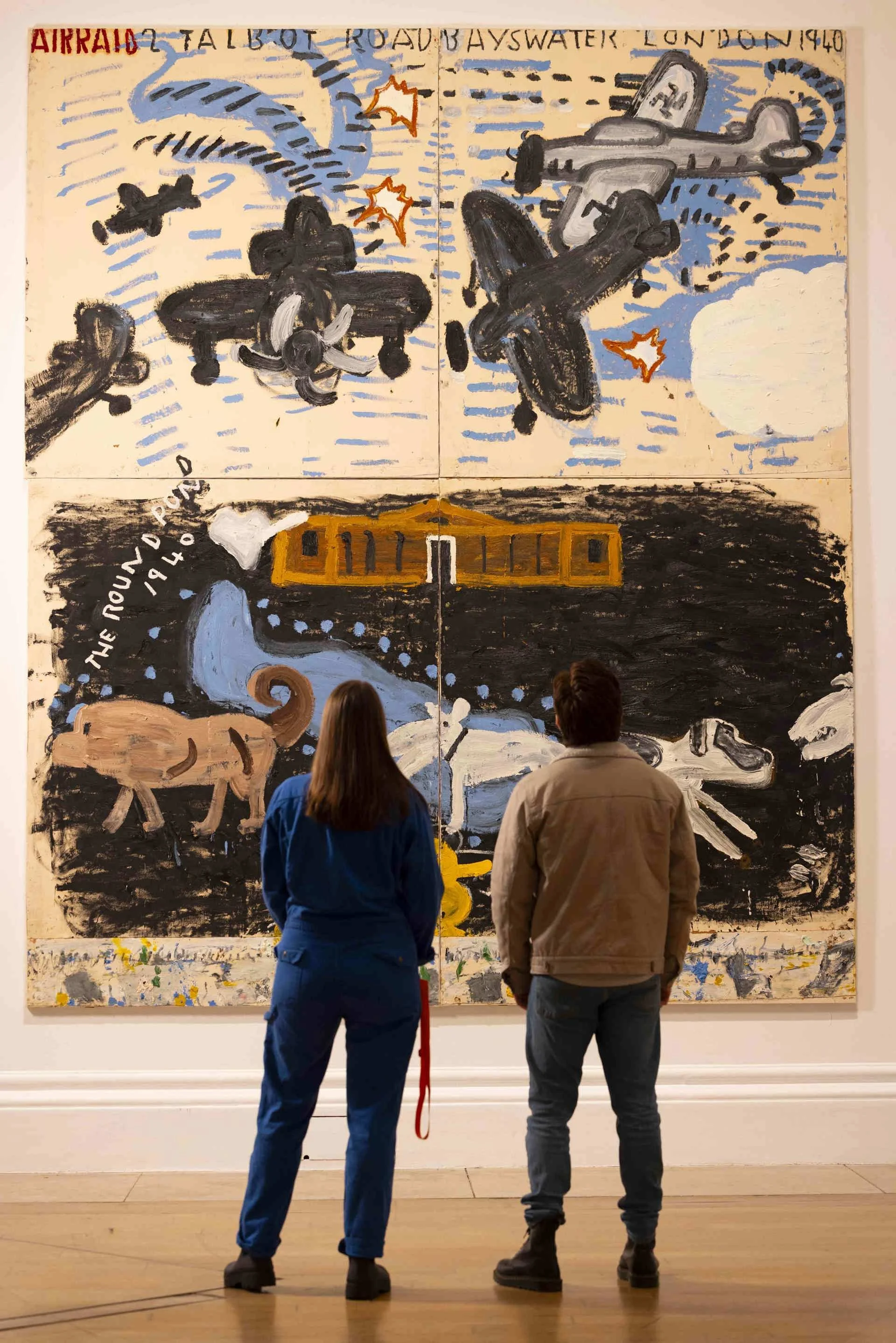
Installation view, “Rose Wylie: The Picture Comes First” at the Royal Academy of Arts, London, Park Dogs & Air Raid, 2017, from a private collection. © Royal Academy of Arts, London / David Parry. © Rose Wylie
It is worth noting, though, that the paintings here are not early works - they are early memories, made at various points in her life - in 1998, 2017, and 2022. That she revisited the motifs over such a long span of time lends the exhibition curation such an interesting perspective, as it adds further context to the framework of her practice. However, at some points throughout, the curatorial communication adds hints of confusion, including in this first room which could easily be misinterpreted as early works grouped together.
The second room introduces an important phrase for Wylie, namely ‘Transformation, synthesis, specific’ , which describes how she arrives at an image. Another quote on the wall from the artist: “A painting is not finally what it does, or what it makes, or what it has, or what it means… it is. The painting is the meaning”. which gives the clearest insight into how Wylie thinks. Her starting points are taken from everywhere. From memory, flora, fauna, film, the internet, archaeological artefacts, fashion shows, and more, which provides a deeper foundation for the rest of the extensive exhibition.
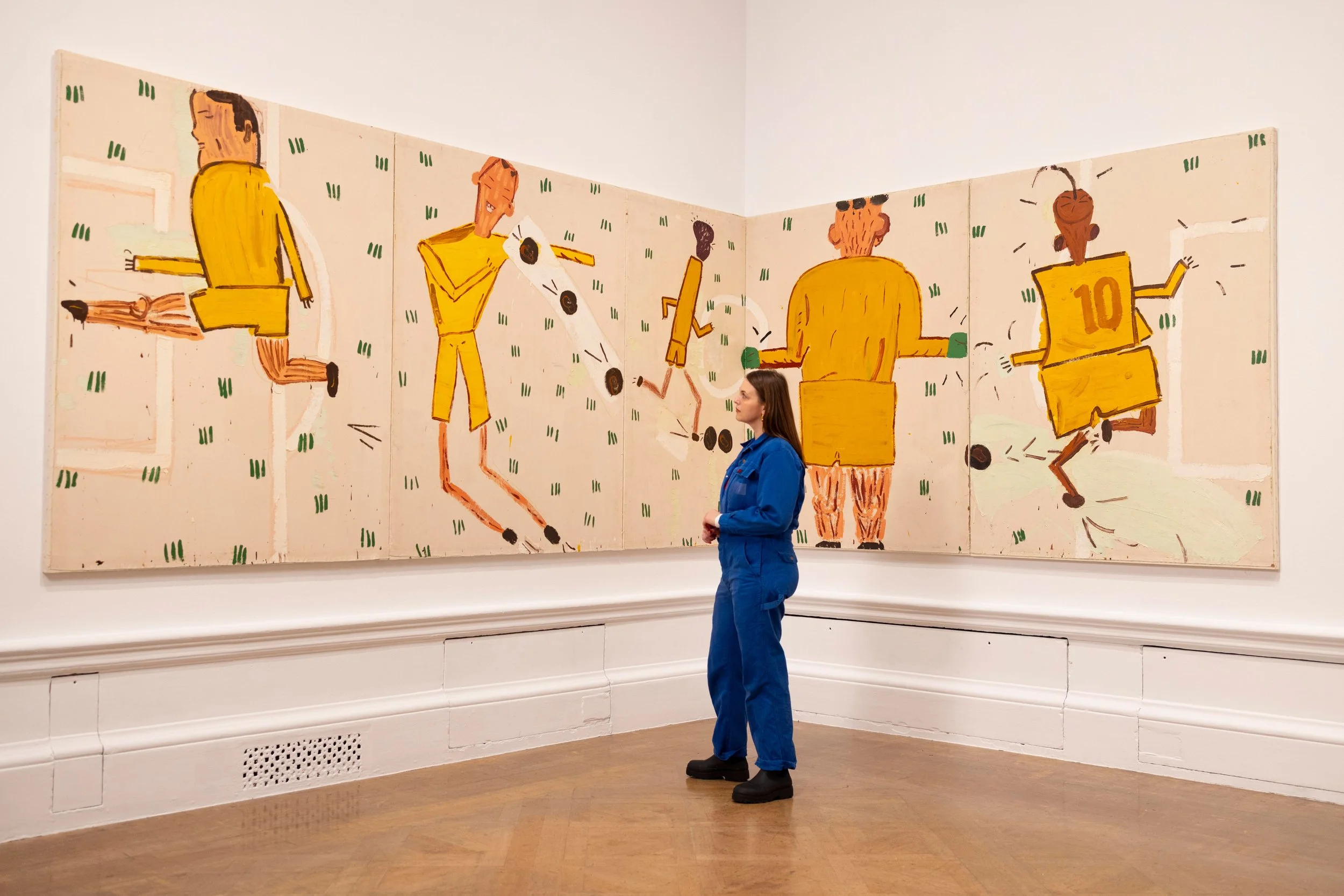
Installation view of “Rose Wylie: The Picture Comes First” at the Royal Academy of Arts, London, Yellow Strip, 2006. Courtesy the artist and David Zwirner. Photo © Royal Academy of Arts, London / David Parry. © Rose Wylie
The displays in the adjoining rooms are those I found to be the most captivating from the exhibition, but also the most confusing in terms of curatorial communicative frameworks.
Walking into the space showing the “Room Project” , the wall text detailed how, as a young woman at Folkestone and Dover School of Art in the 1950s, Wylie studied figurative painting at a time when British neo-romantic painters dominated. It goes on to state that, in the mid 1980s, Wylie devoted herself to painting again after having children, establishing the studio in her Kent cottage where she still works today. We learn that Room Project (2002-03) was painted for Trinity Theatre in Tunbridge Wells and gave Wylie the opportunity to “create large paintings that present their own magical and playful world(…). ” It was incredible to see a contemporary take on medieval tapestry, and one painting in particular, Green Twink and Ivy, hangs across a corner, joining at a 90 degree angle. You have to step close and turn slightly, and suddenly the painting surrounds you on two sides. You feel as if you’re inside the world she has made rather than in front of it.
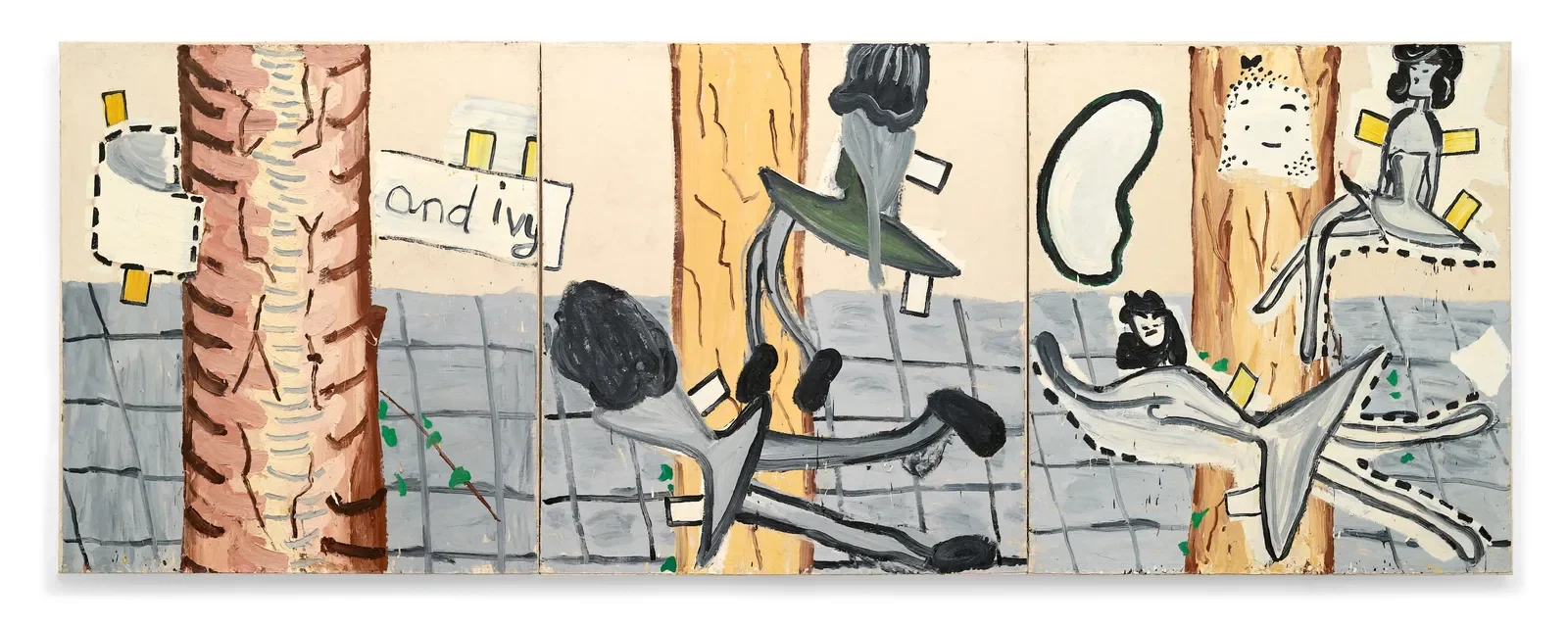
Green Twink and Ivy, 2003, Rose Wylie. Image courtesy of the artist/ JARILAGER Gallery
However, the contextualisation the wall text tries to add creates confusion rather than clarification. Why was it relevant to hear about her studies in the 1950’s and her return to painting in the 1980’s in this room specifically? Or how neo-romantic and avant garde were popular movements during that time? Could the underlying message here be that these paintings reference her time in the 50s and 80s, as well as that her naïve painting style was an anomaly within the arts? If an aim is to communicate clearly to audiences, the fact that a viewer is searching for an underlying message to mitigate confusion in the text is less than ideal. It felt as though there was a missing narrative link, and given the small amount of text and information provided, the opportunity to communicate was not used wisely.
On the other hand, one of the best additions to the exhibition is how it represents the way Wylie draws, and how drawing is an important pillar to her practice. An entire room dedicated to the theme had lowered lighting, presumably for conservation reasons, and it takes leaning in over the glass display table to look closely at sketchbooks, preparatory drawings, and a diary from January 2020. In that diary, Wylie has noted appointments, a funeral at 4pm on one day, a meeting on another with a ‘Mr. Zhang’ that was cancelled, and among those entries is a late-night drawing of the Statue of Liberty, titled as ‘Homage to Jimmy Lee Sudduth’s Statue of Liberty’ . An arrow in her handwriting points upward toward the drawing with the note. The reference to the everyday is part of what makes the object so alive, and is exemplary of Wylie’s practice. Out of everything in the exhibition, this was one of the works that made a lasting impression.
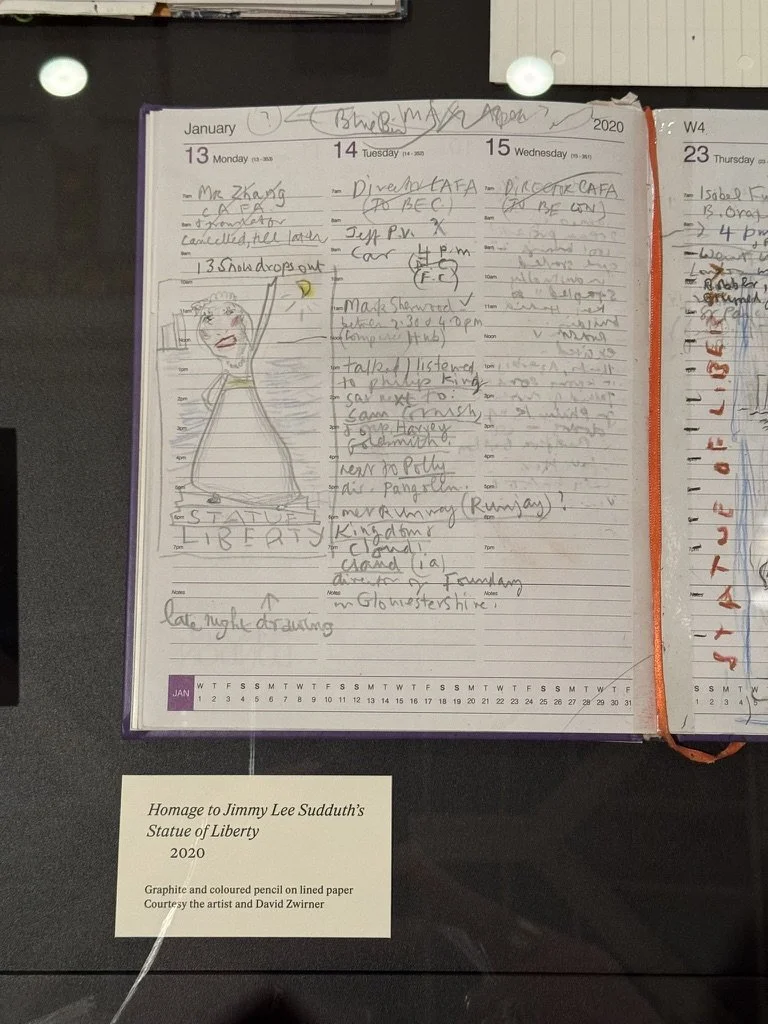
Homage to Jimmy Lee Sudduth’s Statue of Liberty, Rose Wylie. Image credit Alexandra Steinacker-Clark
Overall, this is a fun, moving, albeit sometimes disjointed, exhibition. Rose Wylie is the first British female artist to be given the main galleries at the RA, and the scale of the presentation reflects that significance. The chronology is not always legible - nor does it really need to be - but the curatorial narrative was at times unclear. That being said, the work itself earns the space and creates a truly vibrant energetic atmosphere, whether it includes a preoccupation with heavier themes of war, violence, or other political upheavals or lighter themes of pop culture and memory. Ultimately, in the words of Wylie herself, a painting just… is.
Date: 28 February - 19 April 2026. Location: Royal Academy, Burlington House, Piccadilly, London W1J 0BD. Price: £21-23. Concessions available. Book now
Review by Alexandra Steinacker-Clark







Handmade in Ghana, this beautiful green apron offers a unique design with a front pocket perfect for kitchen utensils or your phone and tie neck straps each made from recycled material. The perfect gift for any cooking enthusiasts!
Our aprons have been named after markets in Ghana. This apron has been named after Kintampo Market located in the Bono region of Ghana it is noted for their sales of yam tubers.