
Irving Norman’s radical protest art is brought to light at Sotheby’s New York
Born in 1906 in Vilnius, Lithuania, Irving Norman emigrated to New York in 1923, before moving to California in 1934. During a time when Abstract Expressionism dominated the art community, Norman championed figuration and produced works reflecting the cruelty, inequality, violence, and technological upheaval of modern society. He posited a crucial question: how different is capitalism from communism? Though the ideologies were supposedly opposites, the way they played out on the global stage in the 20th century was markedly similar. The 1970s provided some of the starkest events to support this and countries across the world experienced the rise of radical ideologies once again. In particular, the Vietnam War saw both the communist East and the capitalist West utilise allied nations to expand their influence through a war of attrition.
In his work, Irving Norman demonstrates how both ideologies rely on two key tactics, exploitation and indoctrination, to influence and hold power. The paintings on display at the Sotheby’s exhibition Pomp and Circumstance, specifically The Summit (1978) and The Academy (1975), exemplify this through psychologically charged scenes in which Norman exposes universal truths. The Summit directly explores the fundamental nature of communism and capitalism while The Academy investigates the very systems that entrench the reign of a certain ideology.
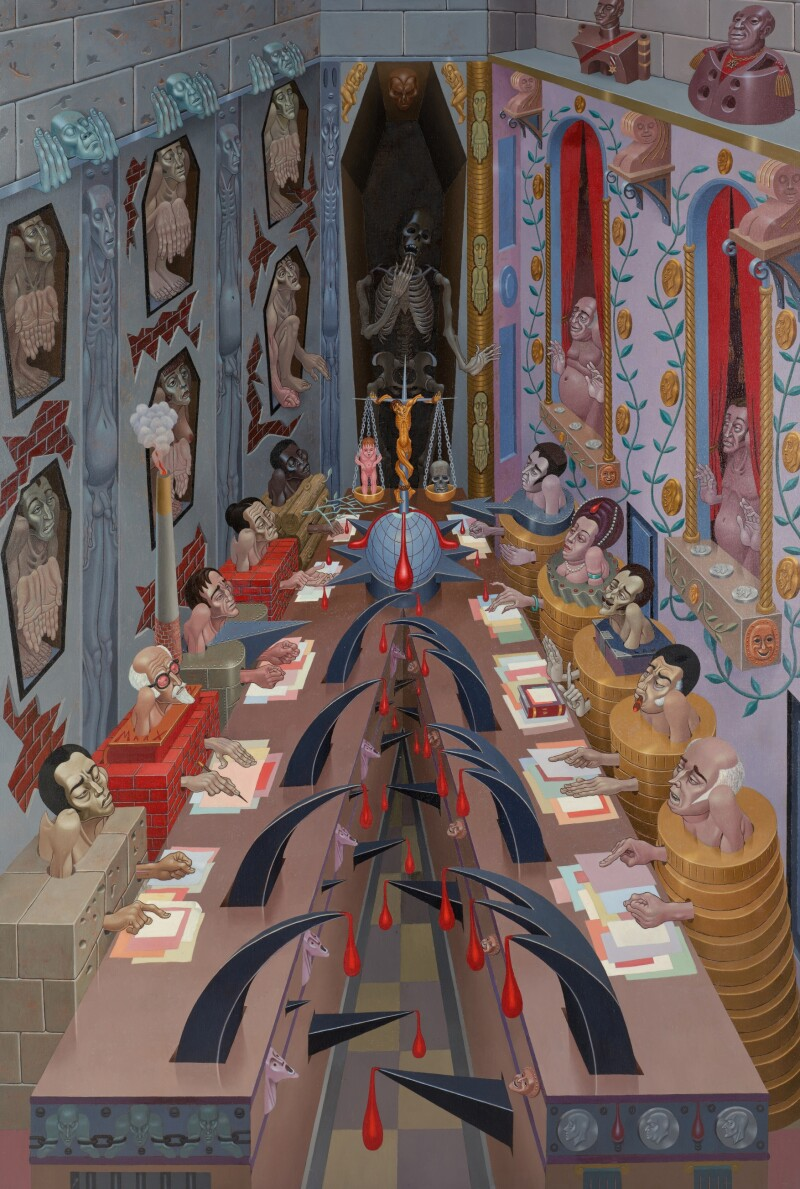
The Summit (1978) by Irving Norman. Presented by Sotheby’s.
In The Summit, Irving Norman draws viewers’ attention to a V-shaped table which has been divided into two sides: communism on the left and capitalism on the right. Not only is the table partitioned, but the entire canvas is divided between the two ideologies. The two halves meet at the vertex of the table where a tomb and a skeleton loom ominously. Directly sitting on the corner of the table are a globe and a scale balanced between a skull and a human baby. Flanking these sepulchral motifs are blood-dripping, spike-like faucets. Through these layered symbols, Norman implies that both ideologies are corrupted by greed for power, leading to the inevitable exploitation and suffering of the people of all nations. While Norman works to draw similarities between them, he also critiques the particular weaknesses of each. On both sides of the table, the heads are trapped: the communists in concrete, brick and wood (materials of industrialism) and the capitalists in gold. Norman’s intentional use of the linear perspective draws viewers to the last two people seated at the vertex: a black man constrained in wood opposite a white man encased in gold. The two men seem to offer an analogy for colonization, demonstrating the extraction of resources by the West, from wood to people themselves. Norman powerfully suggests that without colonisation and subjugation, countries would not be as wealthy and dominant as they are today. Furthermore, he demonstrates that both capitalists and communists continue to suppress and exploit their people. This painting can be interpreted as a warning. At the table’s intersection where capitalism and communism meet, even the skeleton itself is gasping at what he is seeing. Nearly 50 years later, in a once again increasingly politically polarised world, Norman’s work is a bleak vision of systemic oppression.
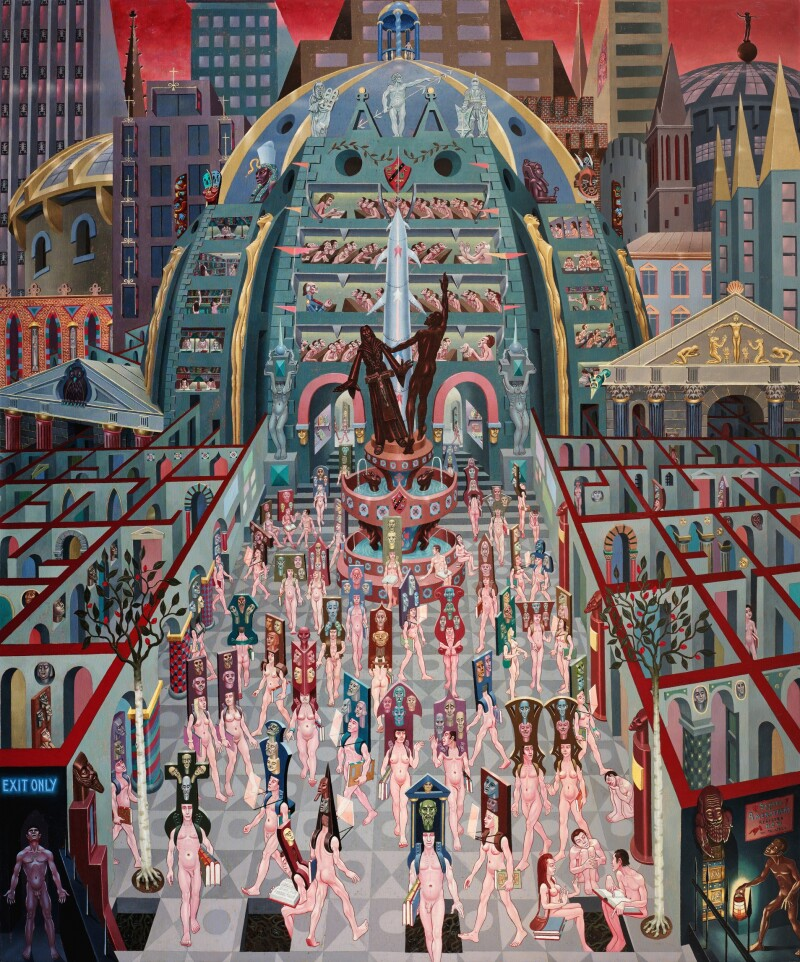
The Academy (1975) by Irving Norman. Presented by Sotheby’s.
The Academy (1975) pointedly explores themes of conformity and institutionalised control through societal structures. At the center of the canvas, Norman highlights a missile emerging from an elaborate water fountain. At the top, a gilded man and a figure resembling Jesus stand gripping the missile. This juxtaposition proposes a new world order, one where weapons, power and force are the new religion, idolized and worshipped as a god. In 1988, Norman sat down with the Smithsonian Archives of American Art interviewer Michael Bell and described how he believed society was at a “crossroads” similar to the clash of values between pagan beliefs and Christianity at the collapse of the Roman Empire. Compounding this classical parallel, in the bottom right corner of the painting a sign reads “SCHOOL OF AMERATHENS”. “Amerathens” is likely a reference to Raphael’s The School of Athens (1509-1511). The fresco fuses classical philosophy, science, and human reason with a Christian setting during the Italian High Renaissance. Compared with Raphael’s idealised scene of liberal higher education, Norman paints a vision of indoctrination. The School of Athenshighlights distinctly different intellectuals who engage in free discourse. By contrast, Norman paints a homogenous community with pink naked figures who wear matching headdresses and work in rigid classrooms. Norman’s “Amerathens” overtly critiques the contemporary education system. The central position of the missile, the uniform student body, and the grating contrast to Raphael’s masterpiece underline how educational systems are being manipulated to indoctrinate the youth, using the guise of religion and knowledge in the ultimate service of modern ideals of war.
Irving Norman: Pomp and Circumstance is on show at Sotheby’s New York, 7-31 August 2026
By Poppy Crowhurst








Stand out this summer with this gorgeous Nsubra beach bag! Handmade in Ghana, this large tote bag is the perfect size for your sun cream, beach towel, purse and your latest book.