
Surrealist Love Stories at MoMA
In 1924 Andre Breton published his Manifesto of Surrealism, defining Surrealism as: “Psychic automatism in its pure state, by which one proposes to express – verbally, by means of the written word, or in any other manner– the actual functioning of thought.” Essentially, Breton classifies Surrealism to be the unfiltered expression of one's subconscious thought and proposed that artists explore this through, “previously neglected associations, in the omnipotence of dream, in the disinterested play of thought.”
A key engine within the Surrealist movement was the collaborative nature between artists. During the late 1930s, Paris became an epicenter for contemporary artists and writers, many of whom co-created and lived together. Two couples exemplify this spirit of collaboration: Max Ernst and Leonora Carrington; Yves Tanguy and Kay Sage. The intensity and passion in both romances pushed them to become some of the most remarkable artists of the surrealist movement. Housed in New York City’s renowned art museum MoMA, the four paintings in this article bring their stories to life.
Leonora Carrington & Max Ernst
In 1937, 19 year old Leonora was an art student at Chelsea School of Art in London when she first met Ernst. The pair quickly fell in love and eloped to France against her wealthy parents’ wishes. The couple’s bliss came to an abrupt halt in 1939 when France declared war on Germany. Max Ernst was promptly arrested and sent to an internment camp. Fearful of the invading Nazi forces, Carrington fled to Spain in hope of obtaining an exit visa for her captive husband. The unrelenting stress of her situation sparked a mental breakdown, causing her parents to intervene and confine her in a Spanish mental institution. Torn apart by war, the pair never reunited.
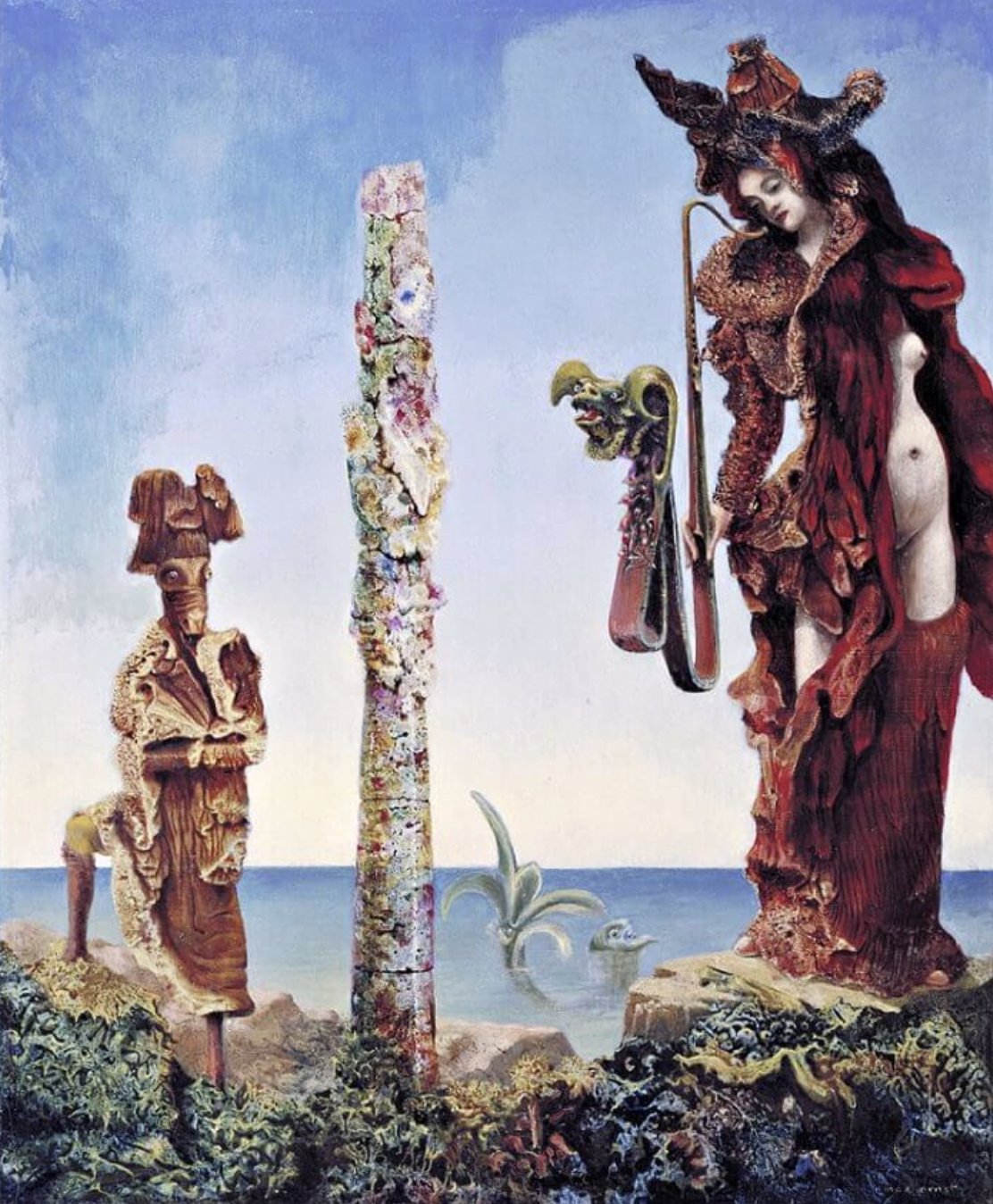
Max Ernst: Napoleon in the Wilderness, 1941
Born in Germany in 1891, Max Ernst was a leading artist within the surrealist movement. In Ernst's youth, he was enlisted as a German artillery engineer during WW1 on both the western and eastern fronts. As a result of these first-hand experiences, he developed a deep hatred for war and focused on creating works that opposed ideologies such as fascism and nationalism. In Napoleon in the Wilderness, Ernst paints an apocalyptic tropical landscape with a bird-man to the left and a statue of a woman to the right. The bird-man resembles Napoleon Bonaparte, who was exiled to the isolated island of Saint Helena after his defeat at Waterloo – a parallel to Ernst who had been arrested by the French government and placed in an internment camp as an “enemy alien”. By comparison, the female statue, painted in the likeness of Leonora Carrington, symbolizes resilience and survival. Ernst broadly signals the collapse of European regimes by contrasting Napoleon's tattered red cloak with Carrington's vibrant, avant-garde garments. A green instrument with the head of a dreamlike creature could also be interpreted as boldly ushering in a new era of creativity, one which promotes and protects artistic autonomy. By presenting Carrington in this way, he rejects the mainstream Surrealist view of women as the “femme-enfant”, or simply a muse, to regard Carrington egalitarianly and as a true artistic peer.
Explore Napoleon in the Wilderness in the MoMA catalogue here.
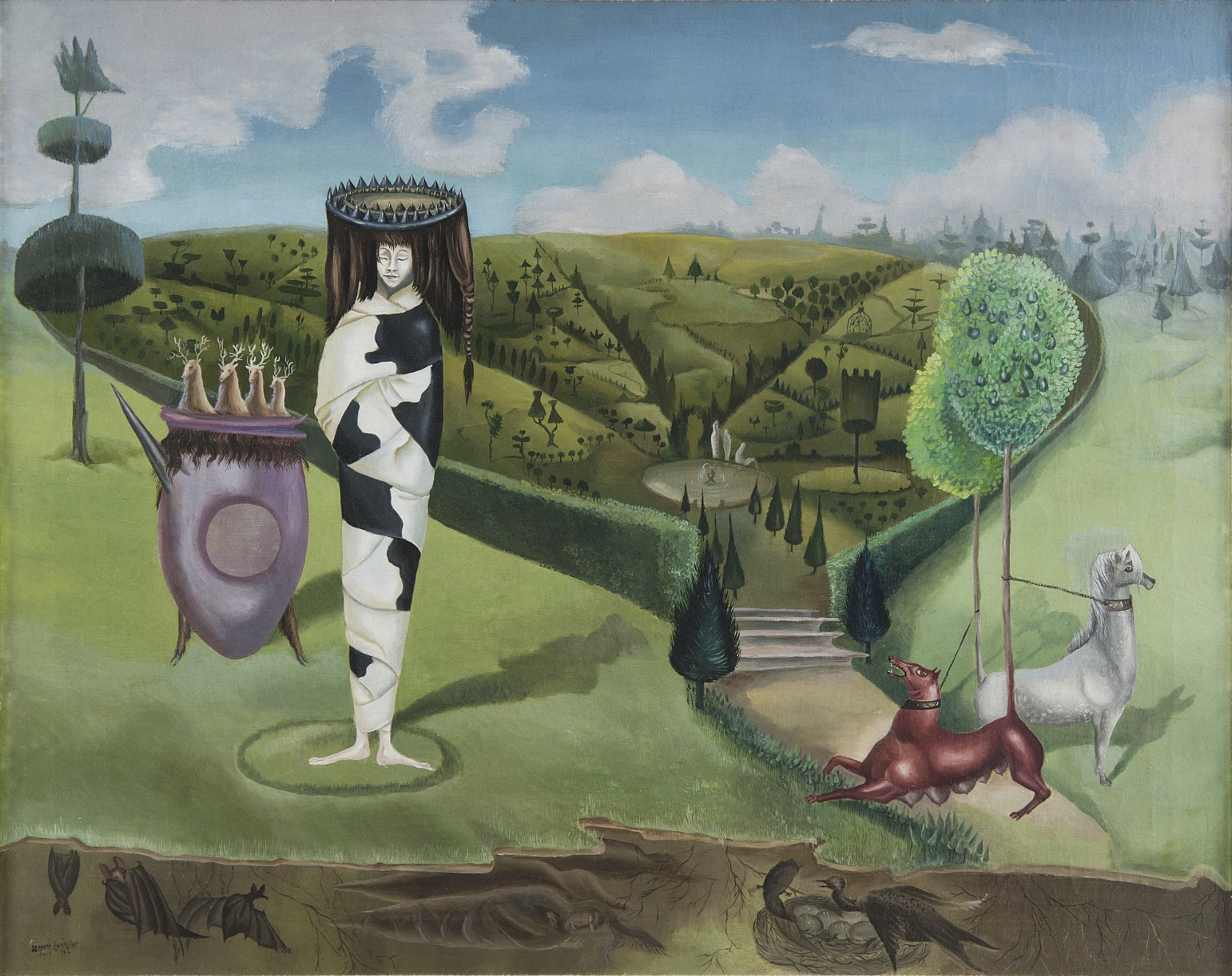
Leonora Carrington: Green Tea, 1942
In this painting, Leonora Carrington seamlessly divides the canvas into two worlds: the conscious surface and the subconscious underworld. Carrington layers her painting with symbols of personal and mythological trauma. As a reference to her time in Peña Castillo Sanatorium, where she was subjected to “treatments” such as being held in a straitjacket, she painted herself wearing a restrictive cow-patterned garment. Carrington also wears a spiked headdress over her curtain-like hair, framing her starkly white face. The headdress likely symbolizes her mind, caged within her own thoughts, while her hair serves to limit her sight to what is directly in front of her. To the right of Carrington are a horse and a hyena tied to a tree. Carrington always viewed horses as her spiritual alter ego: she believed that they represented the ultimate forms of freedom and control. In Green Tea, the horse has lost its freedom of movement and autonomy, echoing Carrington’s own feelings of imprisonment in the sanitarium. Meanwhile, to Carrington’s left is a purple cauldron with four small deer heads perched on top. Both are important symbols in celtic tradition: deer representing untamable creatures, or guides, to the Otherworld, while cauldrons are used as vessels of rebirth or magical transformation. Carrington holds these creatures captive, drawing additional parallels to her custody, while creating an eerie atmosphere that evokes a transformation interrupted and deepens the surrealist notion of creating “dream-like” scenes with layers of celtic mythologies. Next focusing the viewer’s gaze on the bottom portion of Green Tea, Carrington paints an ominous underworld filled with bats, nesting vultures and cadaver-adjacent alien creatures. By painting this underworld directly beneath the pristine garden above, Carrington juxtaposes the two scenes and highlights the ancient concept of a hell. The subterranean world therefore becomes a metaphor for the sanatorium's underlying cruelty, hidden just beneath a surface that, to outside observers, may have appeared calm and orderly.
Explore Green Tea in the MoMA catalogue here.
Yves Tanguy & Kay Sage
Tanguy and Sage met in Paris in 1938 through mutual friends. Both artists had recently split from their partners and were living in Paris, exploring their own artistic styles. Intrigued by each other's art and interpretations of surrealism, their bond grew stronger until they became inseparable. Upon the outbreak of WWII, the couple fled to the United States where they got married in 1940 and settled down together in Woodbury Connecticut. They valued their independent artistic styles, even having separate studios within their country home, but shared many similarities throughout their work. However, as the artists adjusted to their new lives, Tanguy’s drinking deteriorated into alcoholism, and led to his sudden death in 1955. Sage was left completely heartbroken and ultimately ended her life in 1963. In 1963, in Sage’s final note, she wrote “The first painting by Yves that I saw, before I knew him, was called I’m Waiting for You. I’ve come. Now he’s waiting for me again — I’m on my way.”
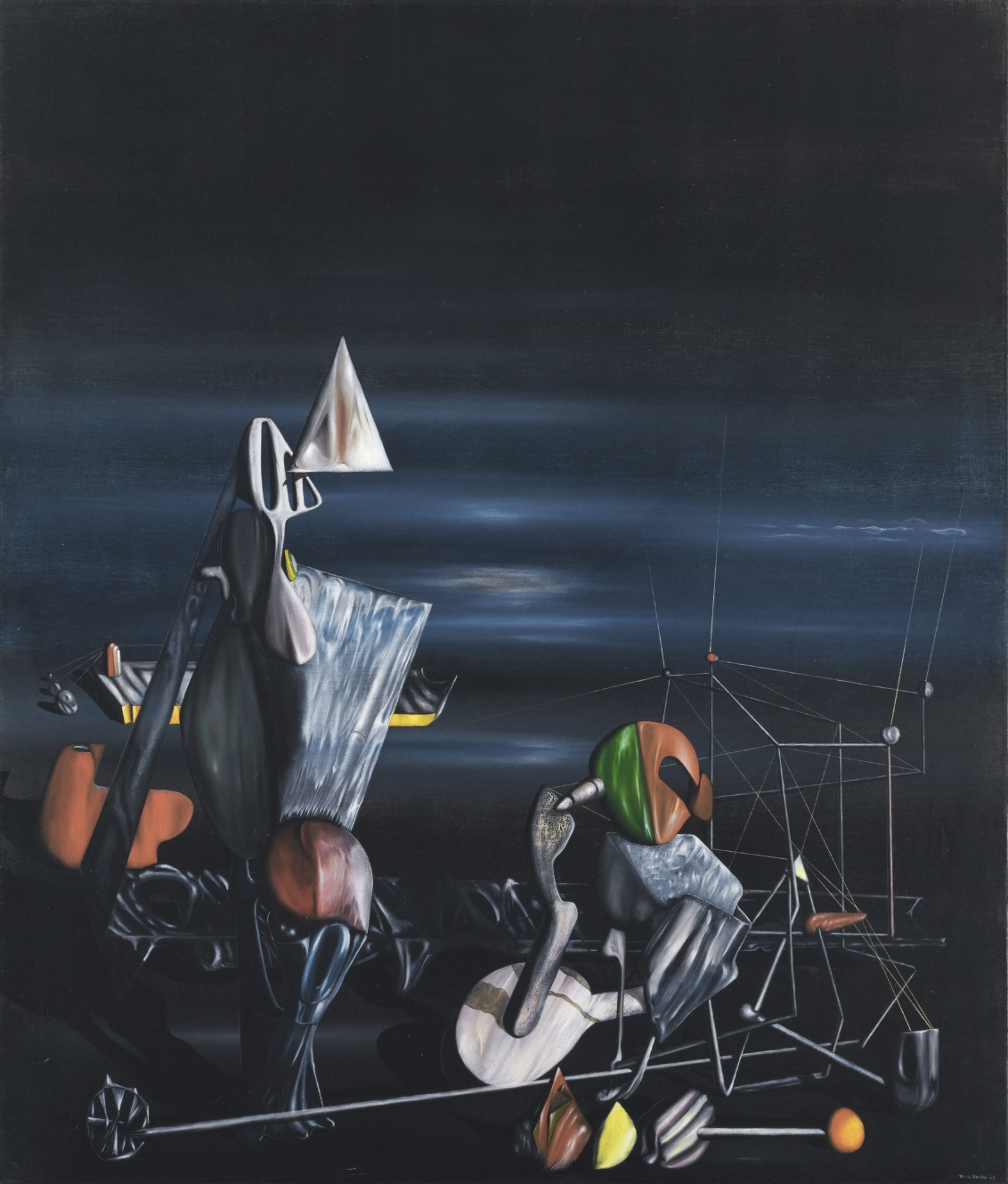
Yves Tanguy: Slowly Toward the North, 1942
Slowly Toward the North is a prime example of Yves Tanguy's signature style which incorporated biomorphic shapes and alien landscapes. Painted in 1942, Tanguy completed this piece shortly after fleeing Europe to his new home in Woodbury, Connecticut. In this work, Tanguy leans into a surrealist dreamlike atmosphere by painting colorful shapes amidst a cool-toned background that darkens to black towards the northern portion of the canvas. The palette evokes an icy atmosphere, possibly a tundra, that's seemingly endless. Though Tanguy never discloses what this tundra symbolizes, viewers can point to a few possible readings. Tanguy may have used the blue to illustrate his feelings of displacement. As WWII raged throughout Europe, Tanguy had no choice but to leave France and immigrate to Woodbury. It must have been difficult for Tanguy to abruptly flee Paris, the surrealist epicenter of the world, and settle in a quiet rural farming town. Furthermore, Tanguy struggled with alcoholism, creating a volatile and sometimes hostile homelife for him and his wife, Kay Sage. The title, Slowly Toward the North, could reference how Tanguy was gradually slipping into his own personal tundra as he struggled to process the world around him. While Tanguy never experienced WWI or WWII firsthand, the barren navy landscape could also be a reference to scorched battlegrounds, emphasising how the global trauma of war deeply bled into his subconscious mind. Finally, the blue could represent the nature of the unconscious mind, depicted here as an existential void. Surrealists were deeply interested in Sigmund Freud's theories on psychoanalytic theories, which pushed them to explore their subconscious. Interpreted in this way, the tundra becomes the trackless territory of the deep psyche. Situating this analysis within the title, Slowly Toward the North could suggest a gradual, deliberate journey inward. By slowly descending into that same boundless psychic terrain, rather than a literal geographic direction, the entire painting can be positioned as a map of the unconscious mind.
Explore Slowly Toward the North in the MoMA catalogue here.
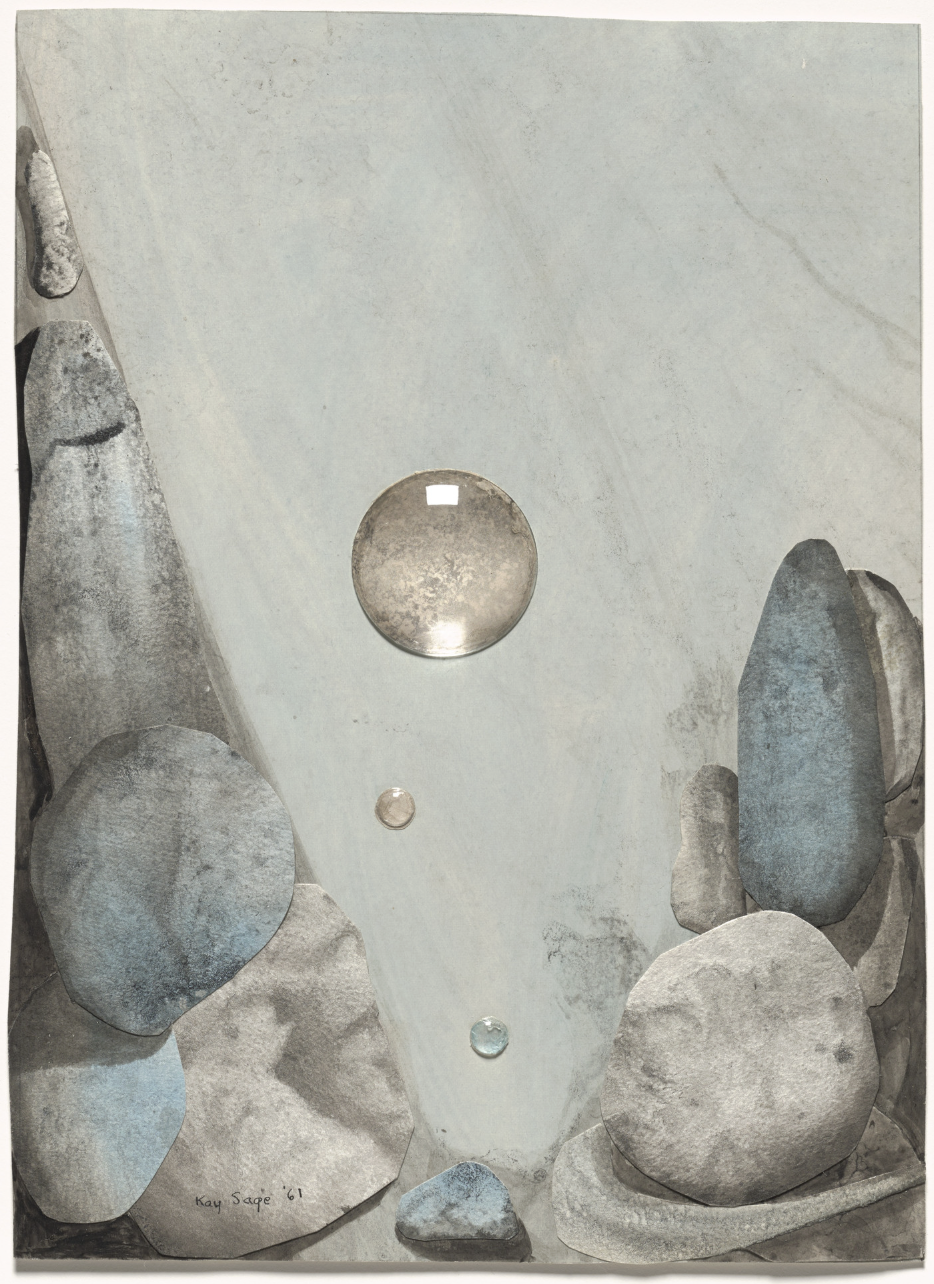
Kay Sage: The Great Impossible, 1961
Painted two years prior to Kay Sage’s suicide, The Great Impossible is an outlier from Sage’s usual scaffolding, lattice-worked architectural structures. Painted on cut-and-pasted paper with glass lenses using watercolor and charcoal, Sage instead creates a surreal shoreline landscape. To create this coast, Sage paints a soft pastel blue space that meets biomorphic shapes towards the lower edges of the work. On top of the pastel blue she paints three water droplets: the biggest at the center of the painting, and two significantly smaller driblets below the central drop. Similarly to how her late husband, Yves Tanguy painted Slowly Toward the North as a direct metaphor for the mind, the same can be said about The Great Impossible. After the passing of her husband, Sage found difficulty in navigating both her profound grief and her rapidly deteriorating physical health. The pastel background acts as a symbol for the vast ocean and the expansiveness of the water emphasises how empty her life is. The background could also represent her failing vision: in succession to Tanguy's sudden death in 1955, she developed cataracts and the pastel blue background may therefore express a vague void resembling her increasingly blurred sight. Viewing this work through the lens of Sage’s misery, the three droplets can represent teardrops. With the largest drop in the center of the painting, Sage demonstrates the initial crushing weight of a traumatic loss giving way to a continuous, trickling stream of daily sorrow. Focusing on the biomorphic shapes, which likely represent Tanguy, Sage places these figures on the shoreline as emblematic to her remaining senses of sanity – now tied closely to Tanguy’s existence in her memory. Under the umbrella of surrealism, landscapes were used to map out the hidden depths, fears, and desires of the unconscious mind. Juxtaposing the shard-like shapes to the endless blue, Sage suggests her internal world is crumbling in on itself and instead of defending herself, she gives into her desolate fate.
Explore The Great Impossible in the MoMA catalogue here.
By Poppy Crowhurst







Stand out this summer with this gorgeous Nsubra beach bag! Handmade in Ghana, this large tote bag is the perfect size for your sun cream, beach towel, purse and your latest book.