
Zurbarán at the National Gallery review
Art history seems to have a thing for boy bands. While the Italian Renaissance had Leonardo da Vinci, Michelangelo, and Raphael, the Spanish Baroque had Bartolomé Esteban Murillo, Diego Velázquez, and Francisco de Zurbarán. The latter is currently the focus of a major exhibition at the National Gallery that will later tour to the Musée du Louvre in Paris and the Art Institute of Chicago. Over 50 works are on display, including his iconic Agnus Dei (about 1635-40) from the Museo del Prado, Madrid.
The exhibition is a stunning showcase of his talents, from small still lifes to towering altarpieces that pleased much of Catholic Spain in the 17th century. Compared to his contemporaries, Zurbarán was the more pious painter, creating a wide array of altar pieces during his long career in Seville and for King Philip IV in Madrid from 1634.
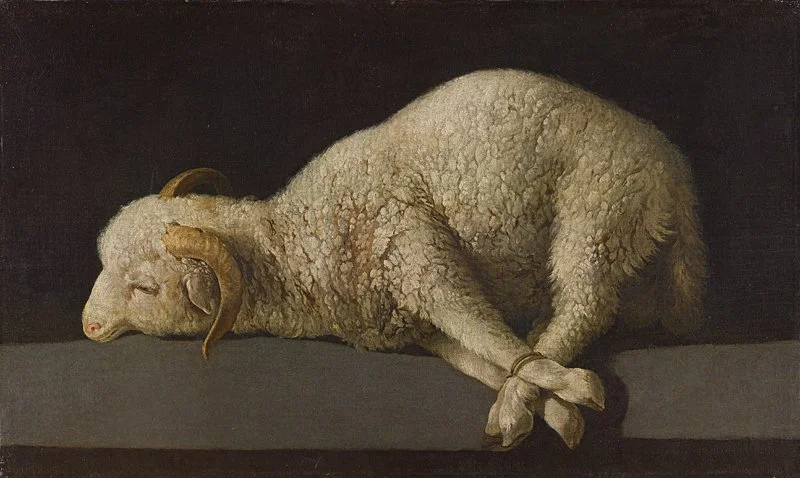
Francisco de Zurbarán, Agnus Dei, 1635 – 1640. Oil on canvas, 37.3 x 62 cm. Museo Nacional del Prado, Madrid © Photographic Archive Museo Nacional del Prado
His earliest dated painting, The Crucifixion (1627), was so life like that everyone who saw it in the Sevillian sacristy of San Pablo el Real ‘believed it to be a sculpture’; that same impression was felt immediately by this reviewer upon entering the first room.
Spanish altarpieces - or retablos - are some of the grandest, most spectacular structures in Western art, typically consisting of multiple large panel paintings, sculptures, and an elaborate, tiered frame to mount them on the high altar. It is, therefore, admirable that the curators have managed to reunite – across a single wall – three pictures from (probably) the middle register of a vast altarpiece that measured 15 metres high and 10 metres wide. Originally commissioned for the Nuestra Señora de la Defensión, near Jerez de la Frontera, by the Carthusian order, Zurbarán provided 12 paintings for the ensemble. The three pictures here have not been seen together in 175 years.
The exhibition is elegantly divided into seven thematic sections, with religion opening the first four rooms and closing the show. The huge scale of everything is immediately noticeable. Special mention must be given to the beautiful section devoted to Zurbarán’s paintings of single-figure saints. Mostly life-sized and set against dark backgrounds, the saints are given a luminous quality that enhances their divine attributes, especially for the pair of Saint Francis pictures showing him kneeling in meditation in life, and in death as a still-standing body looking to the heavens in devotion. Recent conservation on the latter – on loan from the Musée des Beaux-Arts, Lyon – uncovered the artist’s signature and date.
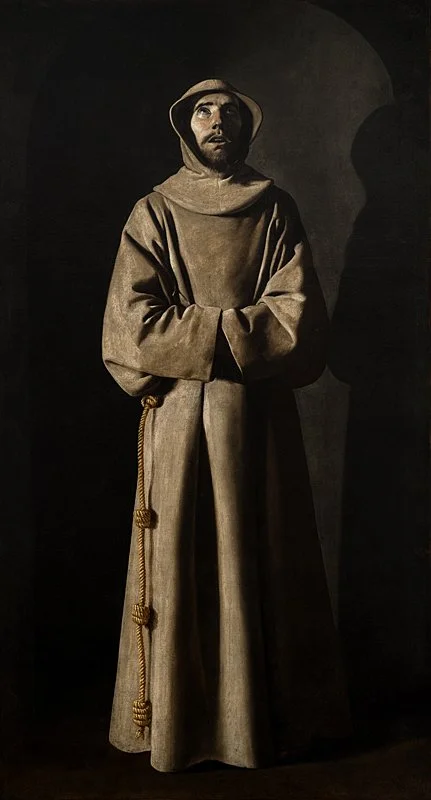
Saint Francis of Assisi, 1636. Oil on canvas, 200 × 110.5 cm. Musée des Beaux-Arts, Lyon. © Lyon MBA - Photo Martial Couderette
Throughout the exhibition, one notices Zurbarán’s style change quite dramatically at times. In Room 4, one is overwhelmed by the towering presence of two Crucifixions and two Immaculate Conception paintings. It feels like being right there at the altar. These were his most popular subjects, showcasing his ability to create variations on a theme. Created six years apart, the two Immaculate Conceptions are noticeably different in Zurbarán’s treatment of the Virgin Mary’s face and clothing; she appears sculptural with features like a real person in The Immaculate Conception with Two Boys Praying (1632), but idealised and animated in The Immaculate Conception with Saints Joachim and Anne (1638-39).
But the greatest difference is in comparing The Crucified Christ (1635) with Christ on the Cross with the Virgin, Mary Magdalene and Saint John (1655) – his last known depiction of the subject – where the pristine classicism of his early work morphs into sharp chiaroscuro and softer contours. While the former elicits appreciation of the male form, the latter is a visceral attack of the emotions, particularly via the tearful mourners at the foot of the cross.
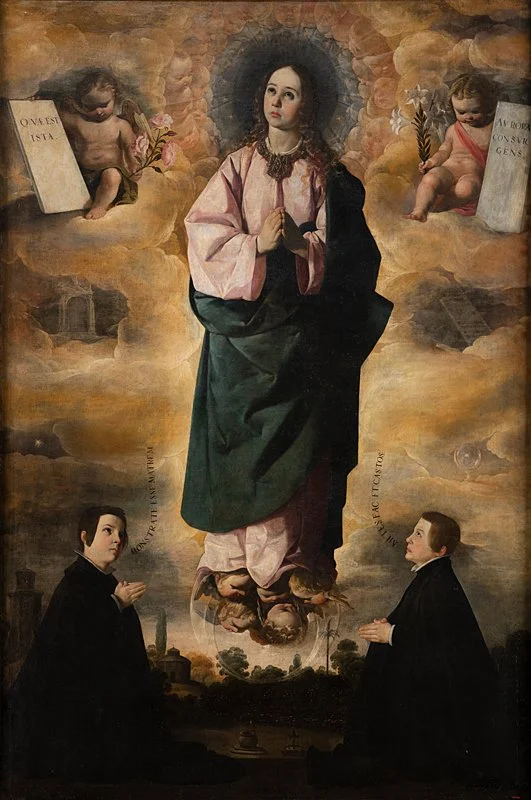
The Immaculate Conception with Two Boys praying, 1632. Oil on canvas, 252 × 170 cm. Museu Nacional d’Art de Catalunya, Barcelona. Bequeathed by Santiago Espona, 1958. © MNAC - Museu Nacional d'Art de Catalunya, Barcelona
For the past 40 years, academic scholarship on Zurbarán has been steadily on the rise, with exhibitions outside of Spain increasingly prominent compared to Murillo, Velázquez, and even Jusepe de Ribera. As a result, the National Gallery has been able to benefit from active new research into the artist and his periphery. A highlight of the fifth room is a colossal painting of a male head from the Prado, recently attributed to Zurbarán himself. First documented on a staircase in Madrid’s Buen Retiro Palace in 1661, its origins and function are unknown, although it may have been painted for a theatre set. In the exhibition, it shares a room with two paintings from a 10-piece series illustrating the Labours of Hercules, for which stylistic comparison is made with the artist’s execution of the demigod’s face.
Bringing things back down to earth, Zurbarán also dabbled in still life painting; less than 10 examples are known to us. The penultimate room reunites the National Gallery’s small painting showing A Cup of Water and a Rose (about 1630) with Zurbarán’s only signed and dated Still Life with Lemons, Oranges and a Rose (1633), where the ensemble reappears on the right. Similarly, a pair of single studies depicting alcarrazas (Spanish ceramic vessels used for storing drinking water) – rediscovered in 2023 and shown here to the public for the first time – have joined Still Life with Four Vessels(about 1650) from the Museu Nacional d’Art de Catalunya, Barcelona, providing valuable insight into the artist’s working methods.
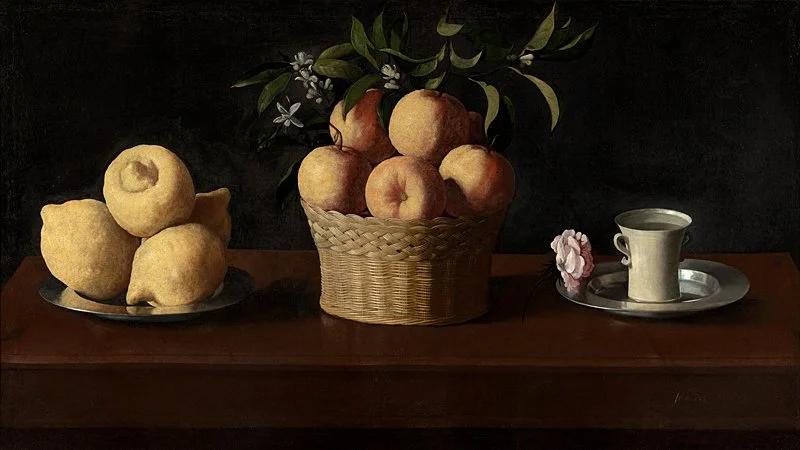
Still Life with Lemons, Oranges and a Rose, 1633. Oil on canvas, 62.2 × 109.5 cm. The Norton Simon Foundation, Pasadena, California. © The Norton Simon Foundation
However, this room is also a showcase of his son’s talents. Juan de Zurbarán made a career specialising in still life paintings. Painted at the age of 18 or 19, his first known painting, Plate of Grapes (1639), is featured alongside three larger, complex compositions that easily match up to his father’s deceptive realism. This elegantly feeds into the final room, dedicated to the elder artist’s paintings that were intended for private devotion and for new clientele in Madrid. Here, we find Zurbarán incorporating still lifes into Marian subjects and Holy Families. There is even a convincing trompe l’oeil in The Veil of Veronica (1658), where Christ’s face is unconventionally depicted as an indistinct stain.
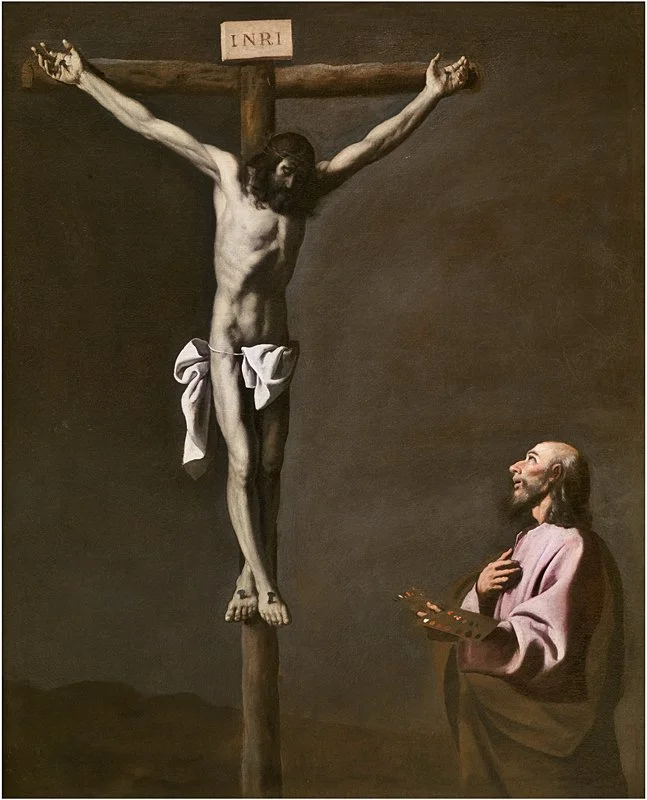
Francisco de Zurbarán. The Crucified Christ with a Painter, about 1650. Oil on canvas, 105 x 84 cm. Museo Nacional del Prado, Madrid. © Photographic Archive Museo Nacional del Prado
Fittingly, the exhibition ends with The Crucified Christ with a Painter (about 1650). No portrait of Zurbarán survives, so this is not a self-portrait. Rather, the artist has channelled himself into Saint Luke, the patron saint of painters, standing at Christ’s feet with palette and brushes in hand. There is no precedent for a painter witnessing the Crucifixion in the history of Western art, and this is what makes Zurbarán so special. He was extremely good at inventing new forms of subject matter, such as the paintings of Asher and Jacob (about 1640-45) from the Twelve Tribes of Israel.
This exhibition is extraordinarily good and full of surprises. If the first room doesn’t convince you, the second one sure will.
Date: 2 May – 23 August 2026. Location: National Gallery, Sainsbury Wing, Trafalgar Square, London, WC2N 5DN. Price: £20 (off-peak, Sun–Thu), £22 (Fri–Sat), members free. Book now
Review by Nigel lp








Handmade in Ghana, this beautiful green apron offers a unique design with a front pocket perfect for kitchen utensils or your phone and tie neck straps each made from recycled material. The perfect gift for any cooking enthusiasts!
Our aprons have been named after markets in Ghana. This apron has been named after Kintampo Market located in the Bono region of Ghana it is noted for their sales of yam tubers.