
Philip Guston: innovation, experimentation and social justice
On June 27, 1913, Philip Guston was born in Montreal to Ukrainian Jewish immigrant parents. When he was six years old, Guston’s family moved to LA where he would spend his early childhood and teenage years. From an early age, Guston was aware of the social inequity of the world: witnessing the active Ku Klux Klan in LA and experiencing significant familial trauma. When he was just 10 years old, he discovered that his father, who had been suffering financial difficulties, had committed suicide. As an adult, Guston moved to New York City where he lived and worked as an artist before retiring from society to Woodstock. Guston’s artistic career can be defined by four periods: his early sketches, social realism, Abstract Expressionism, and finally, his return to figuration. These periods can be understood through four key works in the collections of the Whitney, MoMA, and Met in New York.
The 1930s: Emergence of Figuration
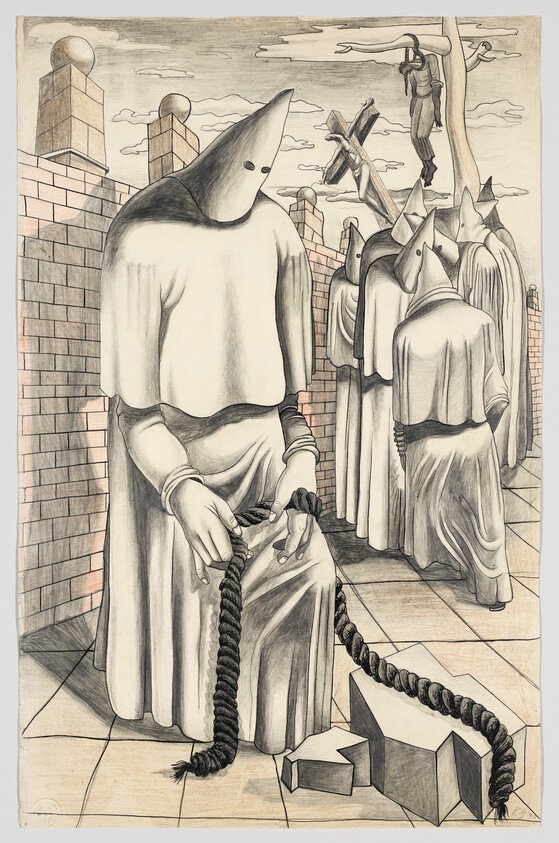
Drawing for Conspirators (1930) by Philip Guston. In the collection of the Whitney Museum of American Art.
Guston sketched this portrait of the Ku Klux Klan (K.K.K.) when he was 17 years old. During this period of his life, Guston was expelled from his LA public high school for publishing a satirical comic about the school’s priority of athletics over the arts - alongside Abstract Expressionist painter Jackson Pollock, who he briefly attended high school with. Guston always used art as a medium to express his discontent with what he saw around him, especially politics. The K.K.K. was extremely active during the 1920s, making violence and death widespread in his youth.
In this sketch there is a hooded Klansman tying a rope. Though the figure is standing alone, he occupies the immediate foreground, and, unlike the other hooded figures, takes up the majority of the frame. His slouched posture and quiet meticulous manner of tying a rope reflects the complex psychological weight of conformity and evil. In the background, there is a group of conspiring Klansmen who stand under a tree with a man who has been lynched. Pointedly, there is a crucifix in the space between the Klan and the lynched man. Viewers have interpreted this religious symbol in many ways. By placing them in close proximity, teenage Guston elevated the victim’s suffering to the level of martyrdom. In contrast, viewing the cross as a symbol dedicated to the Klan brings to light the hypocrisy of the K.K.K. and emphasizes how they weaponized Christianity to justify bigotry and violence.
Explore Drawing for Conspirators in the Whitney collection here.
The 1940s: Murals & Social Realism
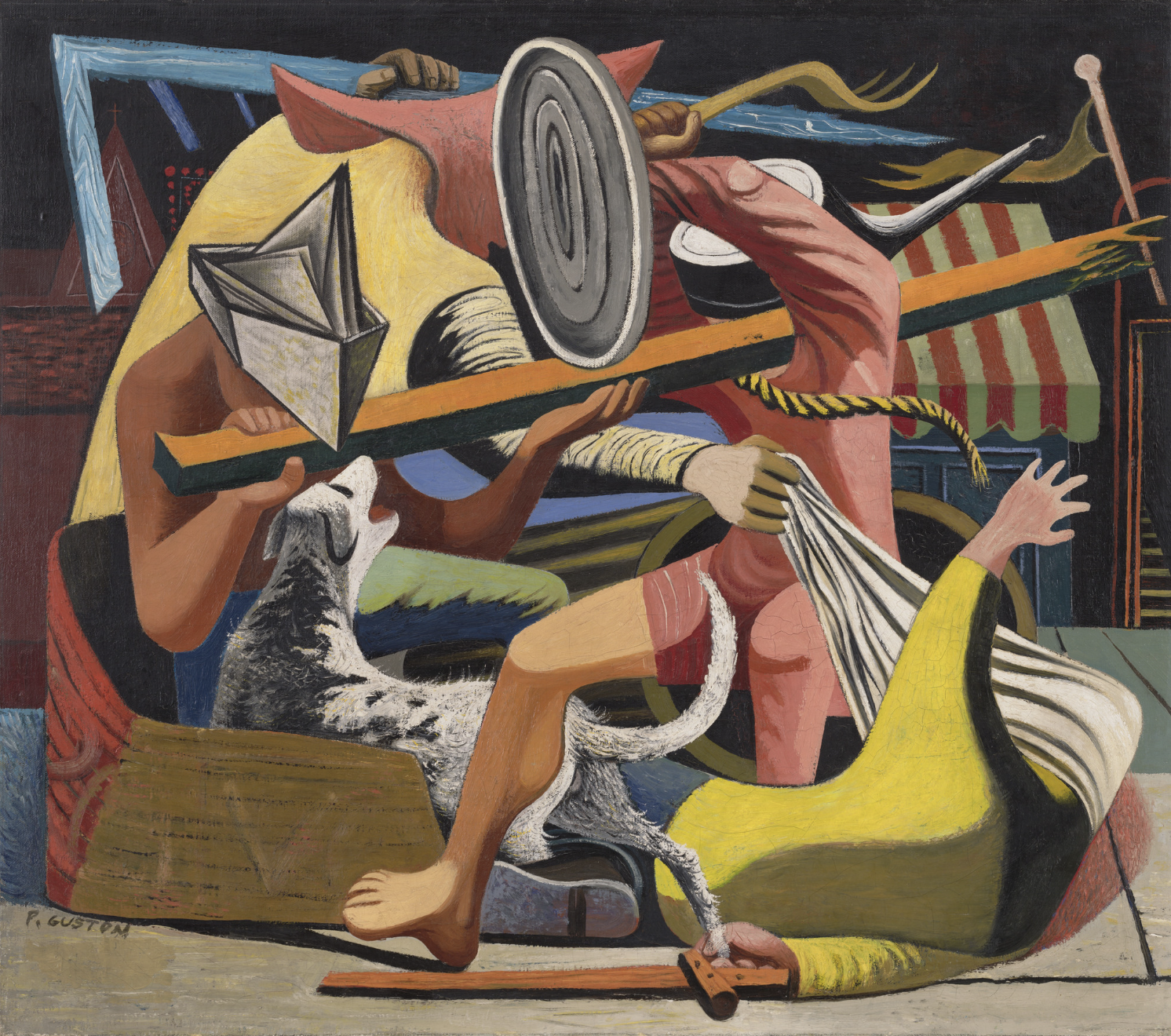
The Gladiators (1940) by Philip Guston. In the collection of the Museum of Modern Art, New York.
This oil painting titled The Gladiators was completed in 1940. In the wake of the Great Depression, Guston was commissioned by the WPA Federal Art Project to paint large-scale murals. One of his largest projects, Work and Play, located by the Queensboro Bridge, features similar motifs of children fighting in the street. In the early 1940s he shifted to studio easel paintings, but his style was heavily influenced by his early murals.
Guston was interested in the everyday conditions of the working class and poor. Through his work, he sought to expose social injustices and political corruption - he was a social realist painter. In The Gladiators, Guston captures children playing with makeshift weapons such as wooden planks, paper hats, ropes, and trash lids. The children are faceless and holding toy weapons, their bodies blending into one another. However, they all resemble adults with athletic builds, as opposed to the softer features more commonly attributed to the young. In this way, Guston uses these children as an allegory for global wartime violence. The US did not officially send troops into the global conflict until 1941 but many citizens were wary of the possibilities of an upcoming draft and enlistment. Guston subtly critiques how easily the innocent youth can be influenced into violence, and how violence has been a central part of society since the ancient world. Close reading of the title, The Gladiators, connects the ancient Roman entertainment, where humans would fight to the death, to modern play fighting . The contrast between children's play fighting and serious violence gives this painting a sinister undercurrent.
Explore The Gladiators in the MoMA collection here.
The 1950s: Abstract Expressionism
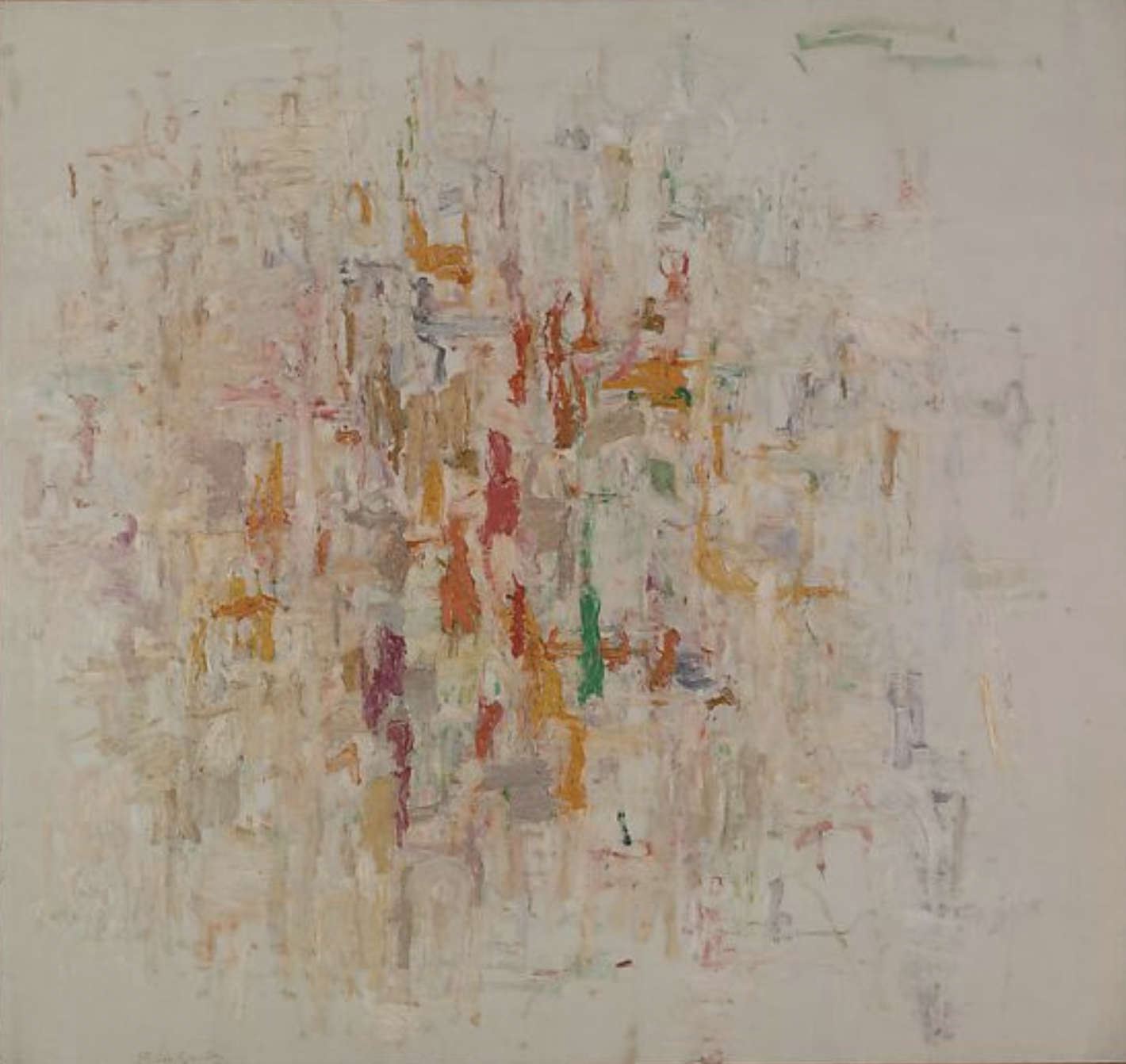
Painting (1952) by Philip Guston. In the collection of the Metropolitan Museum of Art.
During the 1950s and early 1960s Guston abandoned his earlier figurative social realism and solidified himself as a leader within the Abstract Expressionist movement in New York City. At the time, Abstract Expressionism was viewed not just as an artistic movement but as a hard-won theology that sought to help artists understand a postwar world. After the horrors of World War II, Abstract Expressionists believed that the only authentic path to universal truth was complete dedication to the movement. During this period, Guston experimented with more intangible shapes and figures as a way to explore the subconscious, process global trauma, and capture internal human emotion rather than literal events.
In this work, Guston paints bold, warm-colored lines amidst a cream-colored background. The contrast between the two create a visual tension which can be interpreted as a reflection of one's internal psyche. In Guston’s early works he often directly confronted hate groups, such as the K.K.K., in sketches like Drawing for Conspirators, as if trying to understand the nature of evil. The contrasting colors in Painting (1952) could therefore represent a conflicted mind, perhaps hinting at the terrifying psychological complexities behind acts of cruelty.
Explore Painting in the Met collection here.
The 1960s: Return to Figuration
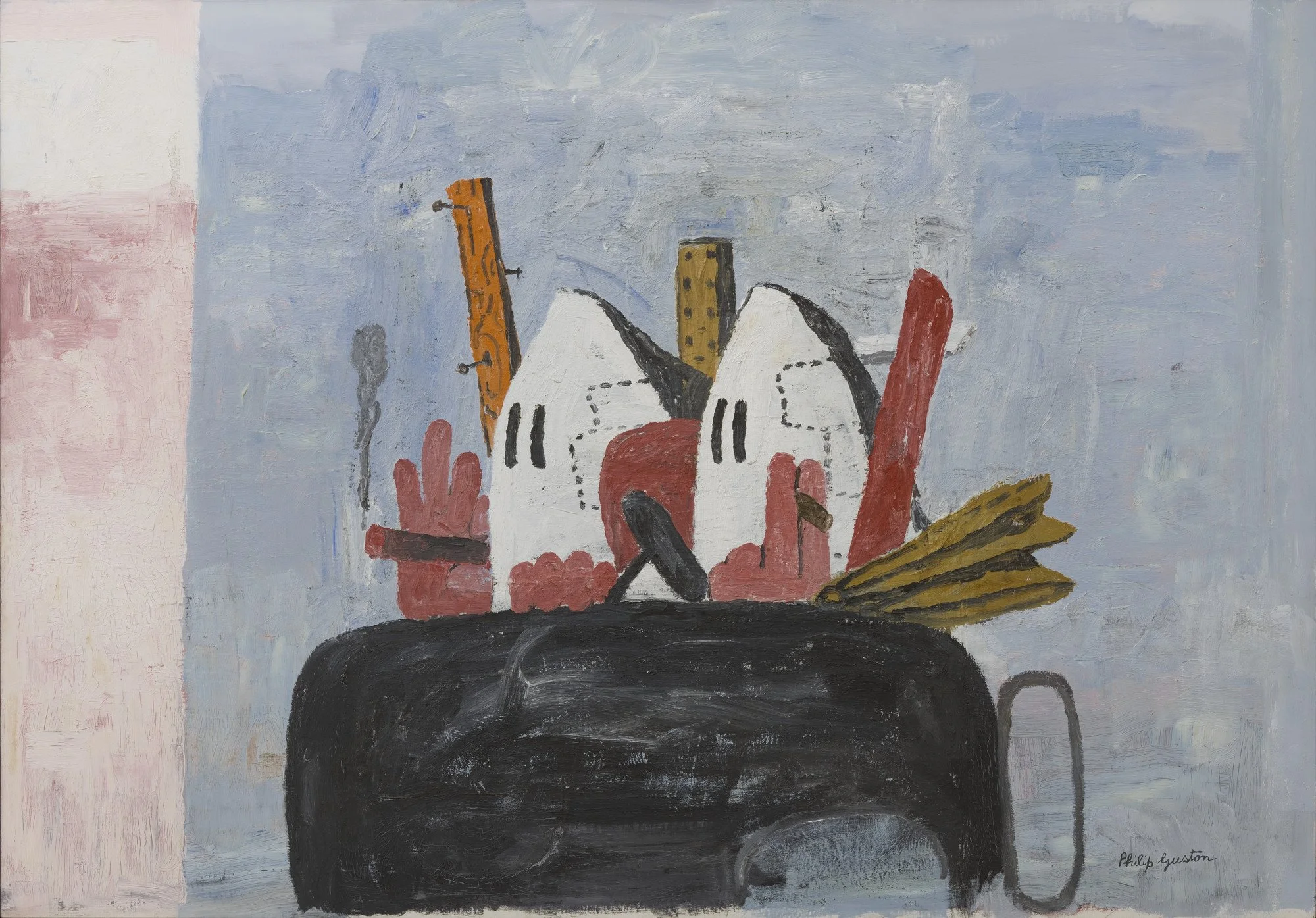
Edge of Town (1969) by Philip Guston. In the collection of The Museum of Modern Art, New York.
The late 1960s mark the last shift of Guston’s artistic style - his return to figuration. This painting debuted at the Marlborough Gallery in 1970. Though Guston was slowly painting figuratively in the privacy of his studio, his official public return came as a shock to the Abstract Expressionist community, and was seen as a betrayal to his followers and peers. He was ostracized from the elite artistic group and moved to Woodstock, where he continued with figuration.
Edge of Town (1969) features two cartoon hooded figures who are driving a car. Looking closely at the bulky black vehicle, viewers will notice a few things: the missing wheel, the circular grey object attached to the back, and its box-like structure. Inside are two hooded cartoon figures. Similar to his earlier work, such as Drawing for Conspirators (1930), Guston has drawn the K.K.K. but in an entirely new style. Their new blocky appearance turns this painting into a piece of satirical art. Guston places these caricatures of bigotry in a broken-down, or even immobile, vehicle, suggesting that while the forces of hatred remain armed and hazardous, their ideology is fundamentally stagnant - a paralysed dead end idling on the fringes of society.
Explore Edge of Town in the MoMA collection here.
Throughout every phase of Guston’s life and career he was focused on painting what he wanted to change in the world. As early as 17, he was directly confronting hate groups in his work, placing himself in the footsteps of evil. His Abstract Expressionist period was meant to expand the remit of his art, enabling him to capture the horrors he saw around him more broadly. However, Guston’s controversial return to figuration was prompted by global violence, such as the Vietnam War, and the resurgence of hateful groups such as the K.K.K. By painting their members as normal people, driving a car while smoking a cigarette, he was simultaneously satirizing them and trying to expose the everyday face of evil. As a new generation of art started to emerge, so did new styles and tastes, and Guston’s clumsy cartoon-like style became respected as the blueprint for the Neo-Expressionist movement. Guston’s commitment to his figurative approach was vindicated by a 1980 SFMOMA retrospective, and he died shortly afterwards on June 7, 1980. Even to this day, Guston’s work is extremely popular, standing as a testament both to his unique style and commitment to social justice.
By Poppy Crowhurst









Stand out this summer with this gorgeous Nsubra beach bag! Handmade in Ghana, this large tote bag is the perfect size for your sun cream, beach towel, purse and your latest book.