
Review: Suppliants of Syria, Hoxton Hall
For a long while I have said that it is a time for telling old stories in new ways, which is why I was eager to catch Suppliants of Syria, a play conceived and directed by Michael Walling. It is a reimagining of one of the earliest plays ever written, Aeschylus' Suppliants.
This story, like the ancient one, is concerned with war, refugees, and women's plight within these man-made blights. The play begins by telling us that theatre held a central part in Greek democracy. Drama was a way that the ancients confronted political ideas of the time, and participation was a way for citizens to exercise their civic duty. The actors duly remind us that the citizens of Athens only included men and not women, slaves, or foreigners. This is just one way in which the nature of democracy and our societies have changed since then. A speech from Albert Camus comes to mind, in which he spoke of the place of art the in modern societies he deems increasingly artificial.
“Is there anything surprising in the fact that such a society asked art to be, not an instrument of liberation, but an inconsequential exercise and a mere entertainment?”
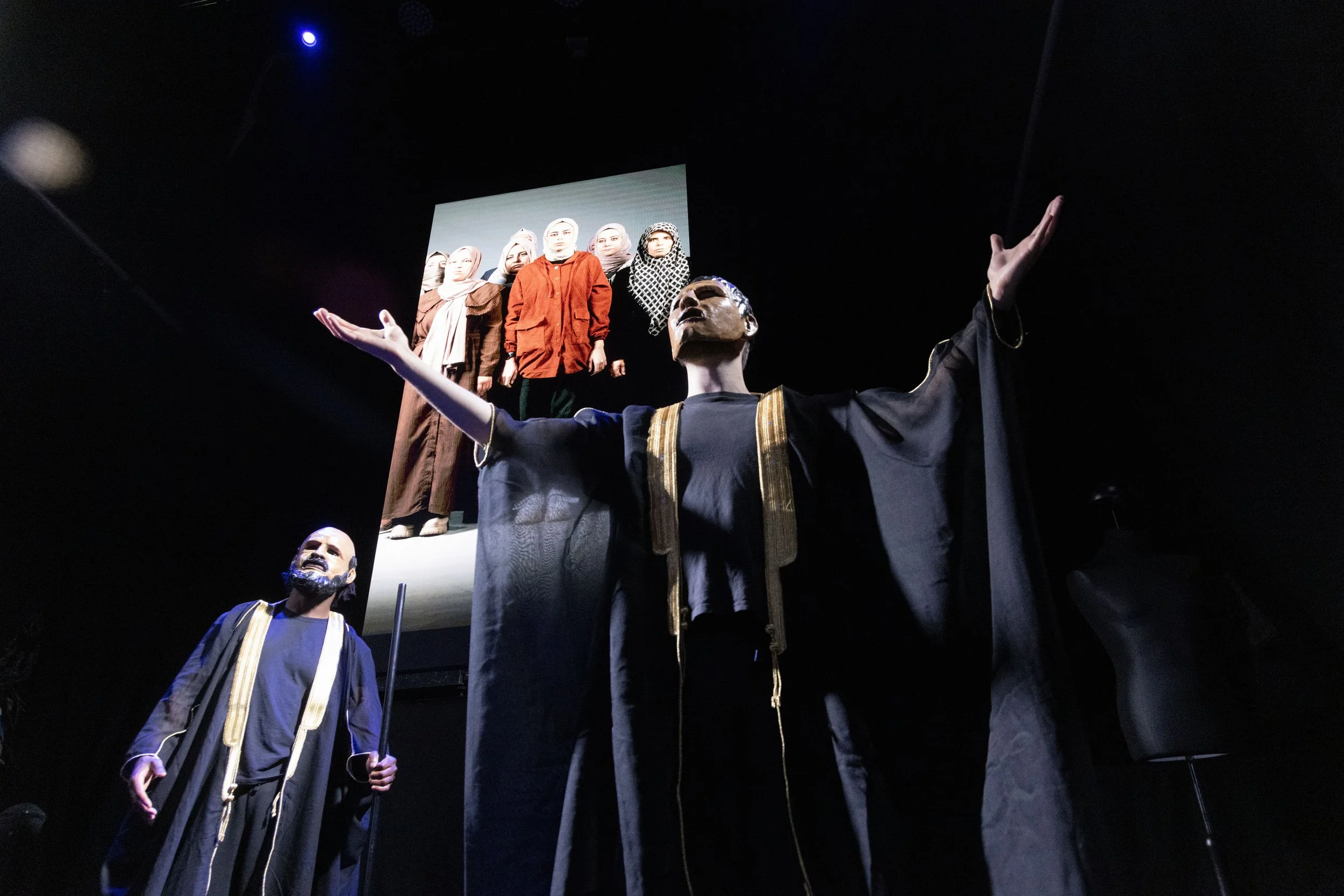
Image courtesy of Border Crossings
Through filmed testimony, poetry, music and movement, Suppliants of Syria reiterates this sentiment through its themes and its form. It is beyond “mere entertainment.” It is stark and it is uncomfortable. The Syrian women tell anecdotes of seeing headless bodies, of giving birth in a hospital that is being bombed and abandoned by the doctors, of witnessing the pain and suffering that is common to those who are displaced by war. These women on film comprise the chorus of the play, mirroring the Danaid's from the original. The director flew to Turkey to film them, and their presence remains on the screen throughout, above the actors on stage, moving in slow motion, reminding the audience that they are the protagonists of this story which is being told by others.
Walling’s script represents a reflective meta-commentary on the production of the play. An actor wonders aloud whether the director felt better, seeing the women in front of him through the lens of his camera. The actors, Tobi King Bakare, Vlad Gurdis and Albie Marber, are playing themselves. Helping to devise their characters, their performance was sincere, energetic, and delivered with the cynicism and irony a script like this requires. Together they question the ethics of performing in such a play: one of them, on the phone to his agent, is not sure he wants the job, and uses the term "grief-jacker" in reference to the director. Another, speaking to his mother, wonders if it is right to be telling the stories of these refugees to an audience that looks nothing like them. Again, Camus’ speech comes to mind:
“Until now the artist was on the sidelines. He used to sing purposefully, for his own sake, or at best to encourage the martyr and make the lion forget his appetite. But now the artist is in the amphitheatre…”
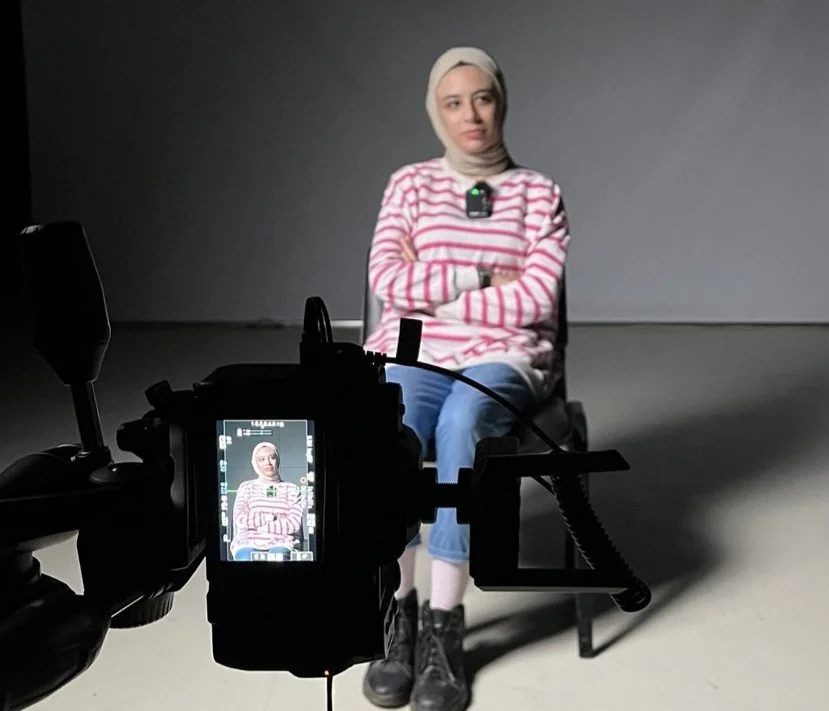
Image courtesy of Border Crossings
Creation of such earnestly political art may well drop an artist into the battle of ideologies, with the politico-social arena being the amphitheatre where the public clashes over the values, identity, and social norms that shape politics, media, and everyday conversation. This play outright embraces its function as part of a wider democratic process, not hiding behind subtlety. It is a piece of art that is not afraid to ask questions of itself. The script acknowledges that some may agree with its self-criticism that the work is “grief-jacking.” From my perspective, I appreciate storytellers who want to amplify the voices of those who go unheard.
An underlying truth is that both democracy and art are uncomfortable because reality is uncomfortable. Art can be our greatest escape from this reality, but it can also be a way of liberating us from it. I hope that these women have some sense of this liberty through sharing their stories through this project. For those in the audience who are safe at home in London, I guess we must sit with the discomfort of not knowing if they ever will feel the freedom of having somewhere to belong, and the unease of knowing that these crises and the politics behind them continues.
Suppliants of Syria was impactful theatre. It was necessary theatre. I leave disturbed, but with heightened senses awoken from a recent complacency. Hearing the voices and stories of others remind us that democracy is not just an empty ideal, and that listening to others is in fact the very first democratic act.
The play is a limited run, from 5 - 8 March. Tickets are available on Hoxton Hall’s website.
Words by Angelo Mikhaeil









Stand out this summer with this gorgeous Nsubra beach bag! Handmade in Ghana, this large tote bag is the perfect size for your sun cream, beach towel, purse and your latest book.