
20 sculptures not to miss at Kistefos Museum in Norway
An hour north west of Oslo, in the small town of Jevnaker, an old wood pulp mill has become one of Europe's most ambitious sculpture parks. Kistefos was founded in 1996 and opened to visitors in 1999, on the site of A/S Kistefos Træsliberi, the mill started by Consul Anders Sveaas in 1889, which produced wood pulp until 1955. The factory buildings and machinery were preserved, and several machines still turn, making the industrial museum a kind of living factory.
The park now holds 60 works. Almost all of them are site specific, which means the artist visited Kistefos, walked the land along the Randselva river, and made something for that exact spot. Kistefos is run by a non profit foundation. The collection has grown through gifts from Christen Sveaas, grandson of the mill's founder, and from his investment company Kistefos AS. In 2019 he set up the Christen Sveaas Art Foundation and gave it around 800 works from his own collection. Kistefos adds at least one new work each year, and a further gallery designed by Swiss architects Christ & Gantenbein is due to open in 2031 to house the wider Sveaas collection.
Here is a guide to the sculptures not to miss when visiting the museum's sculpture park.
Marc Quinn, All of Nature Flows Through Us, 2011
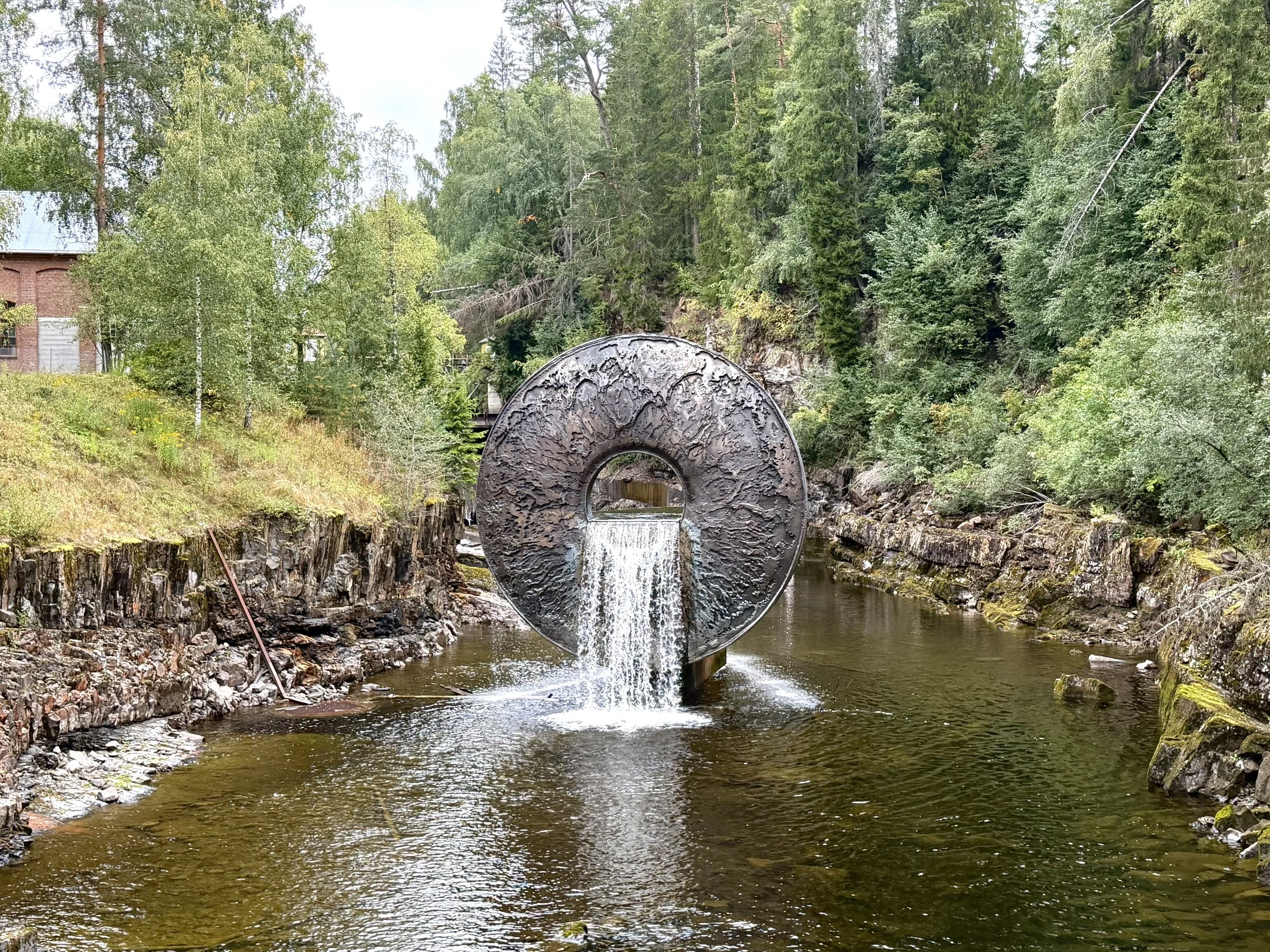
Marc Quinn, All of Nature Flows Through Us, 2011. Kistefos Museum. Norway. Image credit MTotoe/FLO London.
#FLODown: A 10 metre bronze eye, built in the outlet of the Kistefos waterfall with the Randselva river flowing straight through it. The work weighs over 12 tonnes and was cast in eight separate bronze sections of roughly 2,000 kilos each, assembled at the foundry, taken apart again and shipped to Norway to be put together in the water. The iris is an exact copy of the one belonging to Christen Sveaas, the businessman, investor and collector who founded the museum. Quinn started making work from irises in 2009, interested in the eye both as an old symbol and as a modern identifier, the thing a scanner reads to tell one person from another. The sculpture was unveiled in 2011 for his solo exhibition at Kistefos, his first in Scandinavia, and it has become the image most associated with the park. Quinn is one of the original Young British Artists, best known for Self, a cast of his own head made with nine pints of his frozen blood, and for Alison Lapper Pregnant on the Fourth Plinth in Trafalgar Square in 2005. The eye looks completely different depending on the water level, so see it twice if you can, once from the bank and once from above.
Instagram: @marcquinnart
Olafur Eliasson, Viewing Machine, 2001
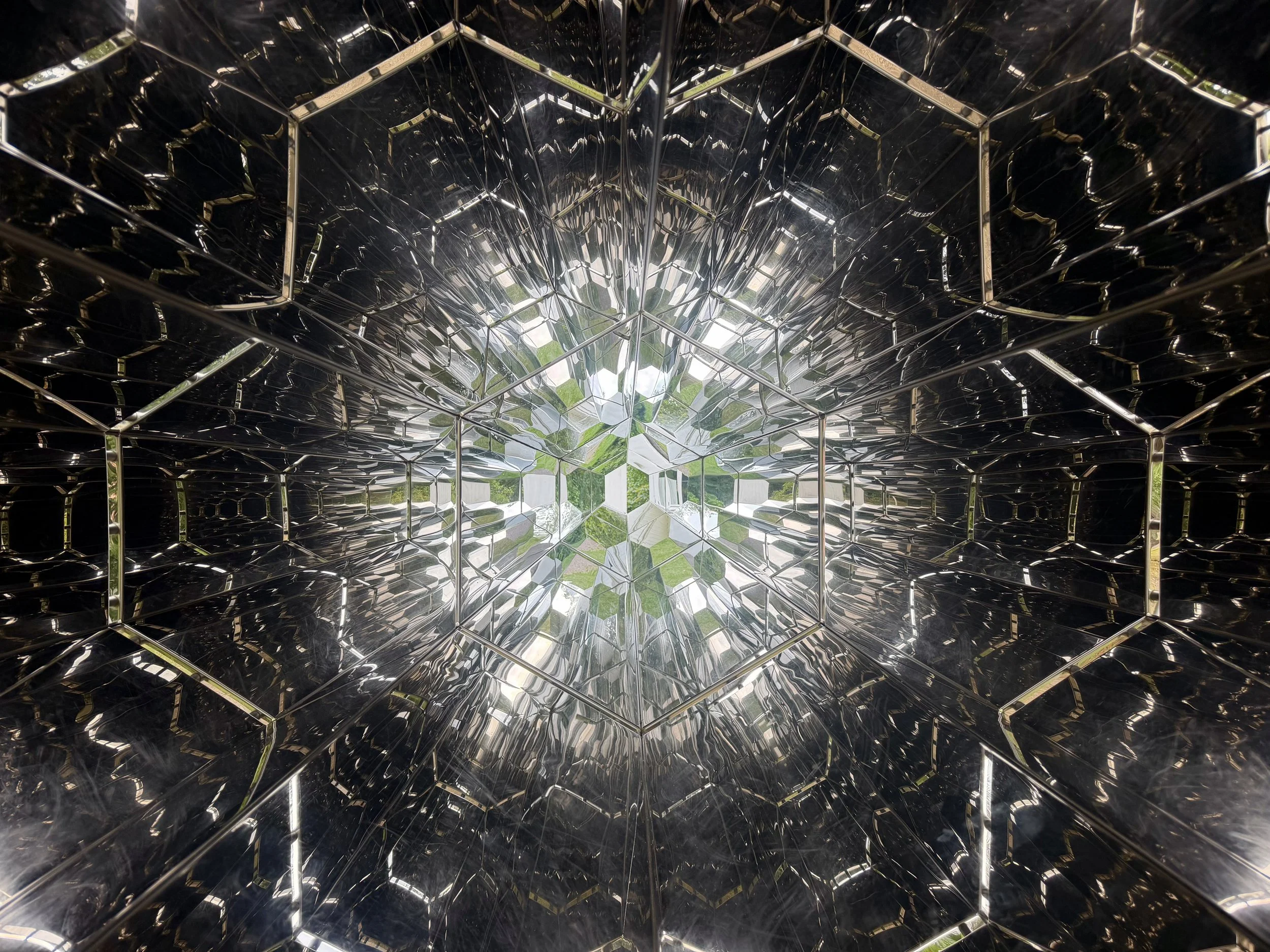
Olafur Eliasson, Viewing Machine, 2001. Kistefos Museum, Norway. Image credit MTotoe/FLO London.
#FLODown: A stainless steel kaleidoscope on a turntable that visitors are meant to take hold of and move. Point it at the trees, the river or the old mill and the landscape comes back as a shifting symmetrical pattern. It is a hit with children. Eliasson is Danish Icelandic, born in 1967, and has built one of the most recognisable practices in contemporary art out of light, water, ice and fog. He represented Denmark at the Venice Biennale in 2003 and in the same year filled the Turbine Hall at Tate Modern with The Weather Project, an artificial sun that drew over two million people. For Ice Watch he shipped blocks of Greenland ice to London and Paris and left them to melt in public. In Norway he also made The other wall, the backlit perforated panels in the foyer of the Oslo Opera House, and his work is held in the Astrup Fearnley collection.
Yayoi Kusama, Shine of Life, 2019
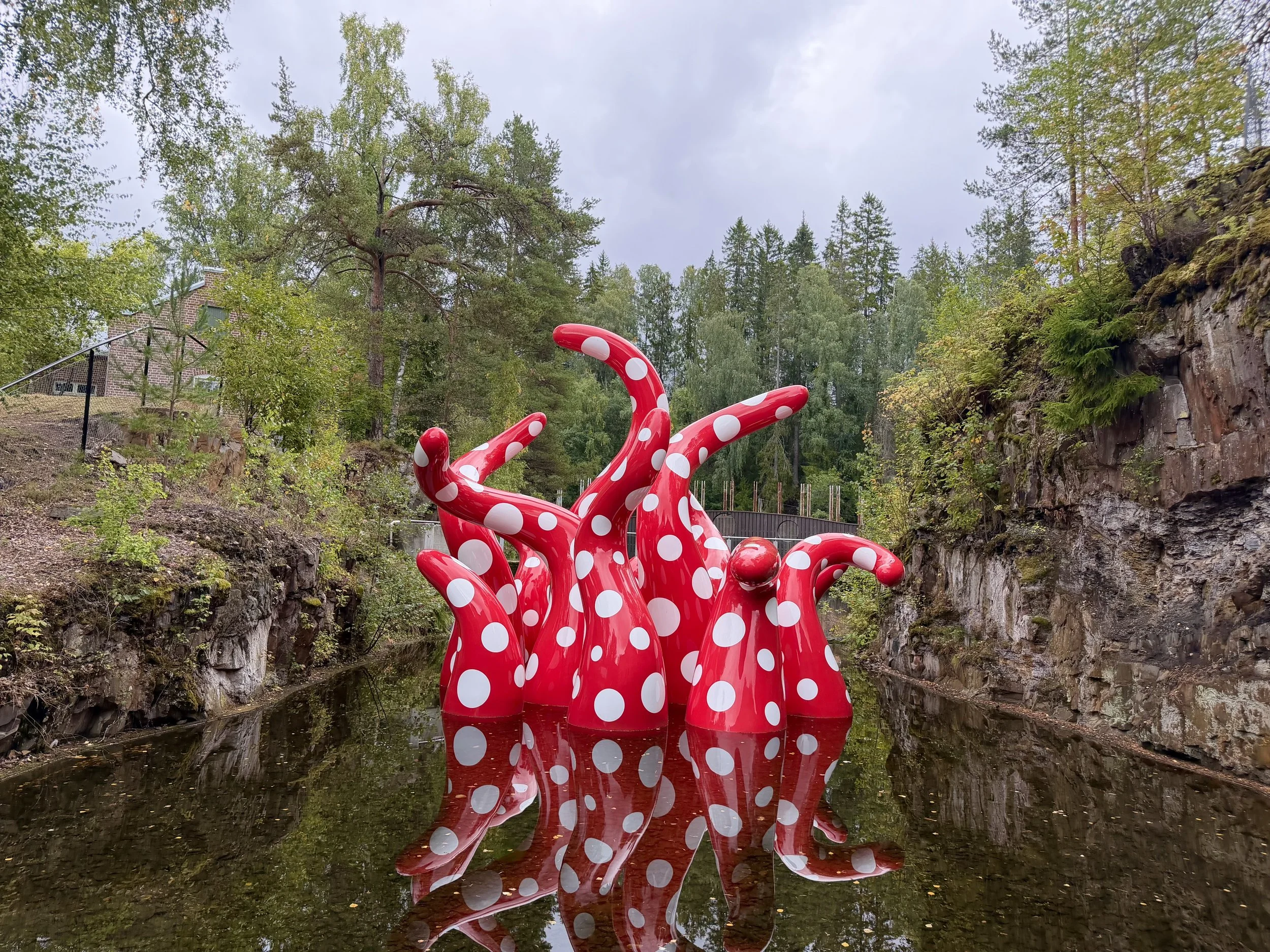
Yayoi Kusama, Shine of Life, 2019. Kistefos Museum, Norway. Image credit MTotoe/FLO London.
#FLODown: Emerging from the water at Kistefos, Yayoi Kusama's Shine of Life is impossible to miss, and yet oddly easy to walk past, because it is tucked into a corner of the park. Six metres high, its twisting red and white tentacles rise out of the water like a strange, fantastical sea creature, covered in the polka dots that are now inseparable from Kusama's name. Created in 2019, the sculpture is the largest Kusama in the Nordic countries and took seven years to realise, with the process beginning in 2012. For Kusama, Shine of Life was a message of love, hope and peace, her tentacles reaching upwards towards the universe. Kusama died in Tokyo on 14 August 2026 at the age of 97, which makes this one of the last major works she realised for a European public space.
Ask at the entrance for its position on the map. It is the one work most people tell us they nearly missed.
Giuseppe Penone, Identity, 2019
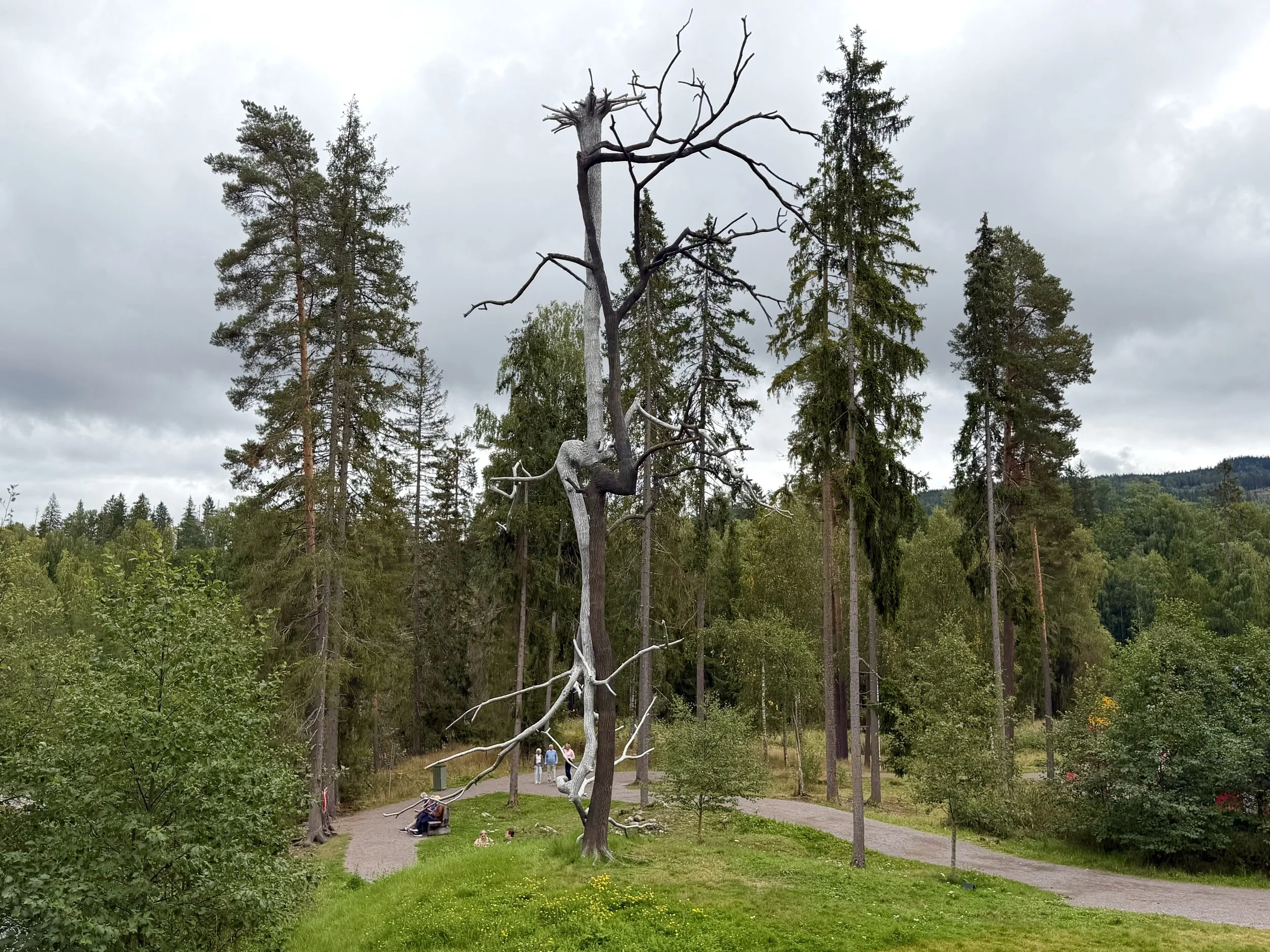
Giuseppe Penone, Identity, 2019. Kistefos Museum, Norway. Image credit MTotoe/FLO London.
#FLODown: Commissioned for the opening of The Twist and installed on 18 September 2019. Penone is the youngest of the Arte Povera generation and has worked with trees, bark, breath and the human body since the late 1960s, often casting trees in bronze or carving back through timber to find the sapling inside. Identity nods to the geometry of The Twist while responding to the forest around it.
Elmgreen & Dragset, Point of View, Part 2, 2019
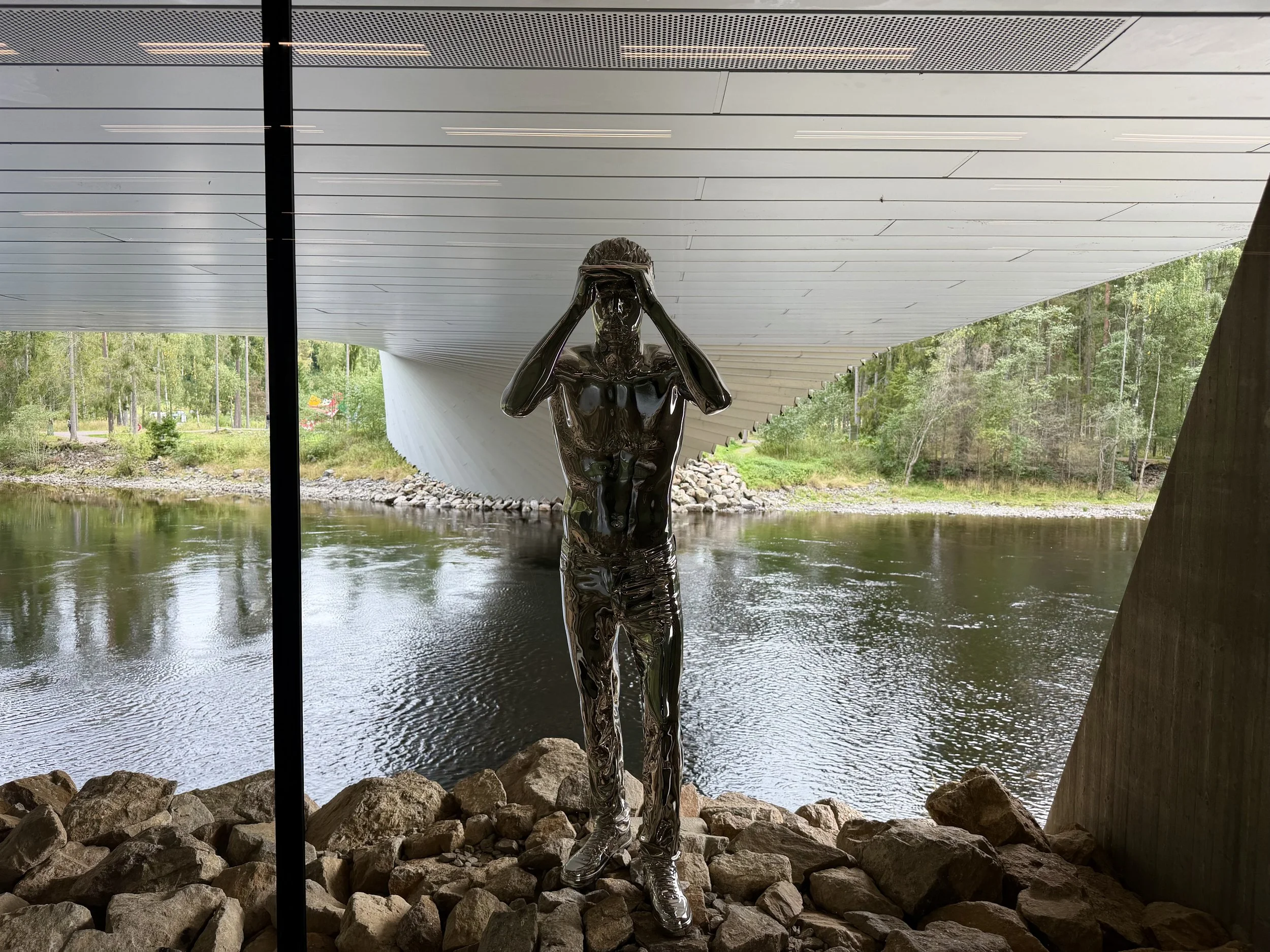
Elmgreen & Dragset, Point of View, Part 2, 2019. Kistefos Museum, Norway. Image credit MTotoe/FLO London.
#FLODown: A lone white male figure pressed against the glass of The Twist, peering in at the exhibition he is not part of. It is the second half of a pair. Part 1 stands at the park entrance, the same man leaning on a free standing fragment of wall and looking through a hole in it. Together they poke at who art institutions are really for. Ingar Dragset was born in Trondheim and Michael Elmgreen in Copenhagen, and they have worked as a duo since 1995. They are probably best known for Prada Marfa in Texas. Kistefos holds four of their works, the two Point of View figures plus Forgotten Babies #2 and Warm Regards, more than any other artist pair in the park.
Instagram: @elmgreenanddragsetstudio
Carol Bove, PASANASAP, 2021
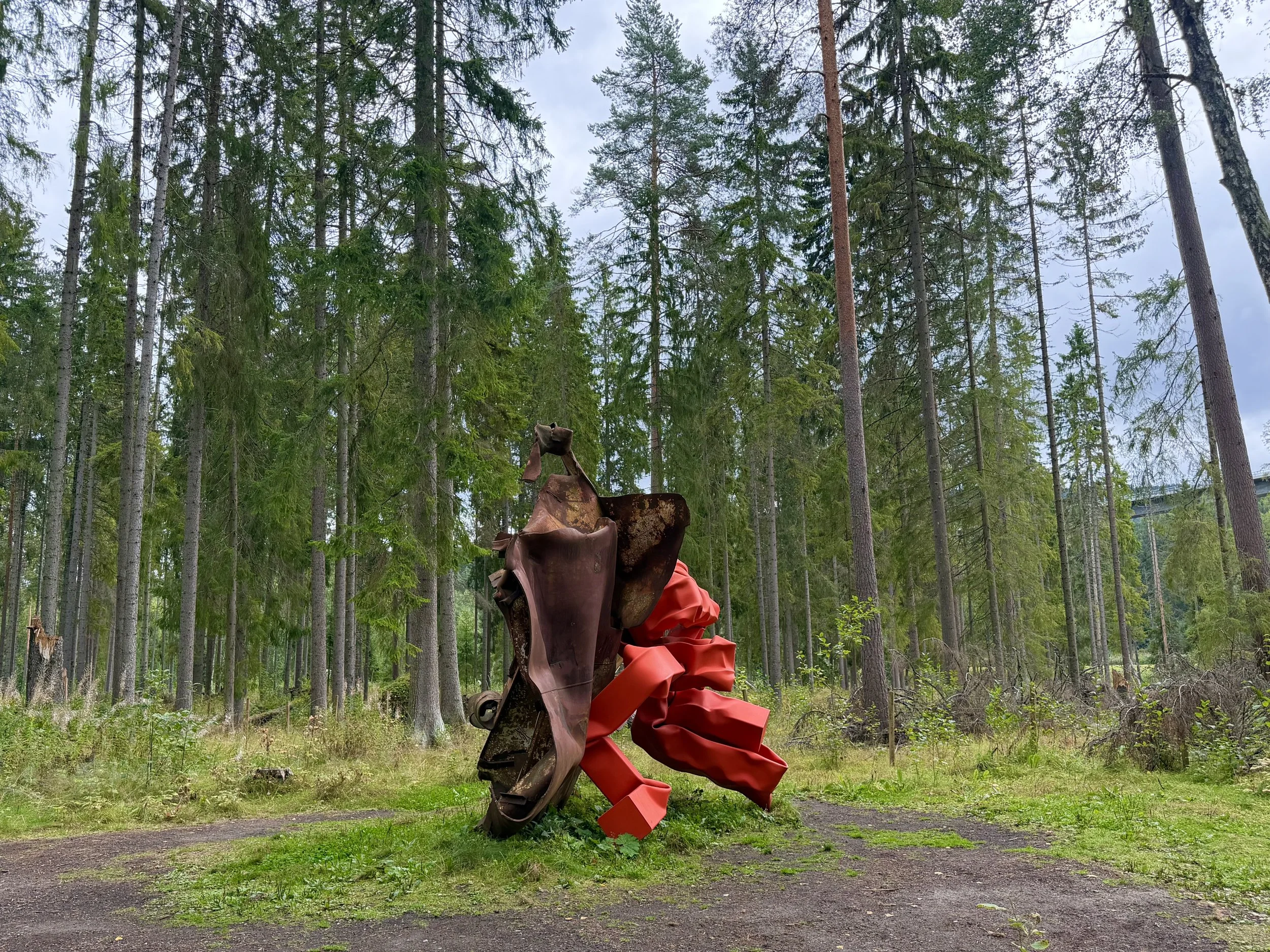
Carol Bove, PASANASAP, 2021. Kistefos Museum, Norway. Image credit MTotoe/FLO London.
#FLODown: A monumental steel sculpture in Bove's signature language of crushed tubes and smooth discs, which somehow reads as soft despite weighing several tonnes. The Norwegian story here is the best in the park. The steel came from MS Server, a cargo ship that broke up and sank off Fedje in 2007 on its way to Murmansk after meeting eight metre waves. The crew were lifted off by helicopter. The stern section, around 1,500 tonnes of steel, was raised in 2018, and that steel became this sculpture. Bove was born in Geneva in 1971 to American parents and lives in New York. The same year she made this work she filled the niches of the Metropolitan Museum's façade with The séances aren't helping.
Marguerite Humeau, The Garden of Resuscitation, 2026
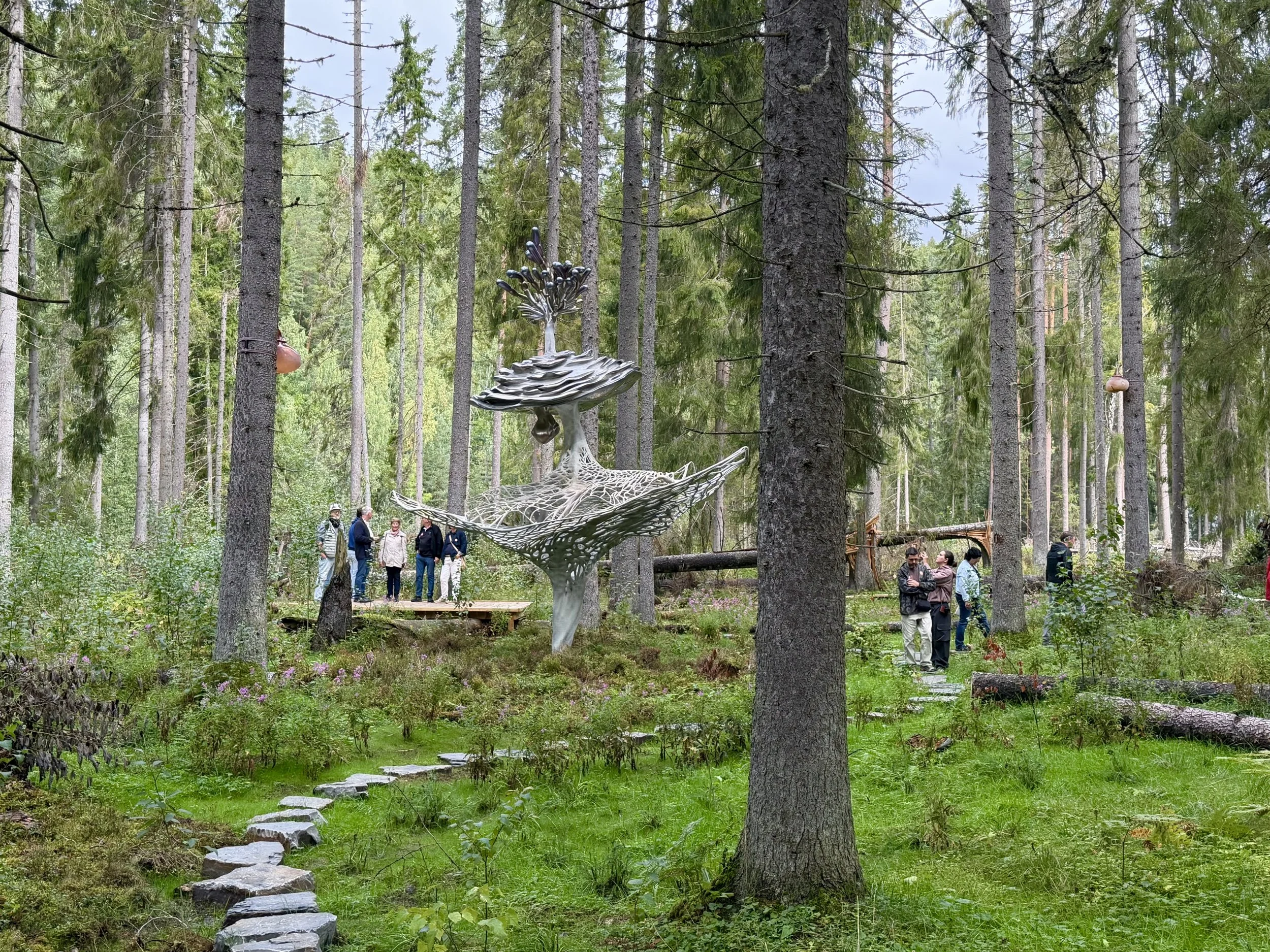
Marguerite Humeau, The Garden of Resuscitation, 2026. Kistefos Museum, Norway. Image credit MTotoe/FLO London.
#FLODown: The newest work in the park, the 60th, opened on 20 August 2026 in the forest by the Randselva. It is a living installation rather than an object, grown around a huge revived spruce and made up of cultivated plants, fungi and a herbal elixir that develops over time. Material from Kistefos' industrial past has been reused in it. The work will keep changing with the seasons, the landscape and the people who walk through it.
Humeau is a French artist based in London. She is on the 2026 Turner Prize shortlist for Torches, shown at ARKEN Museum of Contemporary Art in Copenhagen and Helsinki Art Museum. Her work looks at how life formed, at ancient human history and at imagined future worlds.
Instagram: @marguerite_humeau
Petroc Sesti, Energy Matter Space Time, 2006
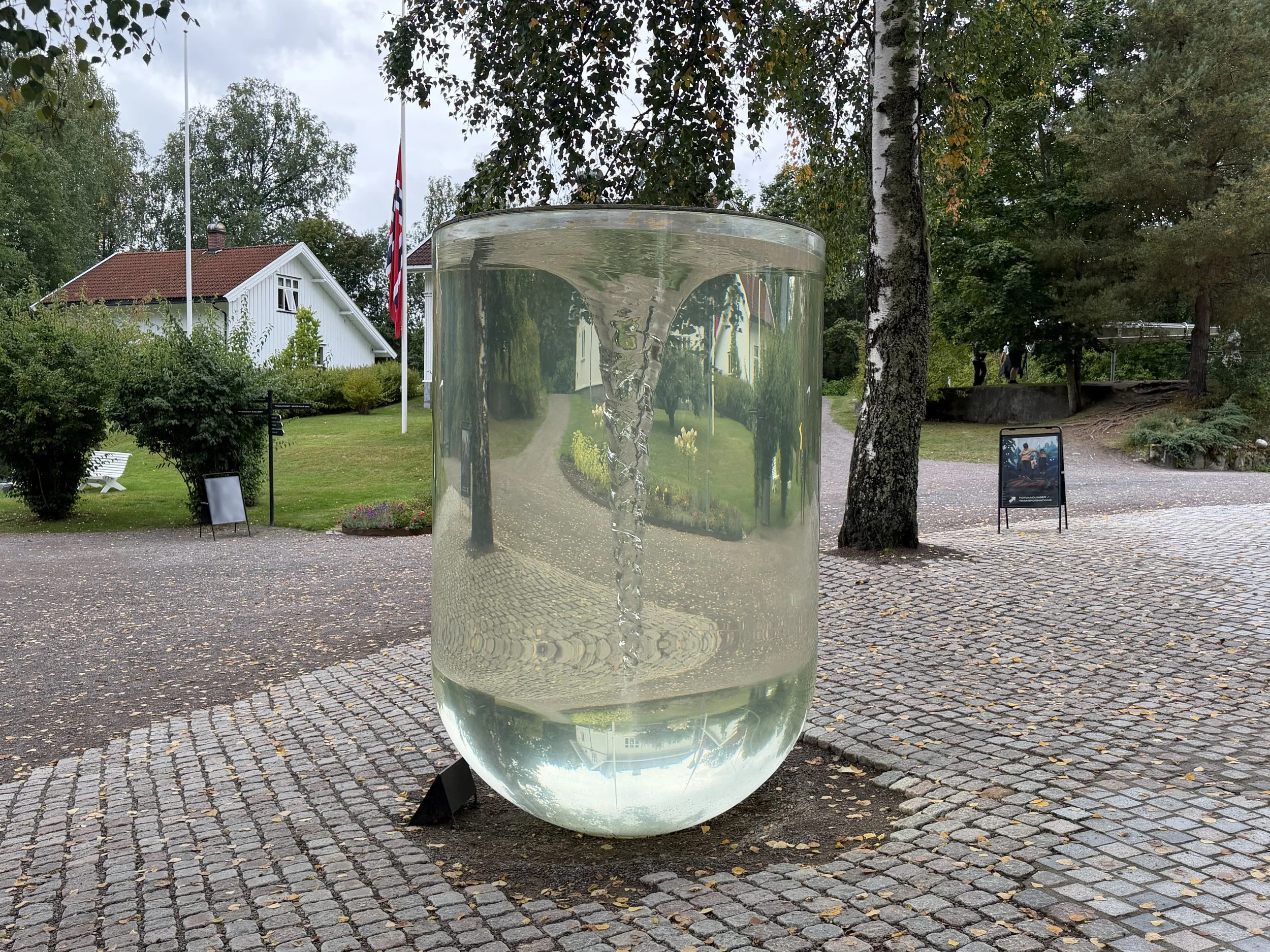
Petroc Sesti, Energy Matter Space Time, 2006. Kistefos Museum, Norway. Image credit MTotoe/FLO London.
#FLODown: A glass vessel holding a permanent vortex, a spinning column of liquid that never stops turning. Sesti, who is British, works with optics and fluid dynamics, and the piece picks up the energy of the waterfall and the turbines that once powered the mill. Get close and give it a minute, because the vortex only resolves properly when you are still.
Instagram: @petrocsesti
Anish Kapoor, S-Curve, 2006
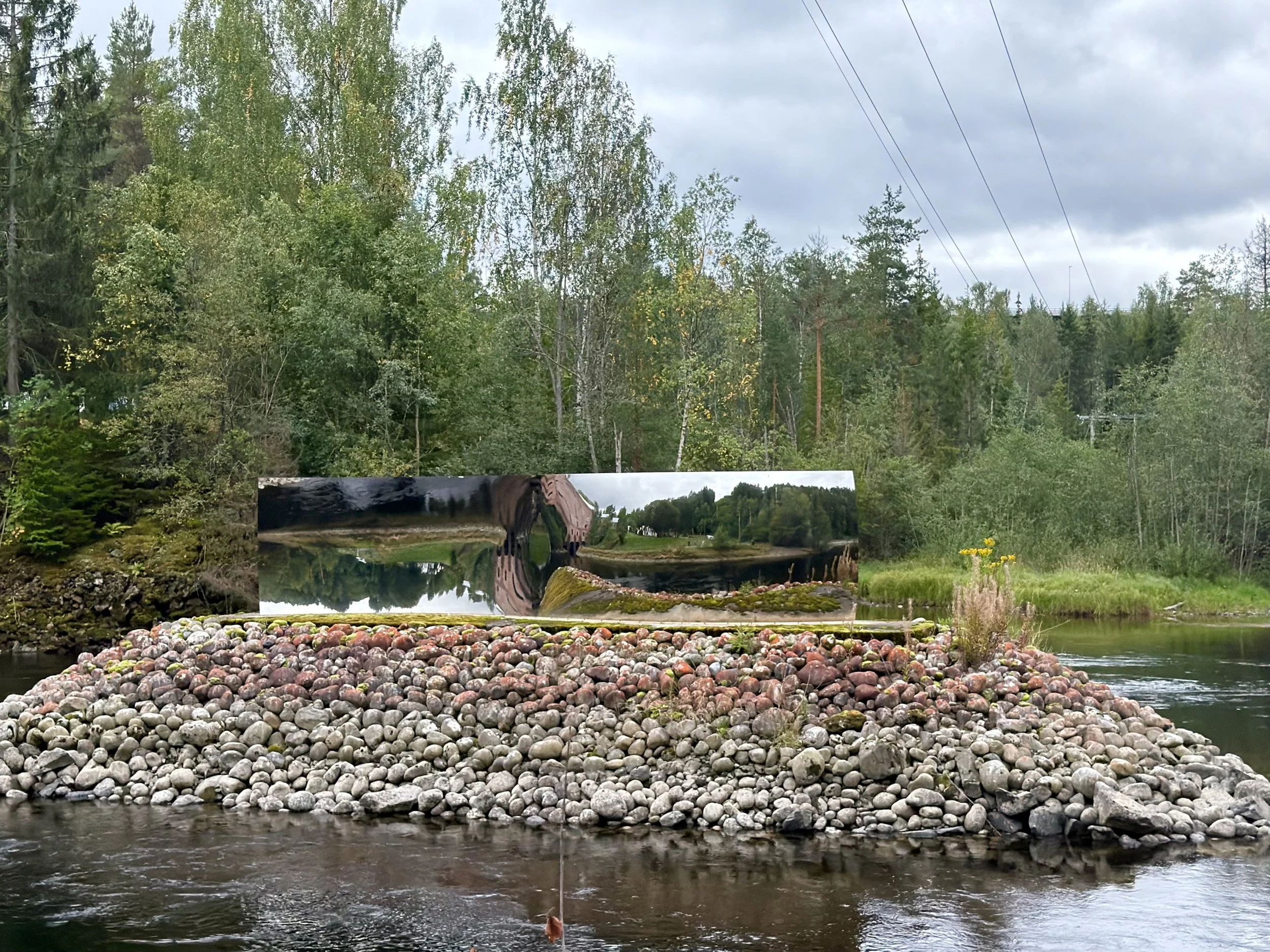
Anish Kapoor, S-Curve, 2006, Kistefos Museum, Norway. Image credit MTotoe/FLO London.
#FLODown: A wall of polished stainless steel, roughly ten metres long, that bends in an S and throws the landscape back at you upside down and stretched. Kapoor had it placed on an island built specially for it in the Randselva, which means you can never touch it or get close. You see it only as an image across water. Kapoor made S-Curve in the same period as Cloud Gate in Chicago and Marsyas for the Turbine Hall at Tate Modern. It changes completely with the season, so the reflection in October is a different work from the one in May. Approach it from the path behind the old pulp mill.
Instagram: @anish.kapoor
Claes Oldenburg and Coosje van Bruggen, Tumbling Tacks, 2009
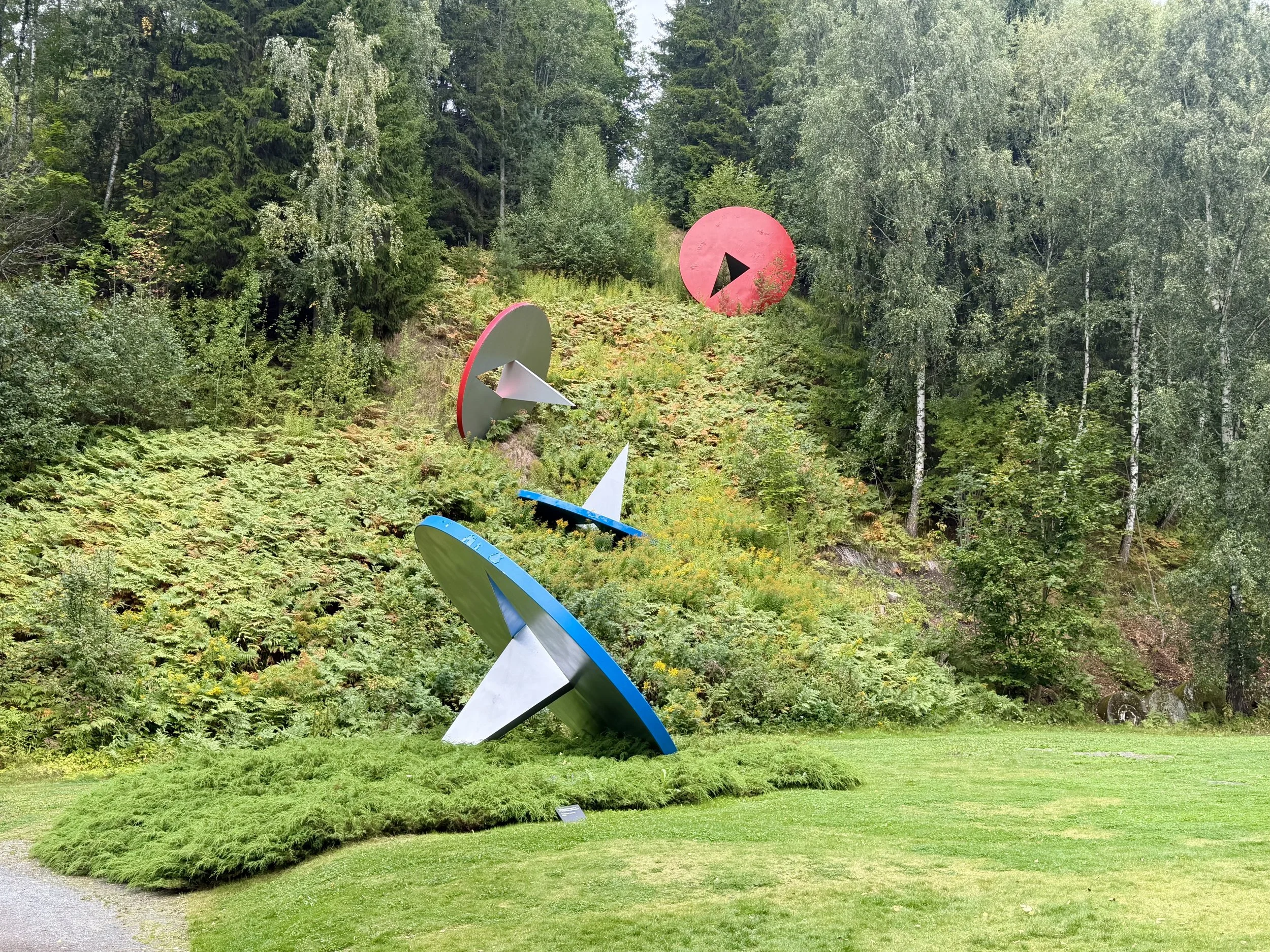
Claes Oldenburg and Coosje van Bruggen, Tumbling Tacks, 2009. Kistefos Museum, Norway. Image credit MTotoe/FLO London.
#FLODown: Four giant drawing pins in red and blue that look as though they are falling down a 45 degree hillside. That slope is where the old aerial cableway once stood. The connection is paper, which is what a drawing pin exists to hold up and what the wood pulp made at Kistefos was turned into. They were fabricated in Italy from steel, fibreglass and gelcoat, and although they appear to be tumbling freely, each one is bolted to a concrete block under the grass. Tumbling Tacks was the last work Claes Oldenburg and Coosje van Bruggen made together. The two had collaborated since 1976 and were married, and they described the partnership as a unity of opposites. Van Bruggen died of breast cancer in January 2009 and the sculpture was unveiled at Kistefos several months later. It is their only project in Scandinavia, and the first of their large scale projects made for a natural landscape rather than a city.
John Gerrard, Pulp Press (Kistefos), 2013
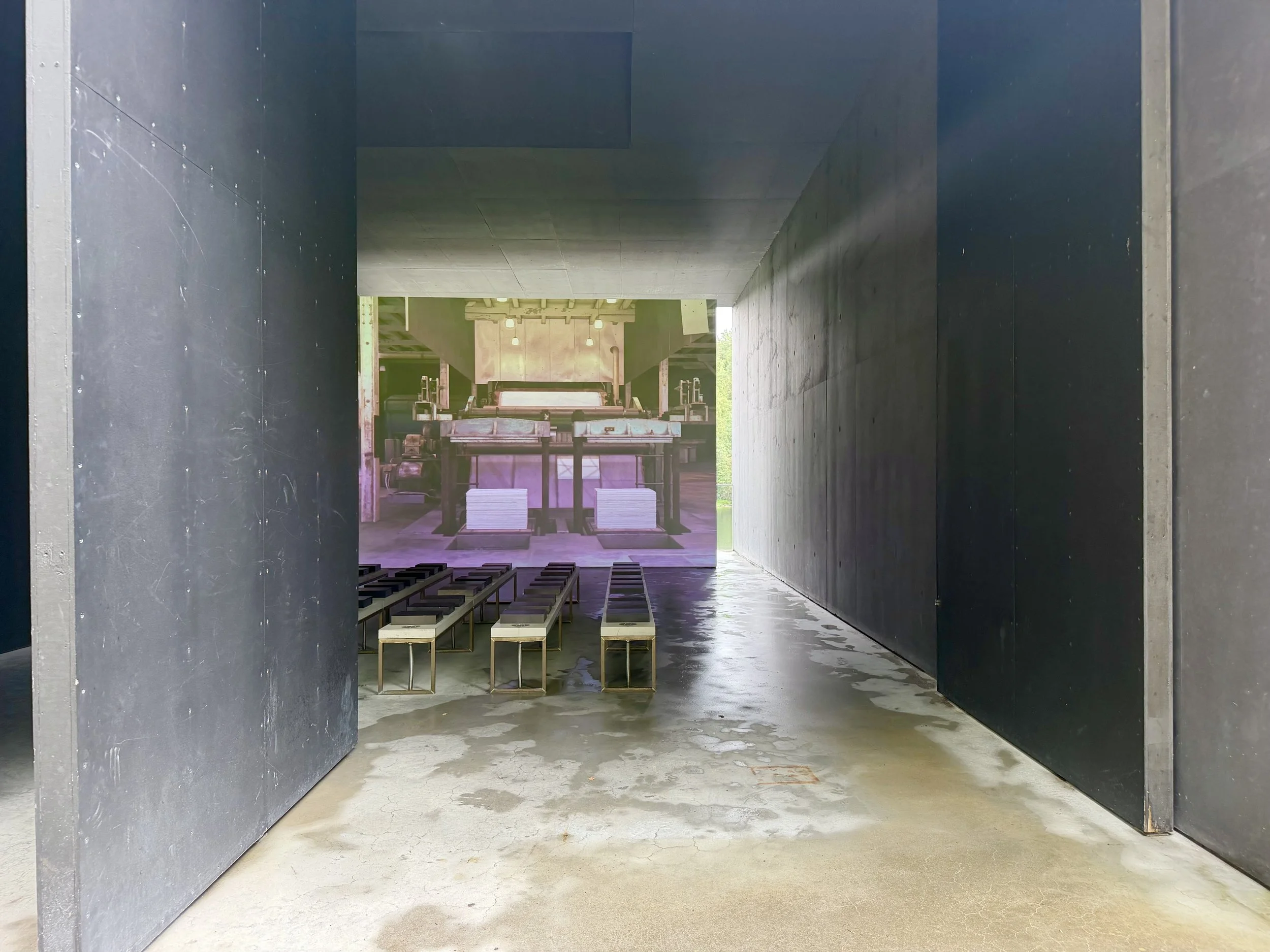
John Gerrard, Pulp Press (Kistefos), 2013. Kistefos Museum, Norway. Image credit MTotoe/FLO London.
#FLODown: A hyper realistic digital simulation of the mill's original pulping machine, rebuilt in a virtual world and running again, projected inside a poured concrete pavilion on the river bank designed with Dublin architects A2. The paper it produces is unique each time and exists only as data, stored on hard drives inside the pavilion. Gerrard, born in Dublin in 1974, has spent much of his career on abandoned industrial sites and energy infrastructure. This is the work that most directly answers Kistefos itself. Go inside rather than glancing through the door. The piece is slow and the point is that it never repeats.
Phillip King, Free to Frolic, 2015
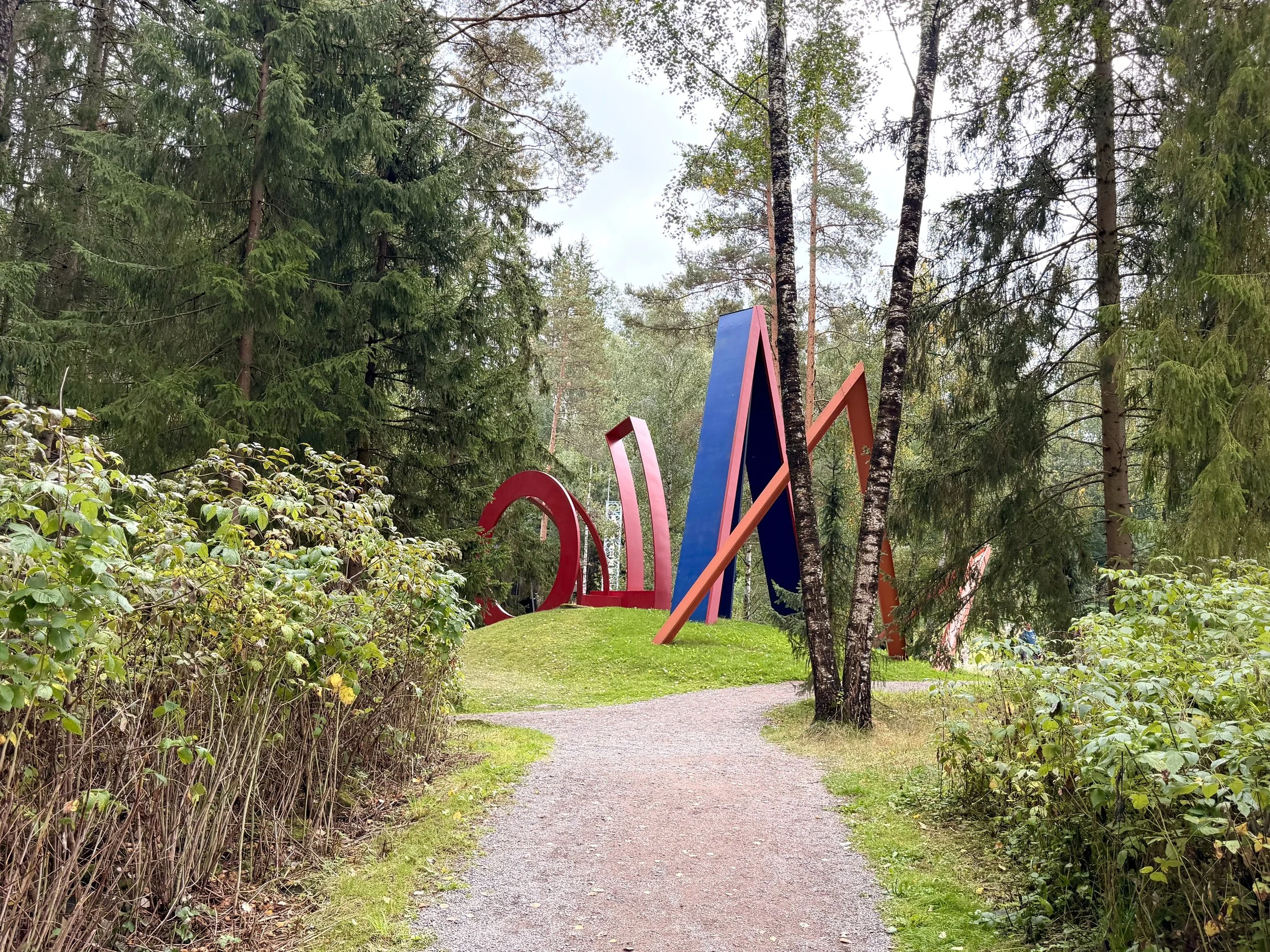
Phillip King, Free to Frolic, 2015. Kistefos Museum, Norway. Image credit MTotoe/FLO London.
#FLODown: A cluster of geometric forms in painted steel, in blue, red and orange, made specially for Kistefos and unveiled at the 2015 season opening with King on site to oversee it. He had held since his student days that a sculpture can never be fully seen, because no single viewpoint gives you all of it, and this one is built to prove the point. The shape you think you are looking at falls apart and reassembles as you move. Phillip King became one of the central figures of the New Generation sculptors alongside Anthony Caro. He represented Britain at the Venice Biennale in 1968, taught at Saint Martin's where Richard Long was among his students, and served as President of the Royal Academy from 1999 to 2004. He died in 2021, which makes Free to Frolic one of the last major outdoor works he saw installed.
Jeppe Hein, Path of Silence, 2016
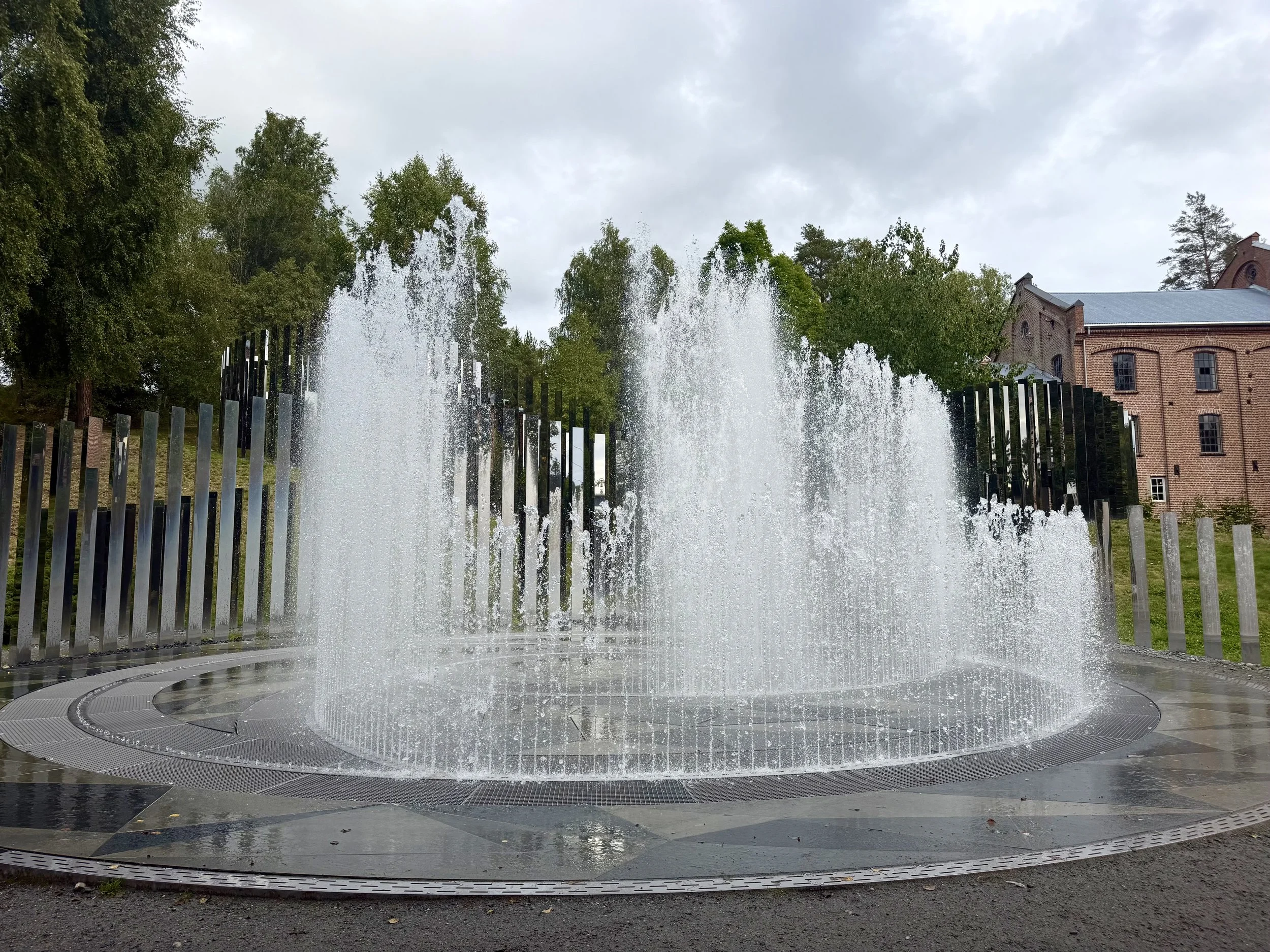
Jeppe Hein, Path of Silence, 2016. Kistefos Museum, Norway. Image credit MTotoe/FLO London.
#FLODown: A mirrored labyrinth with a water pavilion at its centre, built into the stepped terraces beside the industrial museum. Walls of water rise and fall, mirrored steles multiply the trees and sky, and a living tree grows inside the structure. Hein identifies three kinds of silence in it, contemplative, natural and active.
It makes more sense once you know what happened to him. In 2009, at the height of a very fast early career, Hein collapsed with burnout, and almost everything he has made since is built to slow people down. He made the installation for his 2016 Kistefos exhibition Reflection, and it was the largest work he had built at that point. He has a second piece in the park, Modified Social Benches, which you are meant to try to sit on. This is the most popular work with families, and children treat the fountain as a splash pad in summer. Come early in the morning or towards closing if you want to get the silence the title promises.
Instagram: @jeppehein
Ilya & Emilia Kabakov, The Ball, 2017
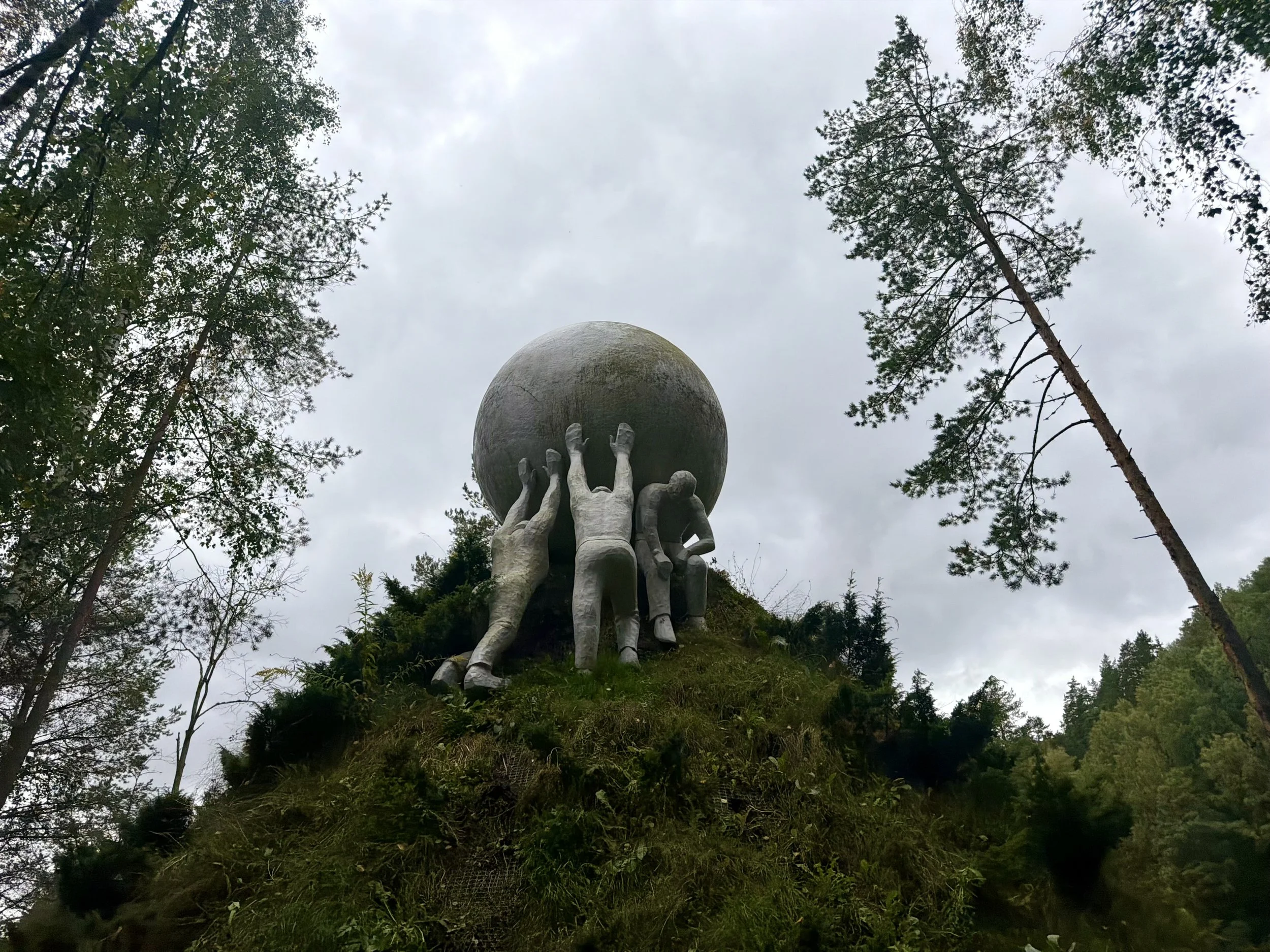
Ilya & Emilia Kabakov, The Ball, 2017. Kistefos Museum, Norway. Image credit MTotoe/FLO London.
#FLODown: Three figures in marble coloured composite push a giant ball up a hill. The hill itself is part of the work, built from stone, covered with earth and planted with grass, and each figure is fixed to both the ball and the slope. The reference is Sisyphus, condemned to roll the same rock uphill for eternity, but here he is not alone. Kabakov turned the Greek punishment into teamwork, three people hauling together rather than one man repeating a pointless task.
Kabakov was born in 1933 in what is now Dnipro, worked in Moscow until the late 1980s, and became the leading figure of Moscow conceptualism. He made this with his wife and collaborator Emilia, as he did with everything after 1989, and died in 2023. Elsewhere in Norway, the National Museum in Oslo holds his major installation Garbage Man, also known as The Man Who Never Threw Anything Away. The horizon behind the figures matters to the artist, who specified it as part of the work. Look at it from below with the skyline behind.
Ida Ekblad, A Deadly Slumber of All Forces, 2021
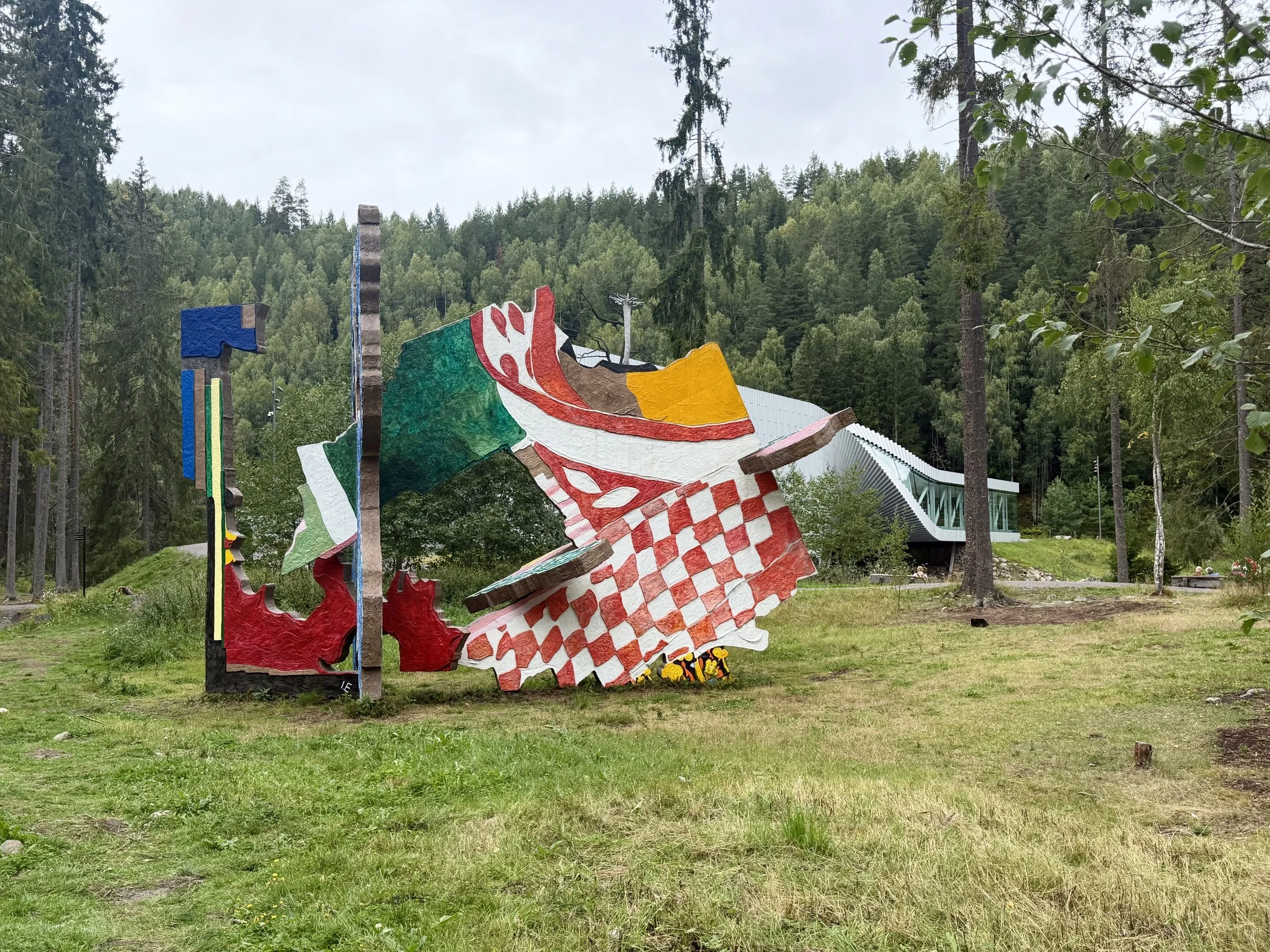
Ida Ekblad, A Deadly Slumber of All Forces, 2021. Kistefos Museum, Norway. Image credit MTotoe/FLO London.
#FLODown: A sculptural collage built from fragments of Ekblad's own paintings. It is made of four parts that interlock like puzzle pieces. It is hand painted and the largest sculpture she has made, commissioned for the park and placed near The Twist at her suggestion.
Ekblad is one of the most prominent Norwegian artists of her generation. She has shown at the Venice Biennale twice, in 2011 and 2017, and works across painting, poetry, sculpture and found material. She is also in The Twist this season as part of When I'm in My Painting, which is on show until 11 October, so you can see her sculpture and her paintings on the same visit. Her solo exhibition World's Largest Metaphor is on show at The Hepworth Wakefield from 21 November 2026 to 3 May 2027, her first major show in the UK, with new oil paintings alongside glass, cast iron and hand painted bronze sculptures.
Instagram: @idaekblad
Pierre Huyghe, Variants, 2022
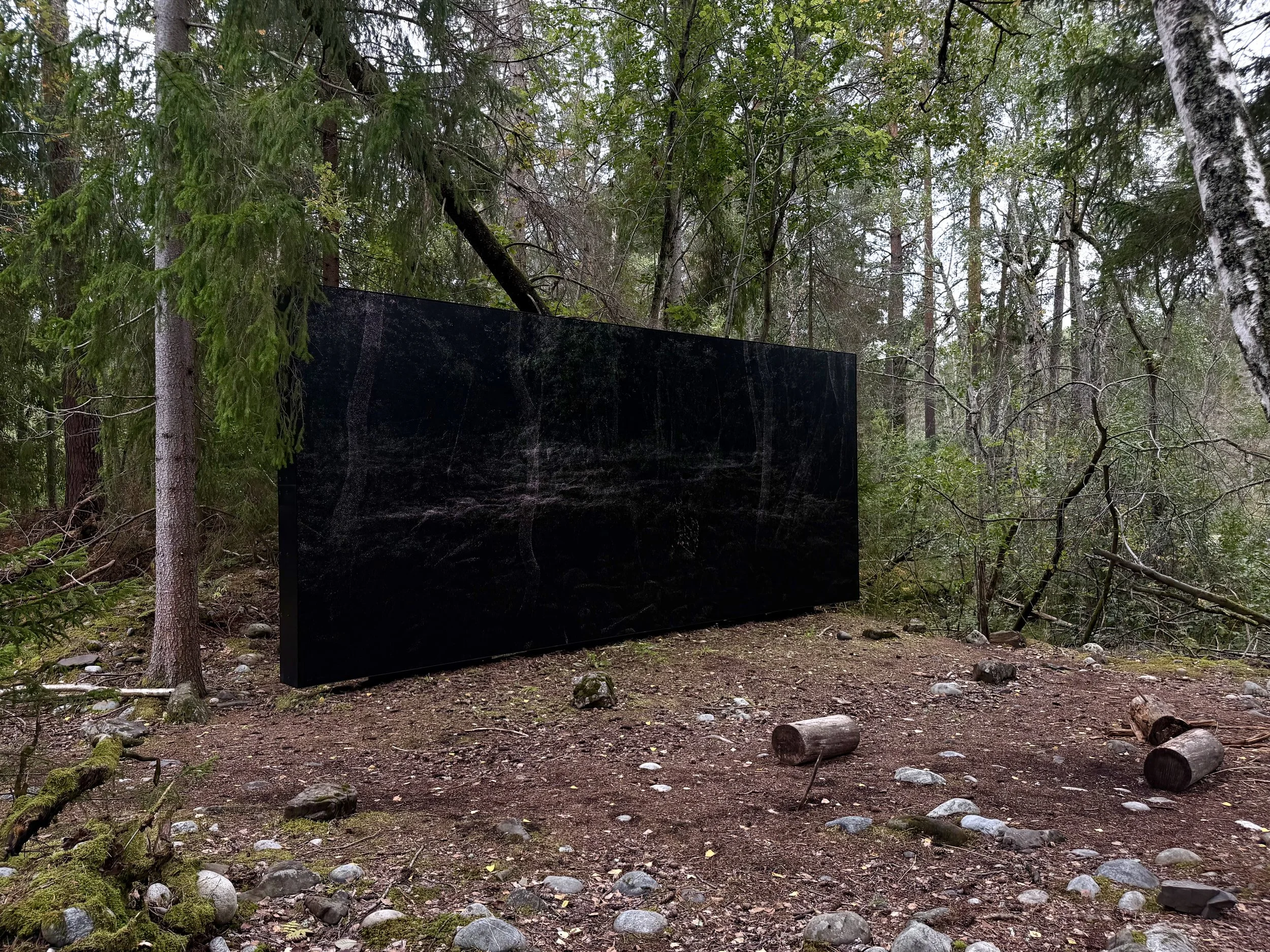
Pierre Huyghe, Variants, 2022. Kistefos Museum, Norway. Image credit MTotoe/FLO London.
#FLODown: The strangest and most technically ambitious work at Kistefos. Huyghe 3D scanned a section of forest and built a real time simulation of it that mutates continuously, driven by environmental sensors, an intelligent camera and the living things on the island, including bee and ant colonies. Some of the simulation's mutations have been materialised as 3D printed sculptures scattered through the trees. It was the 50th work in the park, unveiled in June 2022. Huyghe is French, won the Nasher Prize in 2017, and has spent his career making work that keeps evolving without him.
Two practical points. Variants is on an island that was previously closed to the public, and it may shut at short notice in heavy rain or when the river is high, so ring ahead if this is the work you are coming for. And several of the printed objects are easy to walk straight past, so go slowly.
Marianne Heske, Blue, 2023
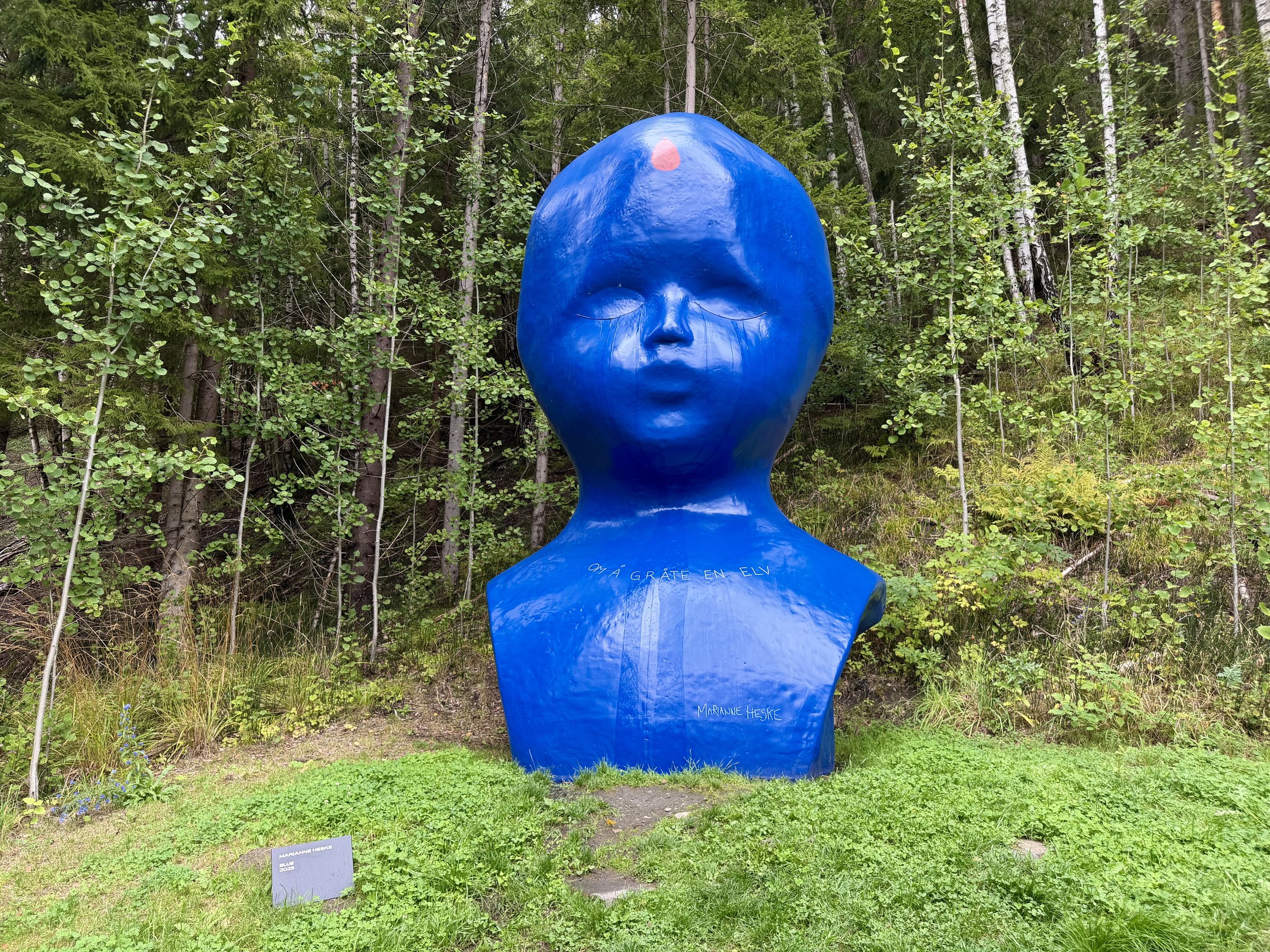
Marianne Heske, Blue, 2023. Kistefos Museum, Norway. Image credit MTotoe/FLO London.
#FLODown: A monumental bronze doll's head painted blue, placed in its own small amphitheatre. Tears fall from the eyes at irregular intervals.
The doll's head has been Heske's motif since she found an antique papier mâché head at a Paris market in 1971, and she has described it as a stand-in for people in general. Born in Ålesund in 1946, she is regarded as a pioneer of Norwegian conceptual art. Her Prosjekt Gjerdeløa of 1980, for which she took apart a 350 year old timber barn in Tafjord and rebuilt it at the Centre Pompidou in Paris, is often called the first Norwegian conceptual artwork.
There is a second doll's head in Torshovdalen in Oslo. She has a second piece at Kistefos as well, Homage to Leo the Lion from 2006, inside the wood pulp mill.
Kader Attia, Whistleblower, 2024
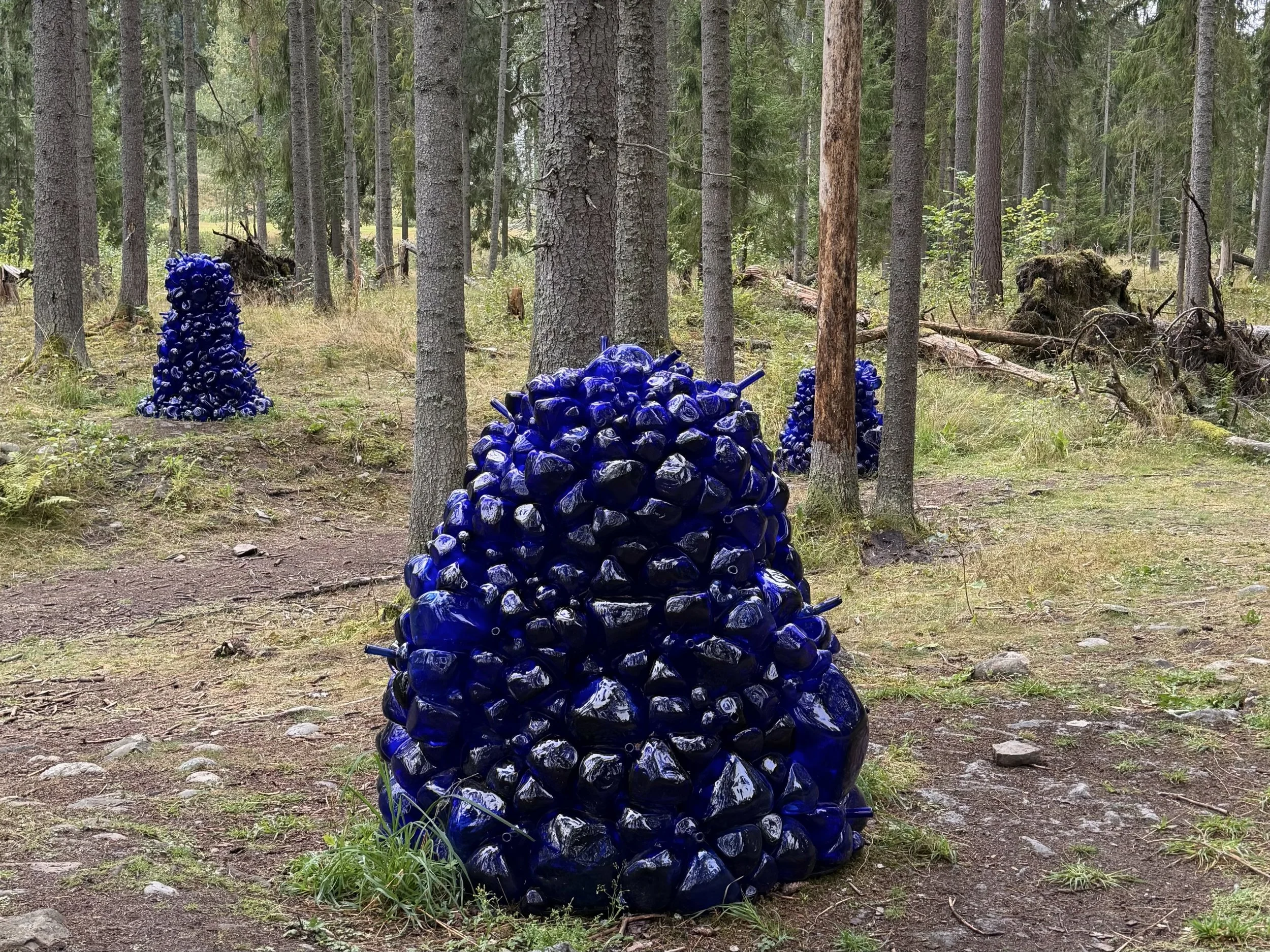
Kader Attia, Whistleblower, 2024. Kistefos Museum, Norway. Image credit MTotoe/FLO London.
#FLODown: Six glass sculptures in the quiet forest south of The Twist, the 55th work added to the park. The idea came from the note the wind makes across the neck of a bottle, which Attia uses as an image of what happens where nature meets human manufacture. Attia, who is French Algerian, won the Marcel Duchamp Prize in 2016 and curated the Berlin Biennale in 2022. His long running subject is repair, both of objects and of histories. This is a listening piece as much as a looking one, so pick a windy day if you have the choice, and go when the forest path is empty.
Nairy Baghramian, Resting Arms, 2025
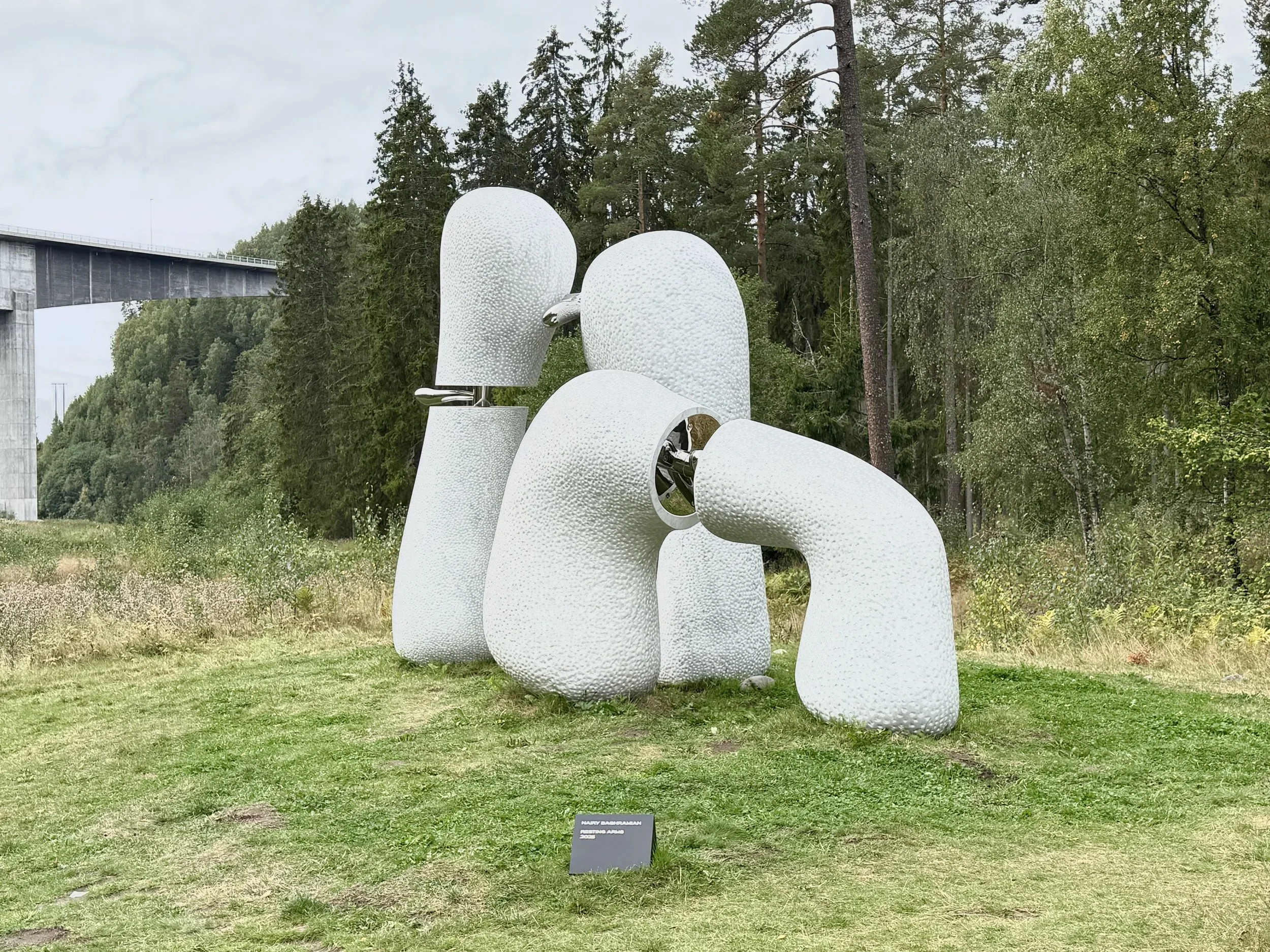
Nairy Baghramian, Resting Arms, 2025. Kistefos Museum, Norway. Image credit MTotoe/FLO London.
#FLODown: Two heavily veined blocks of white Carrara marble and steel, abstracted from the joints of the human body. Baghramian has moved the elbows out of their usual orientation and let them rest, and the pitted marble surfaces are meant to suggest fragility and, in her words, possible collapse. Baghramian was born in Iran in 1971 and works in Berlin. This was her first work in Northern Europe, unveiled at the season opening on 4 May 2025 as the 56th permanent work in the park.
Fernando Botero, Female Torso, 1983
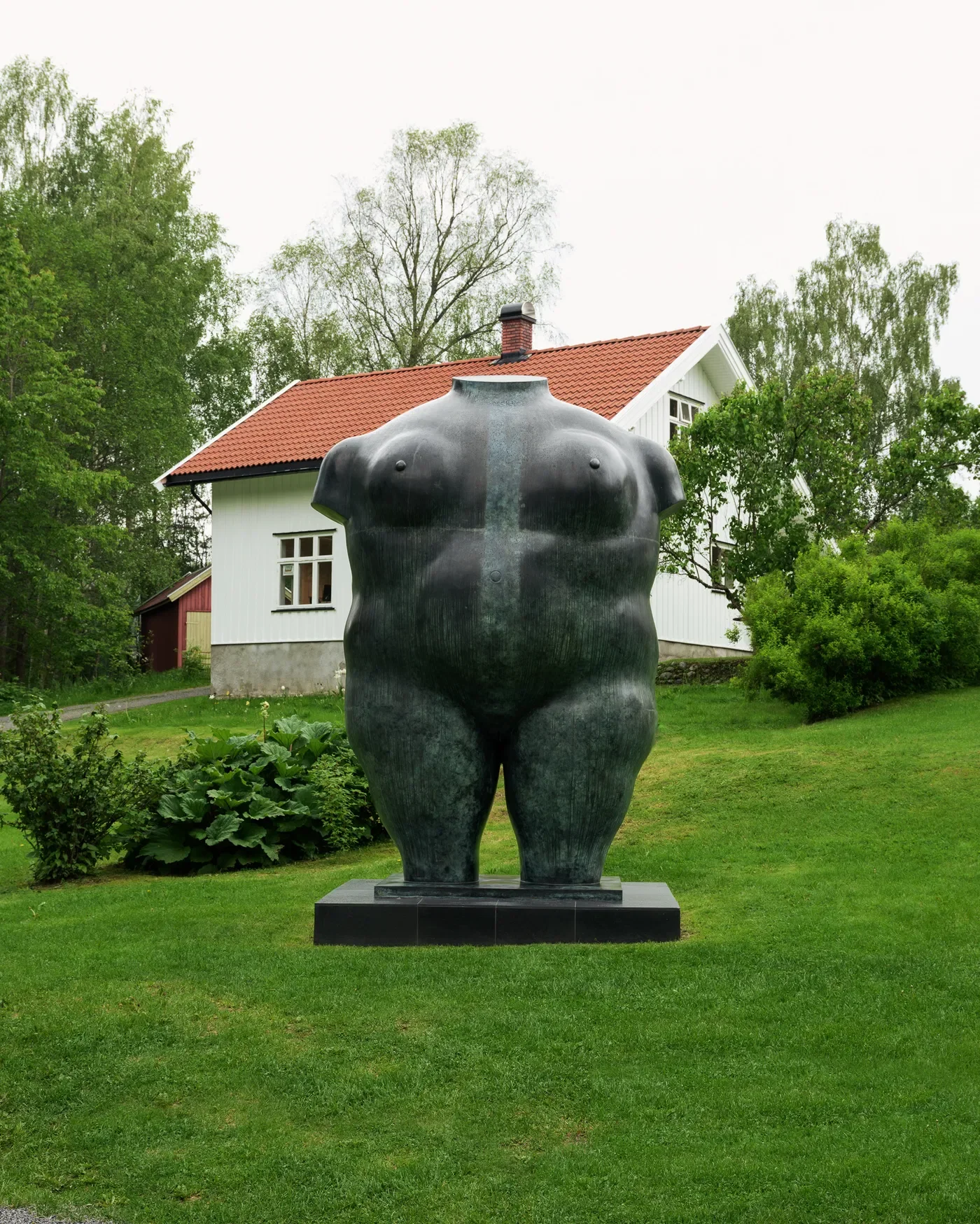
Female Torso by Fernando Botero. Kistefos Museum, Norway. Image credit Einar Aslaksen
#FLODown: A monumental bronze torso in the rounded, swollen style that made the Colombian artist one of the most recognisable sculptors in the world. Botero called his approach an exploration of volume rather than of size. Botero died in 2023. His large bronzes can be found in Medellín, Paris, Madrid and Singapore, and the Kistefos torso is among the few in Scandinavia.
The Twist
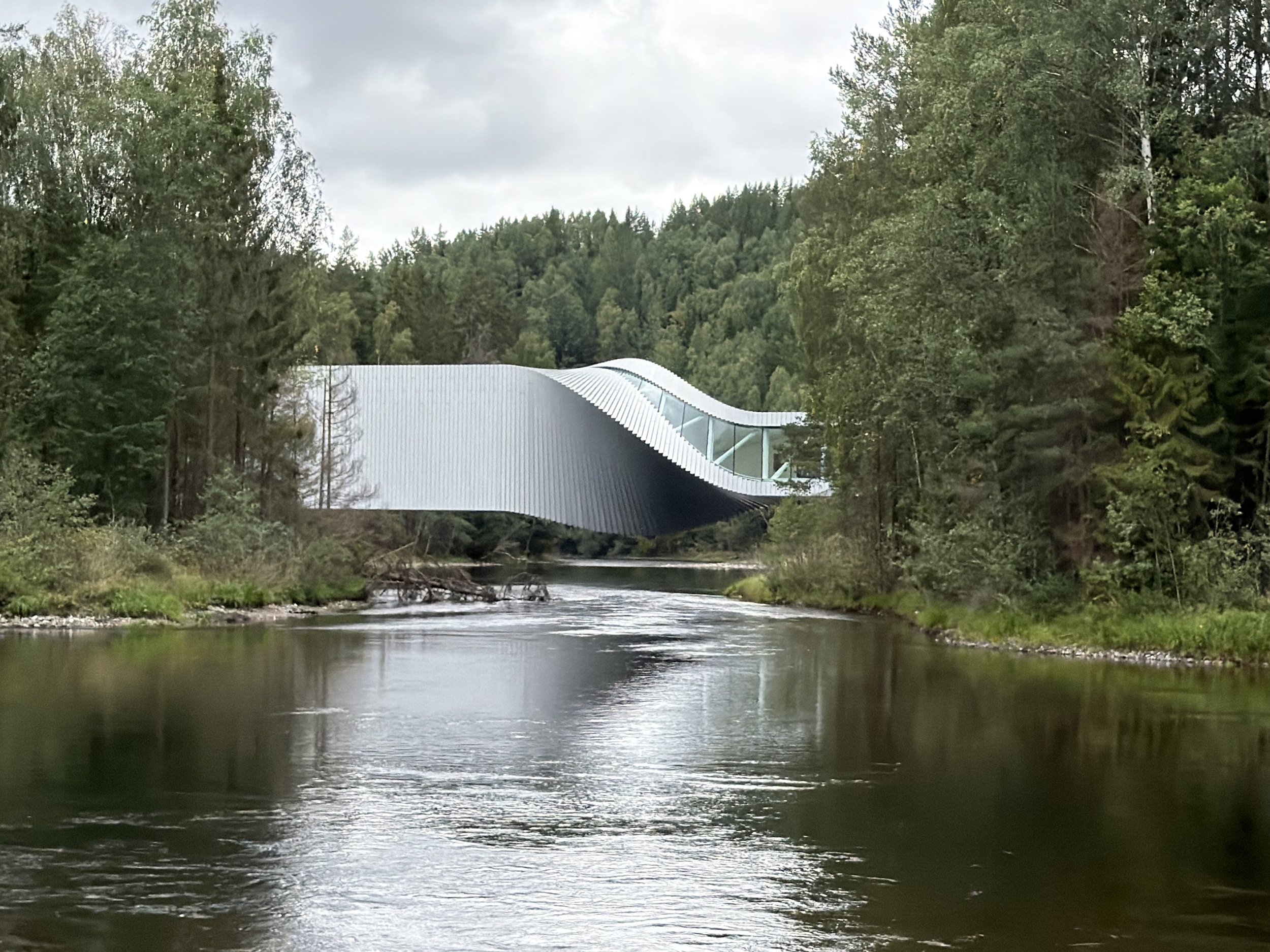
The Twist. Kistefos Museum, Norway. Image credit MTotoe/FLO London.
The Twist at Kistefos,is quite possibly the greatest gallery space we have been in. Designed by Danish architecture studio BIG, the 60 metre structure opened in 2019 and twists across the Randselva, connecting the two sides of the sculpture park. It is part gallery, part bridge and part sculpture in its own right.
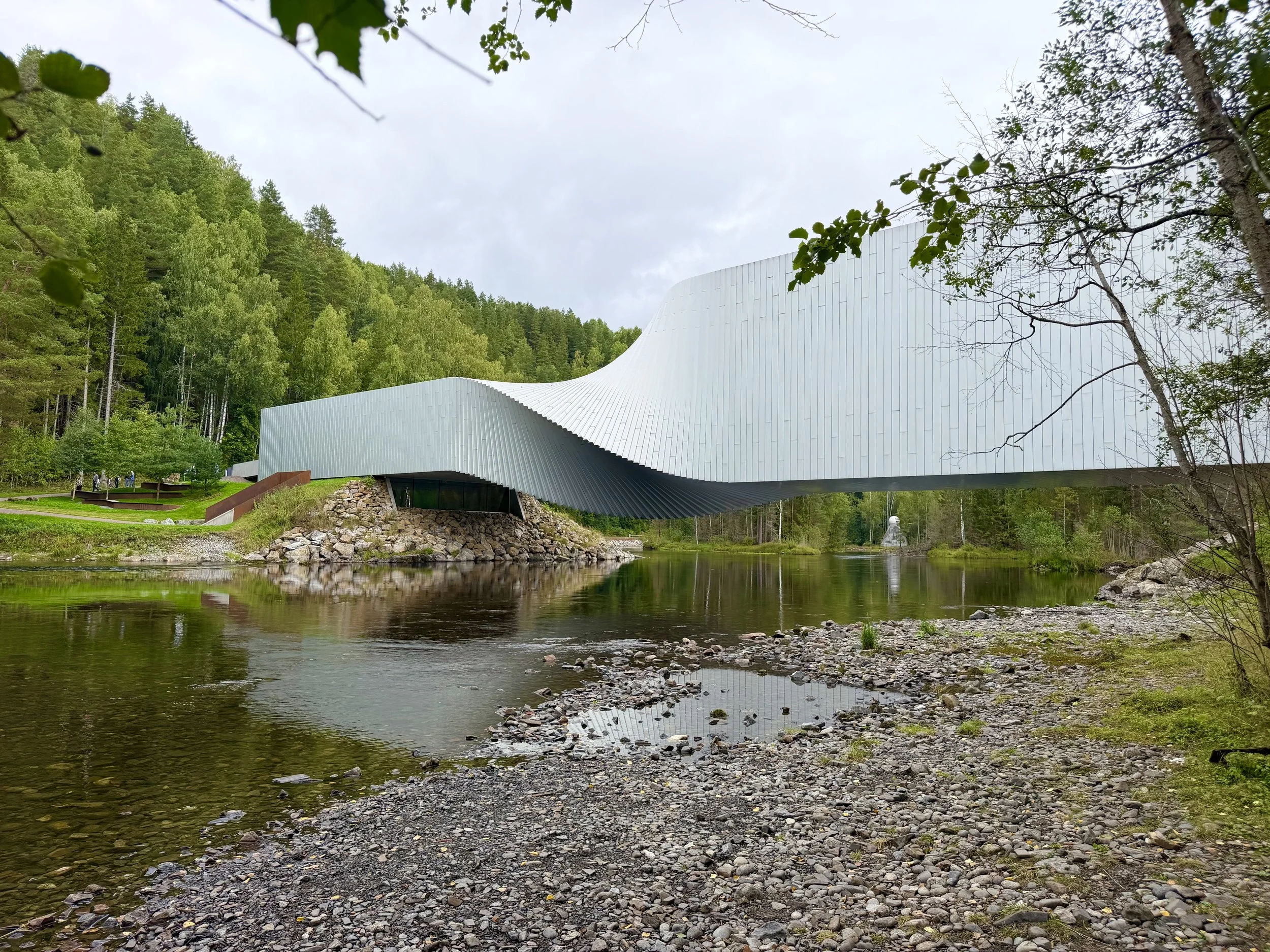
The Twist. Kistefos Museum, Norway. Image credit MTotoe/FLO London.
Currently on show in The Twist is When I'm in My Painting, until11 October 2026, with works by Ragna Bley, Ida Ekblad, Oscar Murillo and Albert Oehlen, all artists held in the Christen Sveaas Art Foundation,
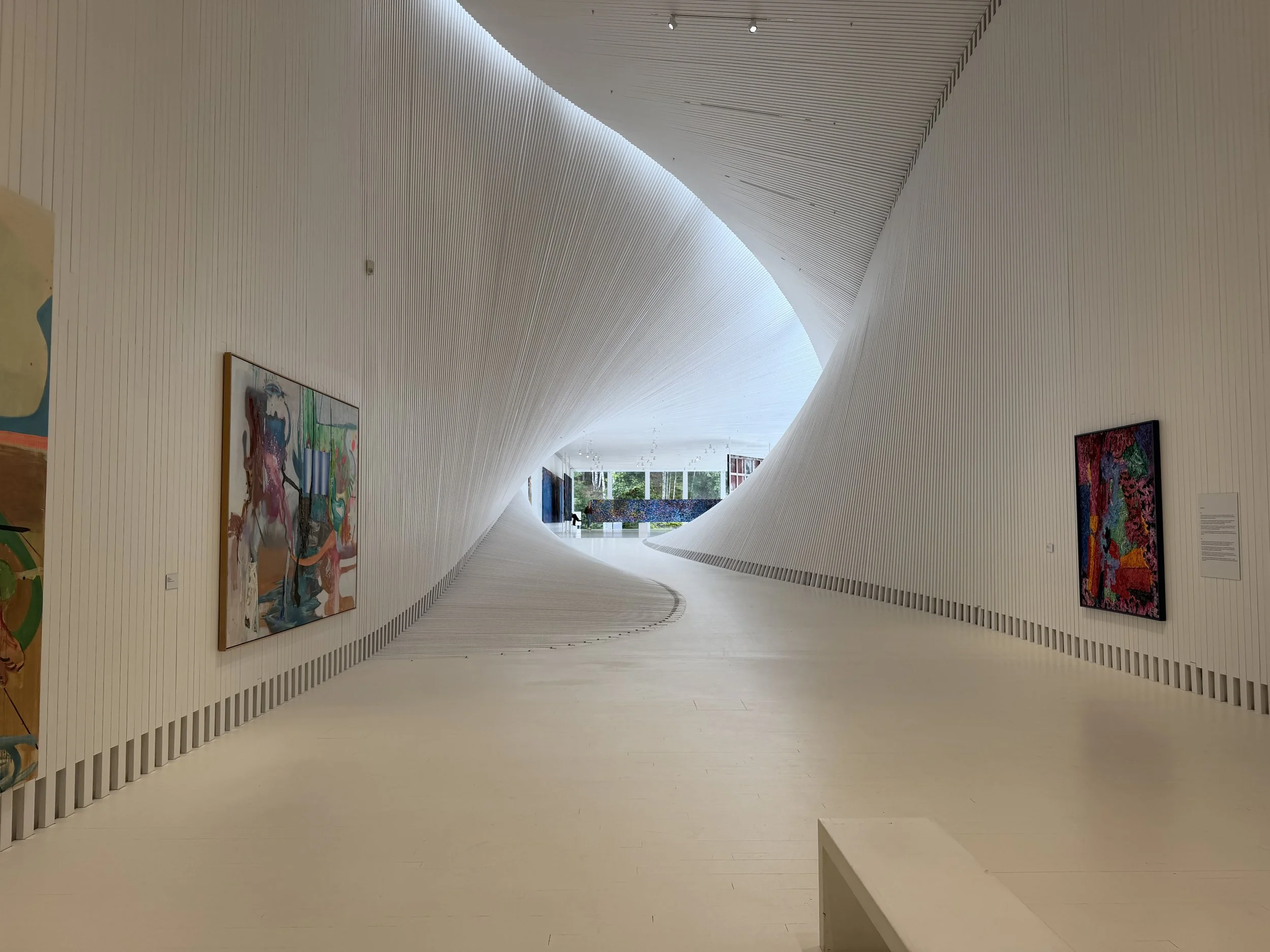
Installation view is When I'm in My Painting (9 May -11 October 2026). Kistefos Museum, Norway. Image credit MTotoe/FLO London.
The title comes from Jackson Pollock's remark about the moment the boundary between artist and painting dissolves. It is curated by Kate Smith Raabe, Kistefos' chief curator.
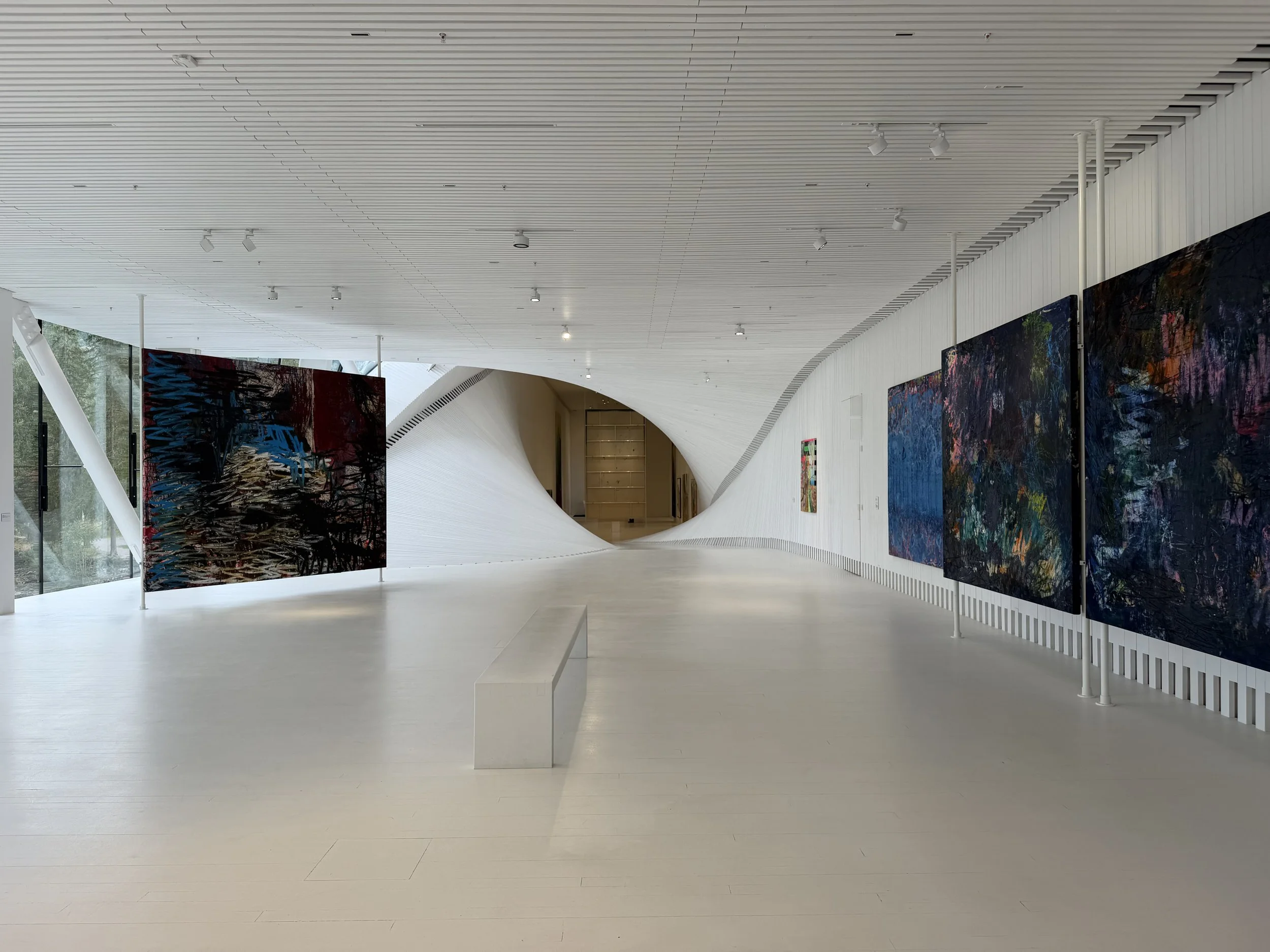
Installation view is When I'm in My Painting (9 May -11 October 2026). Kistefos Museum, Norway. Image credit MTotoe/FLO London.
Over at Nybruket Gallery there is a solo exhibition by London based artist Issy Wood, her first in the Nordics, alongside the Springbrett fellowship exhibition.
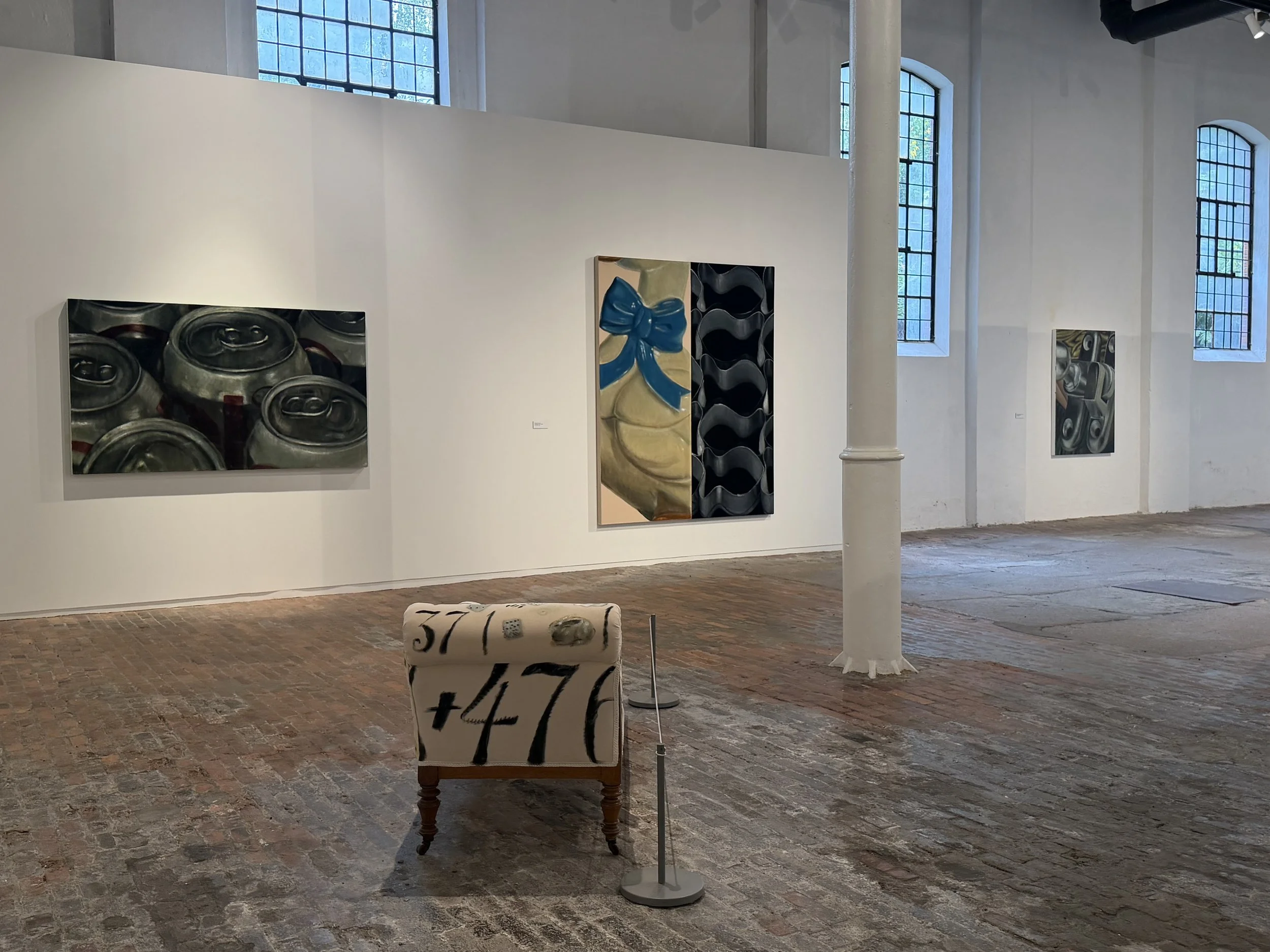
Installation view Fish, Fish, Duck, Issy Wood, Nybruket Gallery. Kistefos Museum, Norway. Image credit MTotoe/FLO London.
Where Kistefos Museum is and how to get there from Oslo
Kistefos is in Jevnaker, on the banks of the Randselva river, about 80 kilometres and an hour's drive north west of Oslo. It is roughly the same distance from Oslo Airport Gardermoen, which makes it workable as a stop on the way to or from a flight if you have a hire car. The museum is seasonal and open from May to mid October. Outside those months the galleries are closed, though the sculpture park stays accessible with an area ticket.
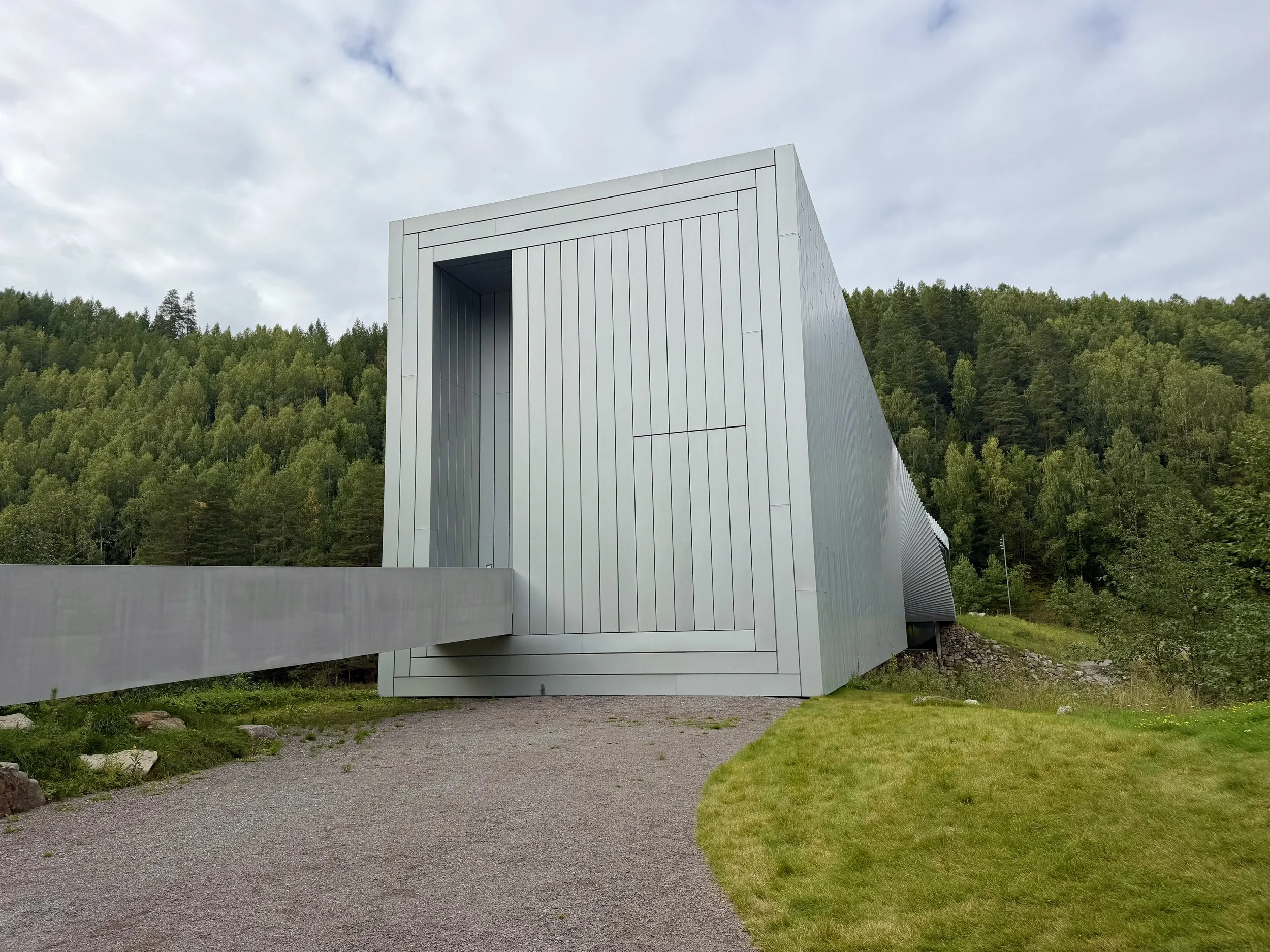
Entrance to The Twist. Kistefos Museum, Norway. Image credit MTotoe/FLO London.
By car, follow signs for Jevnaker. There are two entrances with parking on both sides of the park, at Kistefossveien 112 and at Samsmoveien 41.
Without a car, Vy operates a seasonal express coach, the VY66, direct from Oslo Bus Terminal. The journey takes about an hour and a half, tickets are around 250 NOK each way, and the coach calls at Filipstad, Lysaker and Sandvika on the way. Two things to know. Tickets must be booked in advance, and the service only goes ahead if seats have been pre booked, so you cannot turn up on the day. And the days of the week vary across the season, with weekends only in early May and a longer Thursday to Sunday service through the summer, so confirm the timetable before you plan around it. Click here for departure times.
The ticket also covers a shuttle between Kistefos and Hadeland Glassverk, the historic glassworks a few minutes away, so the two make an easy pair for one day out.
Opening information
The 2026 season is open from 9 May to 11 October. Adult tickets are 210 NOK, under 20s go free and 20 to 25 year olds pay 110 NOK. Outside the season you can still walk much of the park with a 100 NOK area ticket from the vending machine at either entrance.
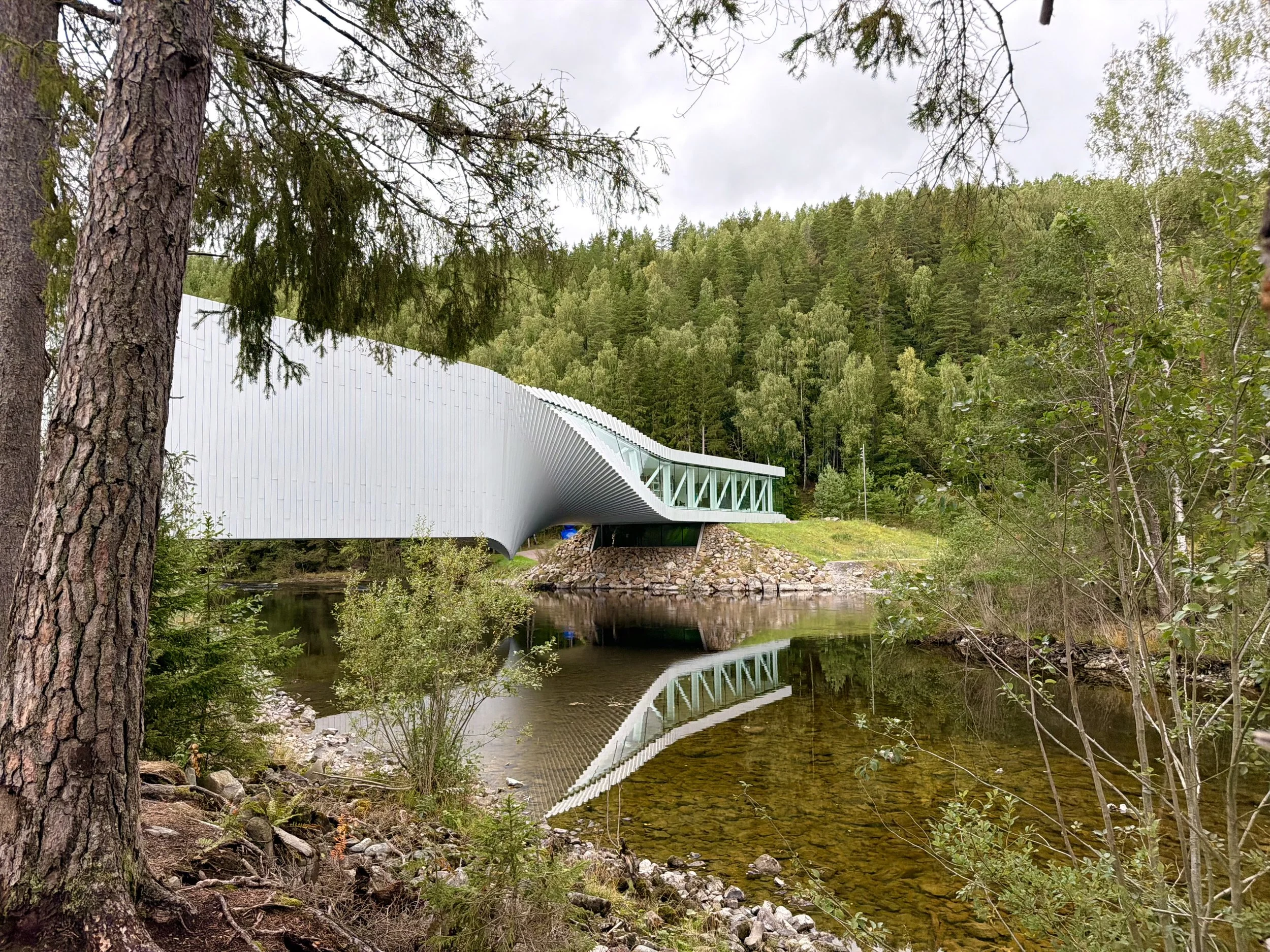
The Twist. Kistefos Museum, Norway. Image credit MTotoe/FLO London.
There are two entrances, north and south. Most visitors start at the south entrance, which is where the newest work stands, and work northwards towards The Twist. Give yourself three hours at a minimum. The terrain is steep in places and the paths are gravel and grass, so wear proper shoes.
For opening hours, tickets, the interactive sculpture map and this season's exhibitions, visit kistefosmuseum.com.








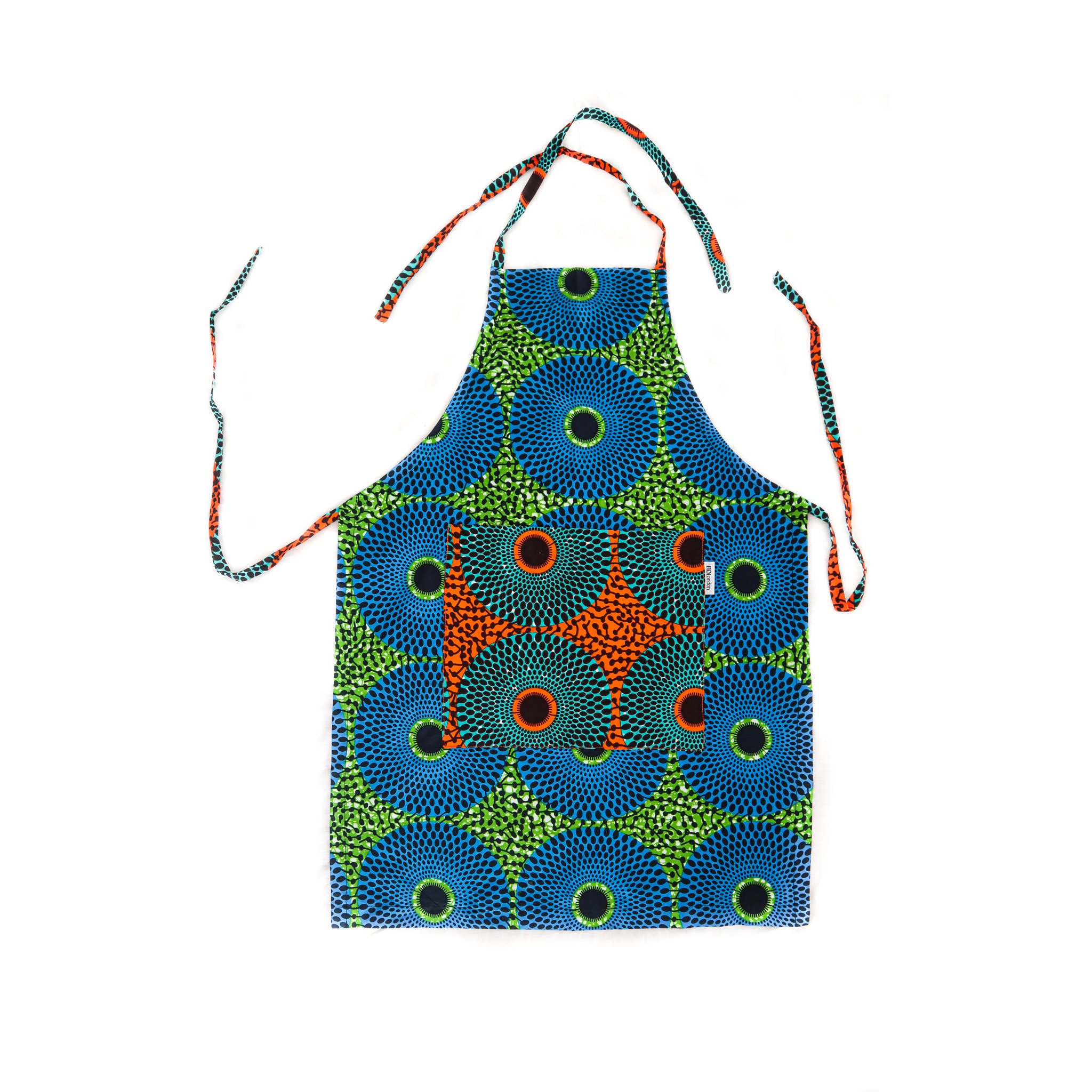


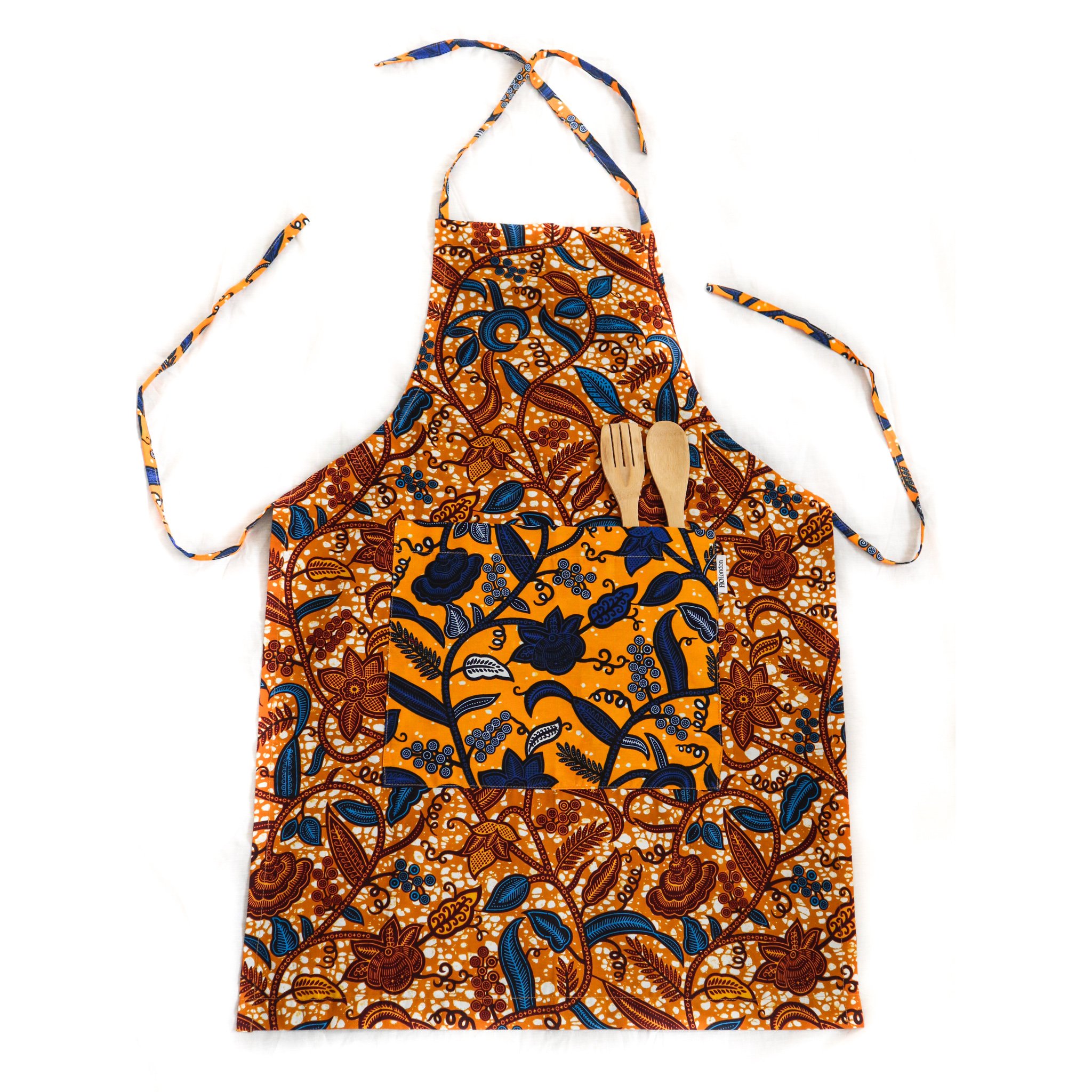


Handmade in Ghana, our aprons offer a unique design with a front pocket perfect for kitchen utensils or your phone and tie neck straps each made from recycled material. The perfect gift for any cooking enthusiasts!
Our aprons have been named after markets in Ghana and London. This apron has been named after street food hub Maltby Street Market.