
Hepworth in Colour at the Courtauld Gallery review
Making my way up three floors of the spiral staircase at the Courtauld Gallery, I’m reminded of my experience venturing out to St. Ives a few years ago. I was visiting specifically to see the Barbara Hepworth Museum and Sculpture Garden. Visiting Cornwall was an incredible experience - albeit not easy to get to if you don’t have a car. Perhaps that is why any Hepworth exhibition is exciting for London locals, reflected in the already quite packed exhibition at 10am on its first day open to the public. With people jostling in front of the small sculptures to peek at their colourful details, I recognize that Barbara has brought an audience - of course she has. A British icon, a legacy sculptor, an example of artistic excellence.

Installation view, The Joseph Hage Aaronson & Bremen Exhibition, Hepworth in Colour, Courtauld Gallery. Photo © Fergus Carmichael.
Cornwall was an incredibly important context for Hepworth, and she sculpted with the colours of the sand, sky and sea around her. She moved from London during the Second World War and - according to one of the exhibition’s wall texts - from the year 1943, “pale blue became her favourite hue”, no doubt due to the influence of her surroundings. I would discover later in the exhibition how she applied these blue hues to interiors of wood carvings, or adding in sunny yellows in curved spaces of her stone sculptures - all reminiscent of the nature around her in St. Ives.
One of the first sculptures in the exhibition, however, shows a deeper, intense cobalt blue encased with white plaster. The blue creates a dedicated surface area to hold space, specifically for whatever force is evoked through her strings taught with tension hovering over the dip in the plaster.
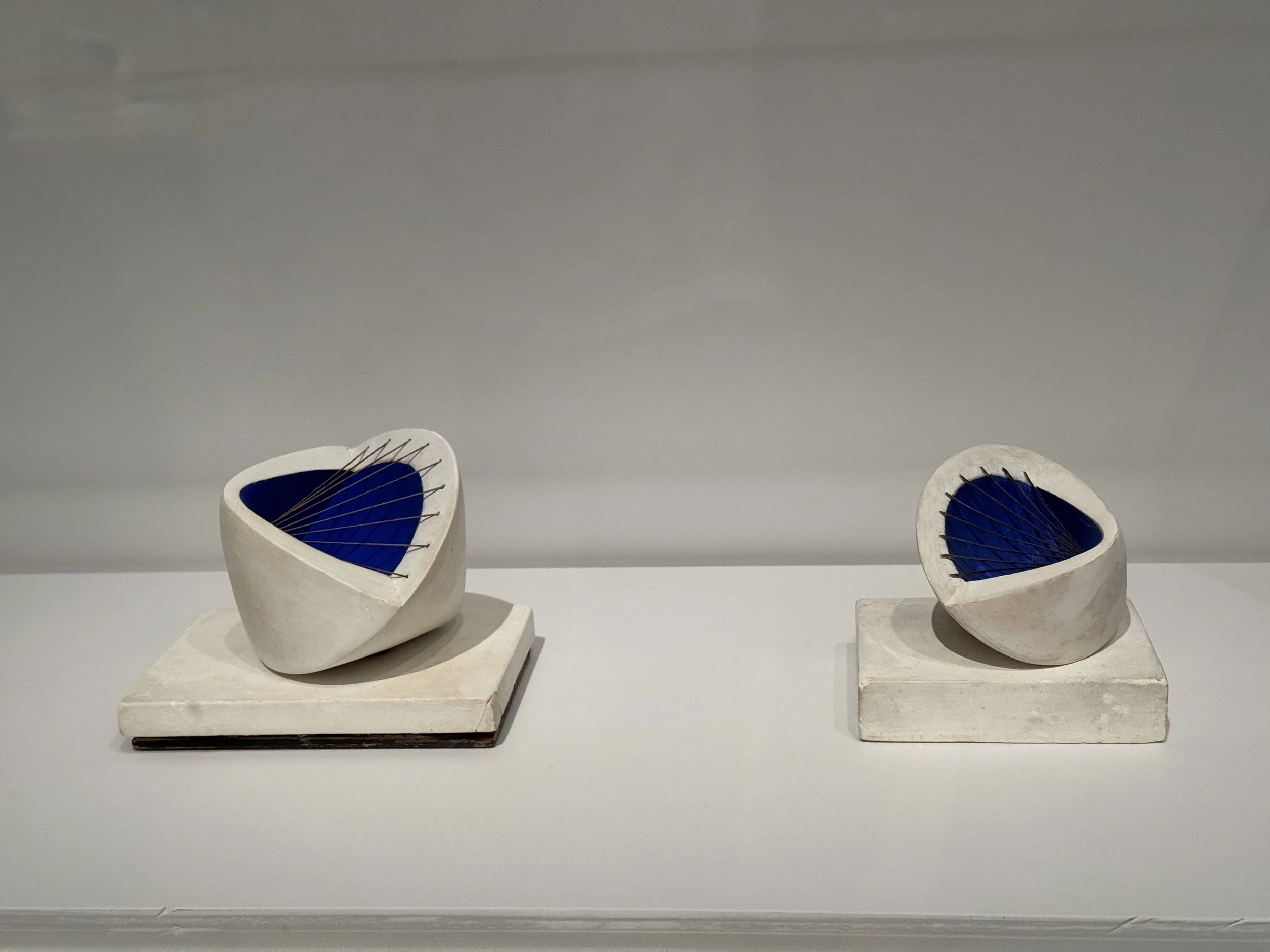
Hepworth in Colour, Courtauld Gallery. Image credit Alexandra Steinacker-Clark
According to the principles of “constructive colour” (i.e. the notion that certain hues provoke specific spatial or psychological effects on the viewer), the deep blue was chosen to give the impression of colour “receding into a space”, and the strings, which were once bright red, have now faded to a muted brown. Disappointingly, no note of any reference as to what the red could mean, was included. It left me questioning which principles of constructive colour was Hepworth playing to with her inclusion of the bright red in tandem with the blue? In other red and blue sculptures in the room, the red emanates more prominently. When addressing colour, and specifically colour and materiality in the context of Heptworth, this exhibition inadvertently nods to inevitable change over time. Although not directly addressed in any of the exhibition materials, these sculptures evoked thoughts of temporality and materiality, with the shifts in hue from exposure to elements or just exposure to time, causing a change to the visual nature of the sculptures themselves.

Installation view, The Joseph Hage Aaronson & Bremen Exhibition, Hepworth in Colour, Courtauld Gallery. Photo © Fergus Carmichael.
Pushing past the sculptures in the centre of the room and shifting focus to the walls, Hepworth’s drawings and paintings are on view. Many display slivers of colour, additions of blues, greens, and browns. Some of the drawings are studies for sculptures, but some are paintings in their own right. The inclusion of Hepworth’s painting palette, displayed in a case similar to her sculptures, pulls us for a brief moment into her practical process of creation. It feels like an act of metalepsis, or “breaking the fourth wall” in this small, intentional show. Of course, it makes sense to not only address the meaning and concepts behind her use of colour. As a lot of discourse around the artist is about the materiality of her work, it is only natural to pull at the same thread, to unravel the conversation around her physical and practical attitude towards painting and colour use, as well.
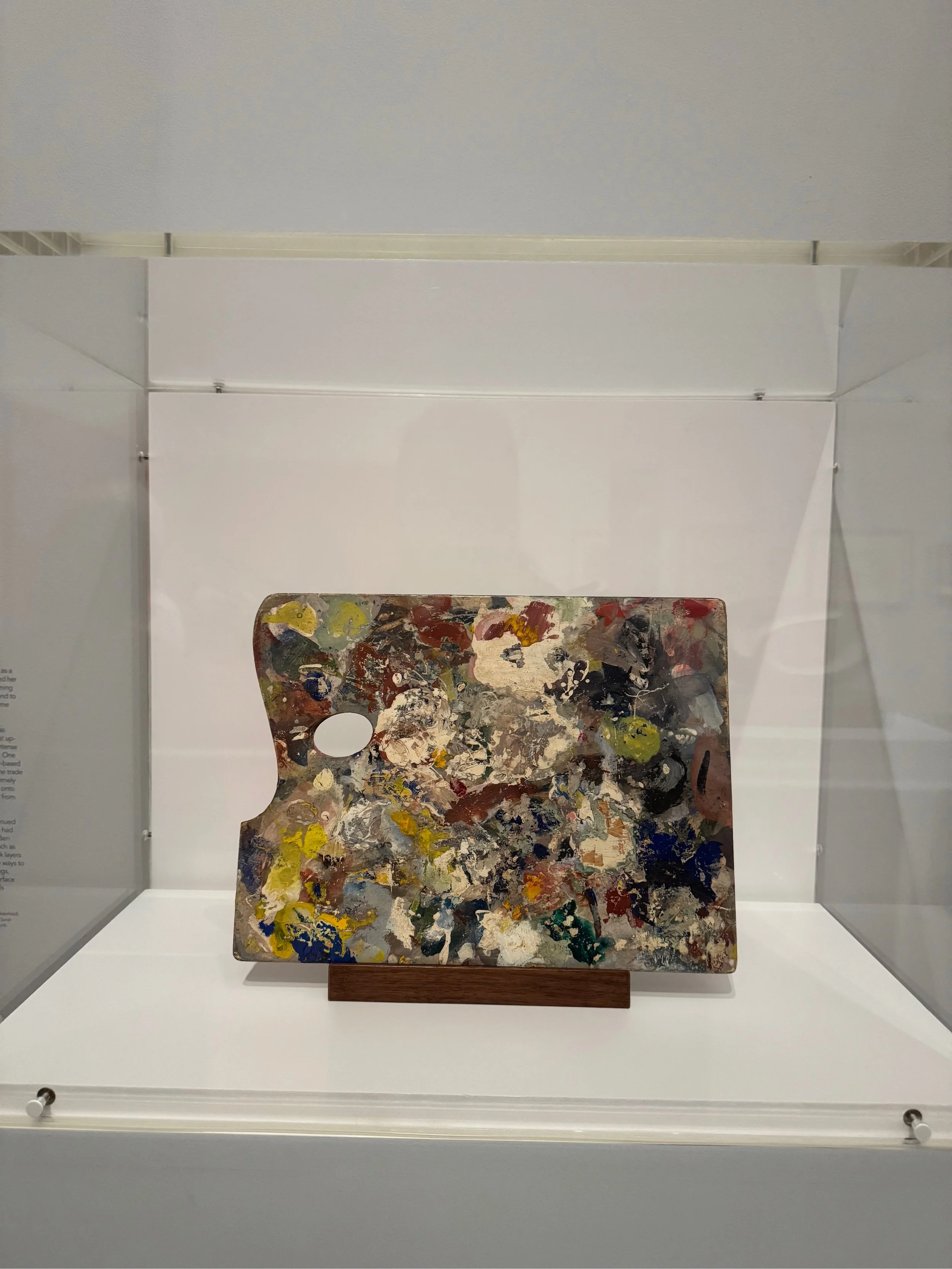
Hepworth in Colour, Courtauld Gallery. Image credit Alexandra Steinacker-Clark
It is well-known that Hepworth’s environment, her surroundings in Cornwall and its landscapes, had a large influence in her life and practice. What I found particularly interesting was her use of coloured materials - not only painting flat surfaces one solid colour, but also using patinas, paint, and coloured marble. Frankly, however, I did not find that the exhibition connected the dots here as well as it could have. There were a few sculptures that, upon first glance, looked as though they were sculpted out of various coloured marble. However, only two of the sculptures in this grouping were made from actual marble. One of Swedish marble, and one sourced from a quarry in Ireland. She spoke a lot about “taming” marble, and explained that,
“It was a new material that I hadn’t carved before. I don’t usually like a patterned marble, and I didn’t know how intense the markings would be until we began polishing the stone. They needed taming.”
As I read this, I thought that perhaps her will to tame the marble tied into a desire to tame a landscape. With the other two works, the ones that looked like coloured marble from afar but, upon closer inspection, were not, she uses techniques to emulate landscape. With one of the sculptures, Sea Form (Porthmeor), the bronze material is painted and the patination lends it an air of having spent its life under the sea. It’s almost as though she wanted control over the landscape or the material by emulating it, as an alternative to “taming” it through extensive polishing and sculpting of natural marble.
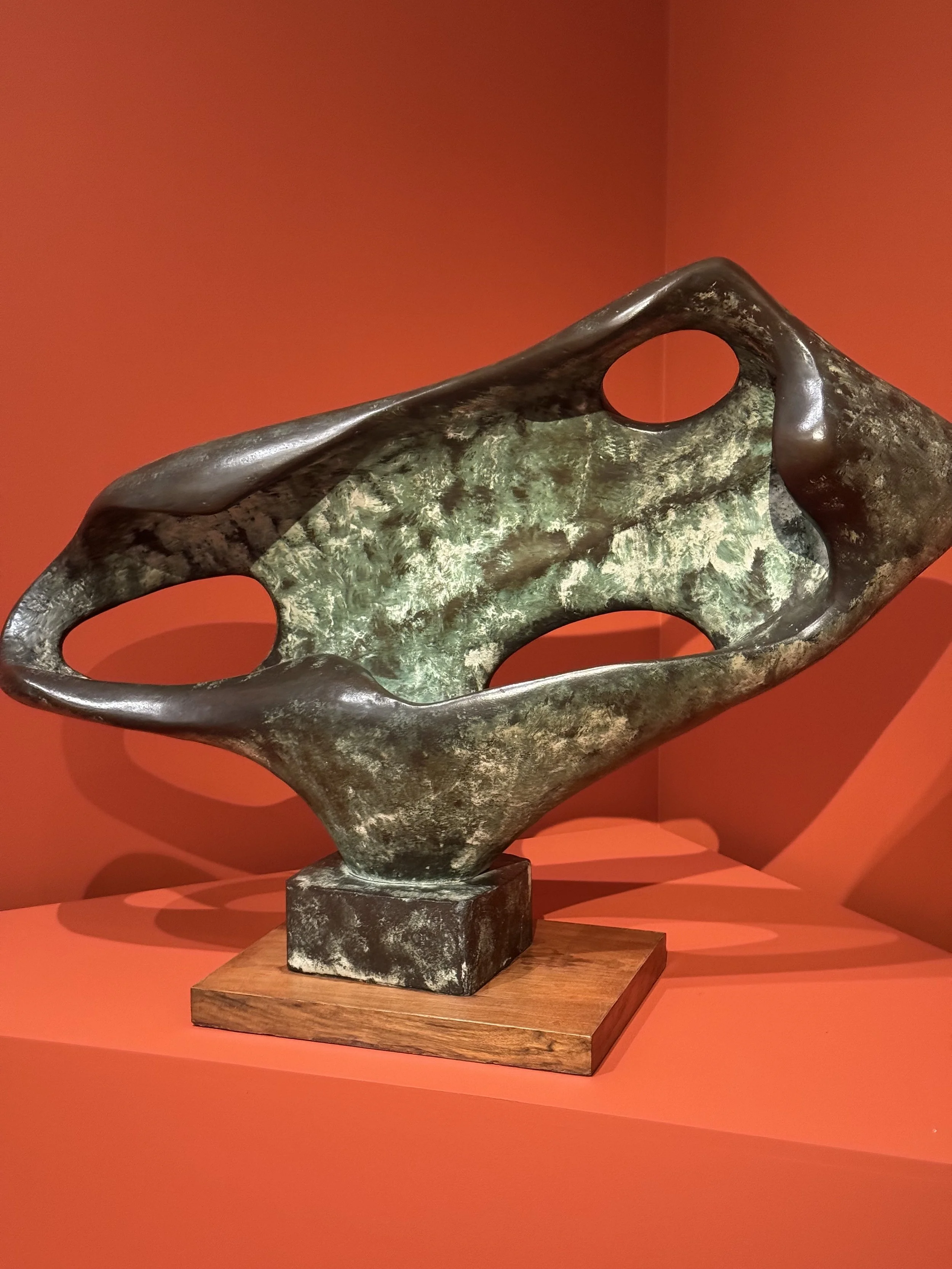
Hepworth in Colour, Courtauld Gallery. Image credit Alexandra Steinacker-Clark
At the end of the exhibition, one sculpture stands as an homage to artist Piet Mondrian and European modernism, which is a connection that felt satisfying having already noticed those influences of abstraction and deliberate use of colour in her drawings and paintings earlier in the show. On the way back down the staircase, I recommend keeping an eye out for a smaller display tucked away on a lower floor, Hepworth and Nicholson: The Hampstead Studio Photographs. Nicholson was Hepworth’s partner, and their shared studio in 1930s London became a hub for a group of artists that included Mondrian himself, forming a cornerstone of British modernism. The photographs offer an intimate continuation to the exhibition upstairs, a glimpse into the studio life behind the sculptures you’ve just spent an hour with.
Hepworth in Colour is on view at The Courtuald Gallery, 12 June – 6 September 2026. courtauld.ac.uk
Review by Alexandra Steinacker-Clark







Handmade in Ghana, this beautiful green apron offers a unique design with a front pocket perfect for kitchen utensils or your phone and tie neck straps each made from recycled material. The perfect gift for any cooking enthusiasts!
Our aprons have been named after markets in Ghana. This apron has been named after Kintampo Market located in the Bono region of Ghana it is noted for their sales of yam tubers.