
James McNeill Whistler at Tate Britain review
To this reviewer, the American-born James McNeill Whistler will always be a printmaker first, a painter second. Alongside his brother-in-law Francis Seymour Haden, who compiled one of the first catalogues raisonnés of Rembrandt's prints, the pair contributed heavily to the Etching Revival in 19th-century Britain. To everyone else, however, Whistler is the painter of nocturnes, family, and friends. Tate Britain's new exhibition – a successor to its 1994 counterpart – is a meeting of these two worlds, providing a comprehensive survey of Whistler's multidisciplinary output across painting, drawing, printmaking, and design.
In the first room, visitors are thrust into the material world of Whistler's studio, inspired by the Art Institute of Chicago’s The Artist in his Studio (1865-66). There are Japanese woodblock prints, Chinese Kangxi style porcelain from his own collection, as well as the artist’s painting equipment, and a recreation of a silk screen painted by the Japanese artist Ōzawa Nampo on one side, and by Whistler on the other. As we will discover later, his interest in Japonisme resulted in a fine blend of Western and Eastern approaches to composition throughout his work.
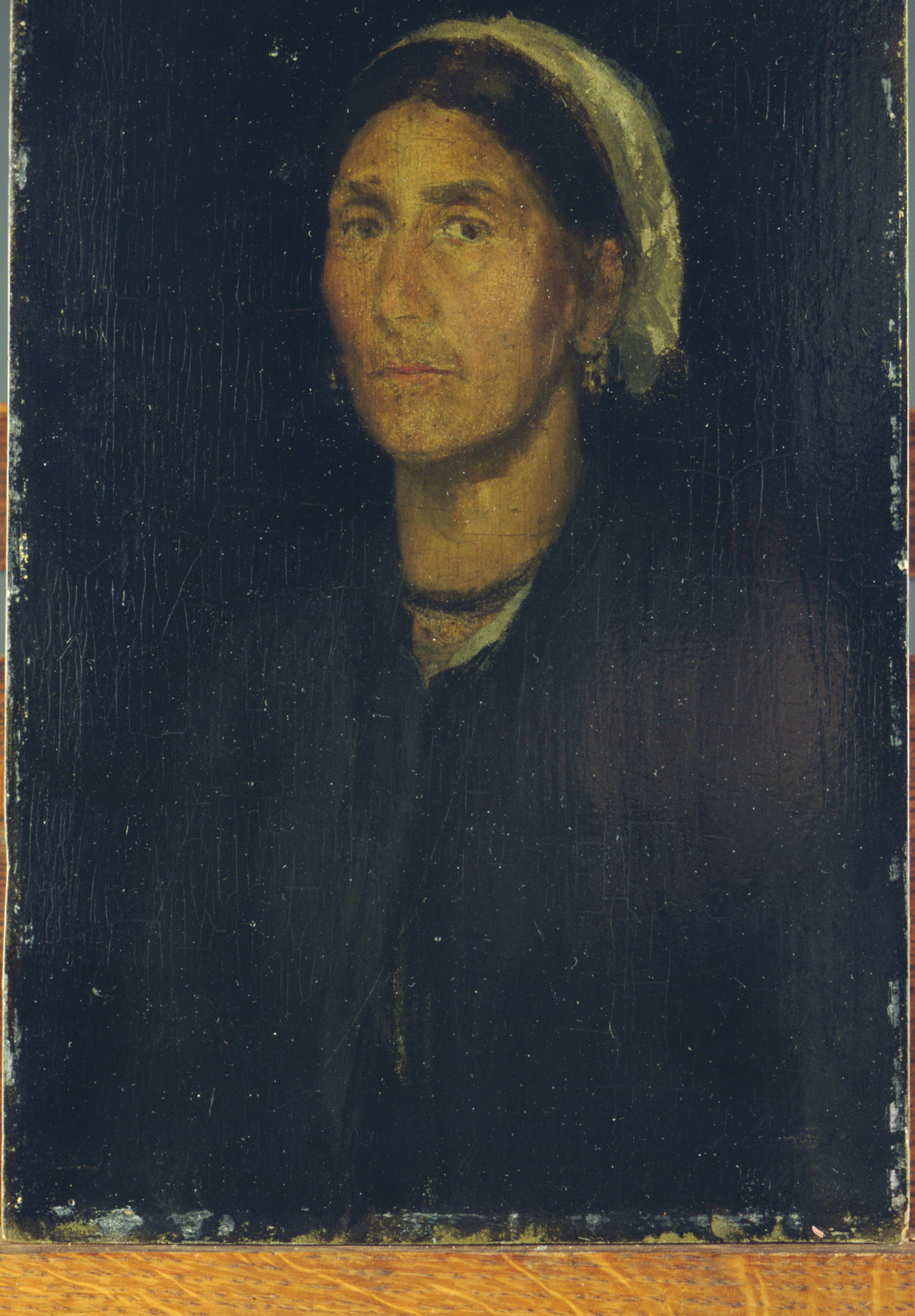
James McNeill Whistler, Head of a Peasant Woman, 1855–58. © The Hunterian, University of Glasgow.
This exhibition has a special interest in Whistler's painting technique, using certain pieces as case studies for investigating different levels of finish, such as the reunited pair of full-length portraits of his partner Maud Franklin. Some of these have recently undergone technical analysis or conservation treatment, specifically Head of a Peasant Woman (1855-58) – his earliest surviving portrait from his Paris years – Miss May Alexander (1874-75), Three Figures: Pink and Grey (1868-78), and Nocturne: Black and Gold – The Fire Wheel (1875).
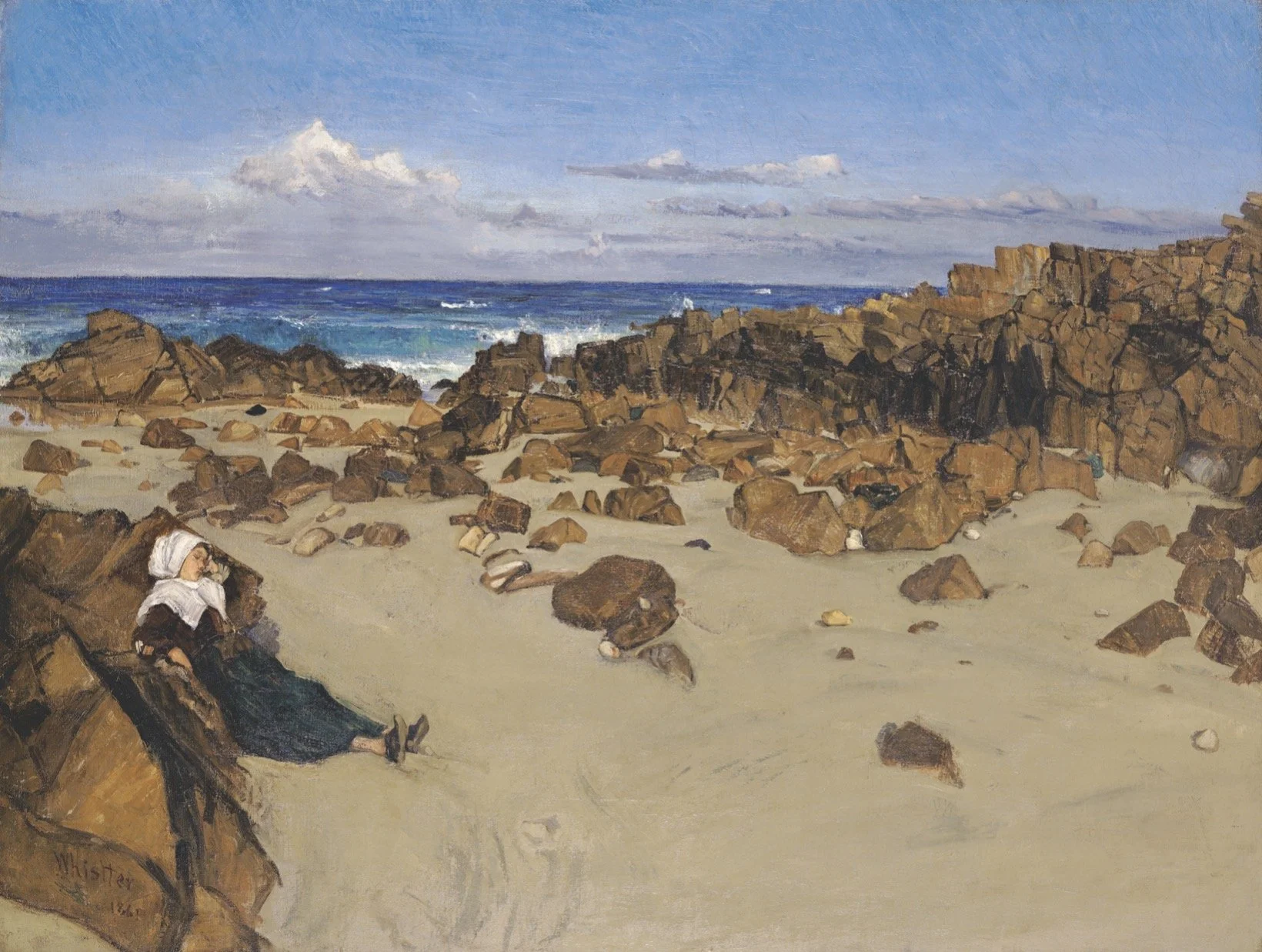
James McNeill Whistler, Coast of Brittany (Alone with the Tide), 1861. Wadsworth Museum of Art. In memory of William Arnold Healy, given by his daughter, Susie Healy Camp
The early rooms introduce Whistler as a prolific draughtsman, bringing together youthful drawings from as early as 14 years old shown here for the first time. They show the young artist taking inspiration from everything he could experience in Europe, such as books, music, and art. He also excelled as a printmaker long before his painting career, depicting friends and neighbours, and street scenes in Paris. In London, he drew his attention to the River Thames in a series of 16 etchings between 1859 and 1871. This period coincides with his earliest painted landscapes, of which The Coast of Brittany (Alone with the Tide) (1861) is a stunning example, as well as the various bridges along the Thames. Comparing Whistler’s view of Old Battersea Bridge with that of his friend Walter Greaves, the former seems to capture a beautiful stillness in an otherwise busy working environment. Tranquillity in urban spaces seems to be Whistler’s trademark, as one discovers later in a room devoted to his famous Nocturne paintings.

James McNeill Whistler Arrangement in Grey and Black No.1 1871 Musée d’Orsay, Paris, France.
Among the many highlights in the exhibition, Arrangement in Black and Grey: Portrait of the Painter's Mother (1871) is the big ticket. On loan from the Musée d’Orsay, the painting of Anna McNeill Whistler was last seen in London in 2006 at the National Gallery and was an important inclusion at the 1994 Tate Gallery exhibition of Whistler’s works. Although the picture was largely a failure in Whistler’s Britain, it gained international popularity when it was acquired in 1891 by the Musée du Luxembourg, Paris. Modern viewers may also recognise it from the 1997 film Bean, when it was accidentally defaced by Rowan Atkinson’s Mr Bean.

Installation view James McNeill Whistler at Tate Britain. Photo © Tate. Image credit Larina Fernandes.
Whistler’s career in designing for interiors is difficult to recreate in an exhibition context, particularly because it would be impossible – and unwise – to transport the Peacock Room overseas from Washington DC to London, his only surviving interior. Tate Britain’s solution is to replicate it with large reproductions, offering a convincing immersive experience with overhead audio commentary recounting Whistler’s quarrel with his client Frederick R. Leyland. But the gem in this room is the 1:1 scale pricked cartoon used to transfer the peacock design to one of the walls, in a manner akin to Italian Renaissance painters. The resulting mural of two fighting peacocks over a pool of silver shillings, L’Art et l’argent (The Art and the Money), is a veiled allusion to their transactional relationship.

James McNeill Whistler, Nocturne. c.1870-7. The White House © 2026 White House Historical Association.
One cannot talk about Whistler without mentioning his Nocturnes. This exhibition contains the largest gathering of these nighttime landscapes to date, featuring 10 oil paintings and six works on paper. The two atmospheric lithotints are a great addition to the ensemble, bridging the gap between his graphic etchings and the softness of the paintings. If there is one unmissable work, it would be Nocturne(c.1870-76) from the walls of the White House itself. Gifted to President John F. Kennedy in 1962, it has never left Washington DC since then.
Following Whistler’s bankruptcy after successfully suing John Ruskin for libel, the artist was forced to give up his home and studio, becoming a nomad around Britain and Europe. Digital tablets also prove access to the pages of four of his pocket sketchbooks which have been brought together for this show. The rest of the exhibition showcases his massive output of small landscapes and scenes of ordinary life – in painting and in print – and his return to society as a portrait painter in high demand. It also illustrates the way Whistler intended for his works to be hung and displayed, typically on plain white walls which were groundbreaking at the time. Room 7 includes a reconstructed arrangement of his First Venice Set etchings (1879-80) from his Fine Art Society exhibition in 1880. Unfortunately, The Venetian Mast and The Piazzetta have mistakenly traded places at Tate Britain, although they are correctly reproduced in the catalogue.

Installation view James McNeill Whistler at Tate Britain. Photo © Tate. Image credit Larina Fernandes.
I will end this review with a minor annoyance that only an art historian would care about, prompted mainly by one of the digital tablets illustrating the various printed states and impressions of Nocturne: Palaces (1879-80). The strength of the current exhibition is its vast representation of Whistler’s prints compared to the 1994 exhibition that featured only 26 etchings.
It also happens at a time when academic scholarship in this area is freely accessible online via the University of Glasgow’s Whistler Etchings Project (etchings.arts.gla.ac.uk), which meticulously lists and describes all the known features for every known state of his etchings. This awareness of differences in printmaking is highlighted in a digital tablet showing the various states of Nocturne: Palaces from early to cancelled impressions. Which begs the question: why do none of the captions mention which state impression is displayed?
While this reviewer appreciates wanting to create less cluttered captions that may be more accessible to the public, this small addition offers valuable insight into the challenges and journeys of creating prints, one that complements the exhibition’s underlying investigations into Whistler’s technical and creative processes. Otherwise, this is a fascinating show that offers a remarkable overview of the artist’s eclectic spirit and struggles.
Review by Nigel lp












Handmade in Ghana, this beautiful green apron offers a unique design with a front pocket perfect for kitchen utensils or your phone and tie neck straps each made from recycled material. The perfect gift for any cooking enthusiasts!
Our aprons have been named after markets in Ghana. This apron has been named after Kintampo Market located in the Bono region of Ghana it is noted for their sales of yam tubers.