
Selling a house with tenants in 2026: a London landlord's guide
For decades, the standard advice to a landlord who wanted to sell was simple: serve a Section 21 notice, wait for the tenant to leave, then sell with vacant possession at the best price. Since 1 May 2026, that route no longer exists. Section 21 has been abolished, and getting a tenant out now means proving a legal ground in court, with a minimum four months' notice attached.
That single change has pushed many landlords toward a route they would once have avoided: selling with the tenant still living there. It is not always the most profitable option, but for landlords who need to move quickly it has become the more realistic path. Here is what actually changes when you sell with a tenant in place.

Key Takeaways
Section 21 no-fault evictions ended on 1 May 2026 under the Renters' Rights Act 2025.
Landlords who want vacant possession must now use Ground 1A, with at least four months' notice.
Ground 1A cannot be used within the first 12 months of a tenancy.
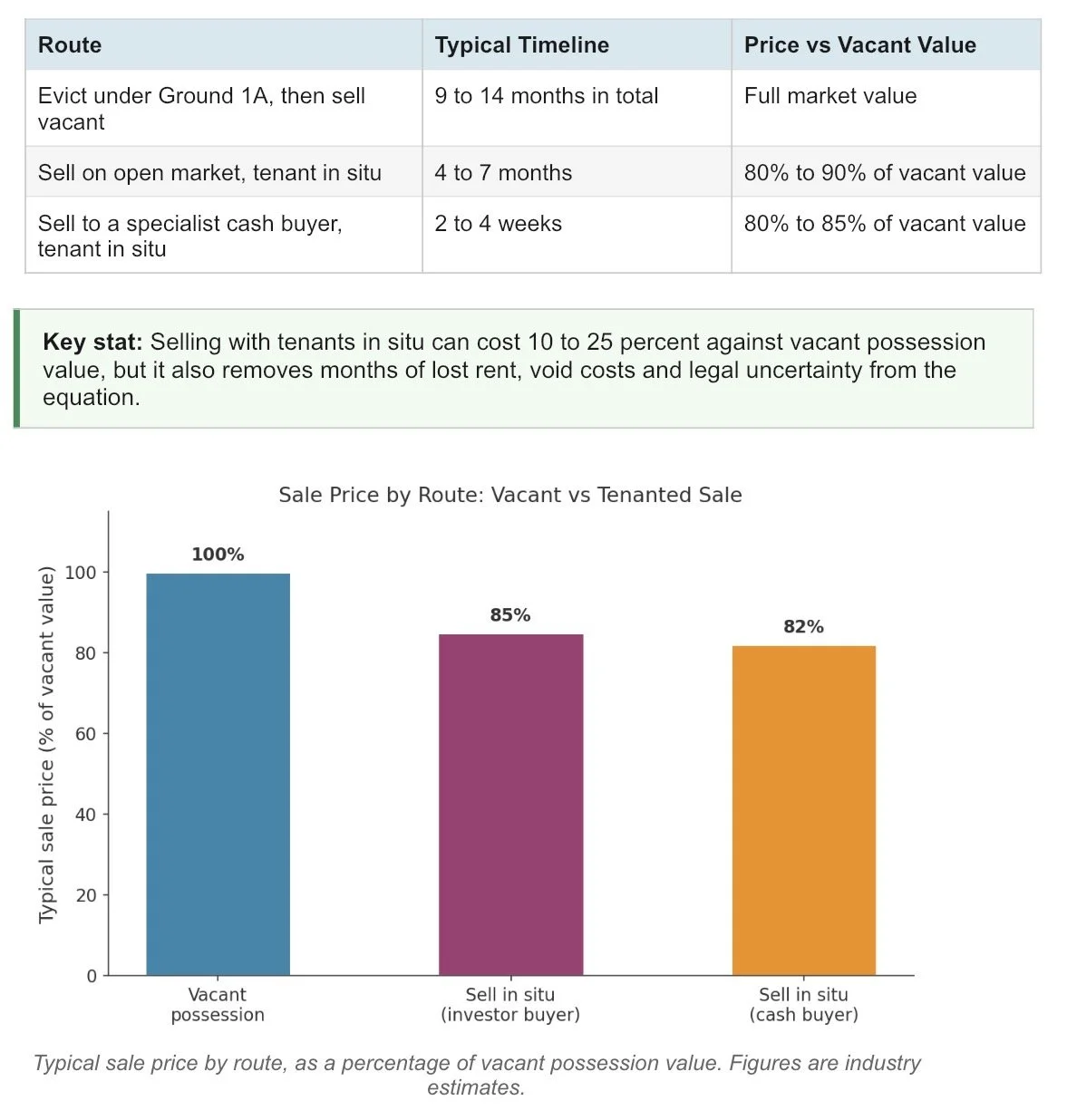
Selling with a tenant in situ typically achieves 10% to 25% less than vacant possession value.
The tenancy, deposit and all landlord obligations transfer automatically to the buyer on completion.
Why the End of Section 21 Changes the Calculation
Until 1 May 2026, a landlord who wanted their property back simply served a Section 21 notice and waited two months, no reason required. The Renters' Rights Act 2025 removed that option entirely.
Every existing tenancy converted automatically to a rolling periodic tenancy, and landlords who want possession to sell must now rely on Ground 1A under a Section 8 notice. According to the government's own guidance for landlords, Ground 1A requires a minimum of four months' notice and cannot be used at all within the first 12 months of a tenancy.
There is a further catch. Landlords who gain possession under Ground 1A are barred from re-letting the property for 12 months afterwards, with substantial penalties for breaching that restriction. For a landlord simply hoping to sell quickly, that combination of delay and restriction has made the traditional evict-then-sell route considerably less attractive than it used to be.

Can You Actually Sell a House With a Tenant Still Living There?
Yes, and it is entirely legal in England and Wales. A tenancy is a contract that runs with the property, not with the individual landlord, so when ownership changes the tenant's rights simply transfer to whoever buys it. No notice needs to be served on the tenant purely because the property is changing hands. Specialist local knowledge matters here, and this is exactly where an experienced agent earns their fee: getting comfortable with the process of selling house with tenants means finding the right buyer pool, since most owner-occupiers will not consider a tenanted purchase at all.
For landlords who own a buy-to-let in Bow, Bermondsey, Surrey Quays or anywhere else in South East London, this route has genuinely become the default for anyone who cannot wait out a Ground 1A notice and a possible court process.
The buyer effectively steps into the seller's shoes. They inherit the existing tenancy agreement on its current terms, the protected deposit, and every compliance obligation that goes with being a landlord, from gas safety checks to the property's Energy Performance Certificate.
What It Actually Costs: The Discount Against Vacant Possession
Selling with a sitting tenant is rarely the route to the highest possible price, and it is worth going in with realistic expectations. Because the buyer pool narrows to investors and portfolio landlords rather than owner-occupiers, tenanted properties typically sell for 10% to 25% less than the same property with vacant possession.
The exact discount depends heavily on the rent being charged. A tenant paying close to full market rent on a standard periodic tenancy is a far more attractive asset to a buyer than one on a below-market legacy rent, since the new owner's return is built directly into the numbers.
Who Actually Buys a Tenanted Property
The buyer pool for a tenanted home is narrower and more specialised than for a standard sale. Most residential mortgage lenders will not touch a property with sitting tenants at all, which rules out the majority of owner-occupier buyers before they even view it.
Buy-to-let lenders that will consider tenanted purchases usually apply stricter criteria: higher minimum deposits, often 25% or more, along with closer scrutiny of the rental income against the mortgage payment. That narrows the realistic buyer pool down to cash buyers, experienced portfolio landlords and specialist property investment companies.
This is precisely why marketing matters so much for a tenanted sale. An agent who already has relationships with local investors and portfolio landlords can put a property in front of genuinely interested buyers far faster than a standard listing aimed at the general public.
The Paperwork You Need to Get Right
A tenanted sale carries more administrative weight than a standard one, and getting it wrong can leave the new owner, and by extension you, exposed to a compliance breach. A handful of documents matter most:
A full copy of the current tenancy agreement, including any variations agreed since it started.
Proof the deposit is registered with a government-approved tenancy deposit scheme.
Current gas safety record, electrical safety certificate and Energy Performance Certificate.
A record of the rent payment history and any arrears or disputes.
Under the Landlord and Tenant Act 1985, a new landlord must notify the tenant of the change of ownership within two months of the sale completing. Missing this step is a common and entirely avoidable mistake that can create friction with a tenant who has done nothing wrong.
Talking to Your Tenant Before You List
Cooperation from the tenant makes a tenanted sale significantly easier, and a blindsided tenant is far more likely to be difficult about viewings. Most landlords find it pays to explain the situation early, before the property goes anywhere near a portal listing.

Reassurance matters as much as notice periods. A tenant who understands that a sale to another landlord will not automatically affect their tenancy is generally far more willing to accommodate viewings than one left to assume the worst.
Choosing the right agent to manage that relationship matters too; FLO London has previously covered how some letting agents get this badly wrong, which is exactly the kind of experience a tenanted sale cannot afford.
Frequently Asked Questions
Can a landlord sell a house with a tenant living in it?
Yes. It is entirely legal in England and Wales. The tenancy transfers automatically to the new owner on completion, and no notice needs to be served purely because the property is being sold.
How much less does a tenanted property sell for?
Typically 10% to 25% less than the equivalent property with vacant possession, largely because the buyer pool narrows to investors rather than owner-occupiers.
What is Ground 1A and when can it be used?
Ground 1A is the mandatory possession ground introduced by the Renters' Rights Act 2025 for landlords who genuinely intend to sell. It requires at least four months' notice and cannot be used within a tenancy's first 12 months.
Do I need to evict my tenant before selling?
No. You can sell with the tenant remaining in place, and many landlords now prefer this route given how much longer eviction under Ground 1A takes compared with the old Section 21 process.
What happens to the tenant's deposit when the property is sold?
It transfers to the new landlord, who becomes responsible for keeping it protected in a government-approved scheme and returning it correctly at the end of the tenancy.
The Bottom Line
Selling with a tenant in place is no longer the fallback option it once was. With Section 21 gone and Ground 1A carrying a four month minimum notice plus a 12 month re-letting ban, many landlords are finding that a slightly lower sale price is a reasonable trade for a faster, more certain exit.
The right route still depends on individual circumstances, the strength of the tenancy, and how much time pressure a landlord is actually under. For a wider view of what is shaping the London sales market more broadly, our look at the challenges facing London property sellers today covers some of the same pressures from the other side of the transaction, and our piece on how cash house buyers are changing the selling process is worth a read for landlords weighing up a fast, tenant-friendly exit.
References
GOV.UK, Renters' Rights Act: an overview for landlords. https://www.gov.uk/guidance/renters-rights-act-an-overview-for-landlords
Legislation.gov.uk, Landlord and Tenant Act 1985. https://www.legislation.gov.uk/ukpga/1985/70
Fact Check: All statistics and data points in this article were verified against original sources as of 9 September 2026. Sources are listed in the References section above.





































Handmade in Ghana, our aprons offer a unique design with a front pocket perfect for kitchen utensils or your phone and tie neck straps each made from recycled material. The perfect gift for any cooking enthusiasts!
Our aprons have been named after markets in Ghana and London. This apron has been named after street food hub Maltby Street Market.