
The Bayeux Tapestry at the British Museum review
There is no doubt the temporary loan of the Bayeux Tapestry, also known as the Canterbury Embroidery, to the British Museum is the once-in-a-lifetime experience to rule them all. Meticulously stitched by hand by talented women, the embroidery has never returned to English soil in over 900 years since its creation around the 1070s. Although many worried for its fragile condition, visitors lucky enough to bag the £33 ticket will have a 40-minute experience to brag about for the rest of their lives.
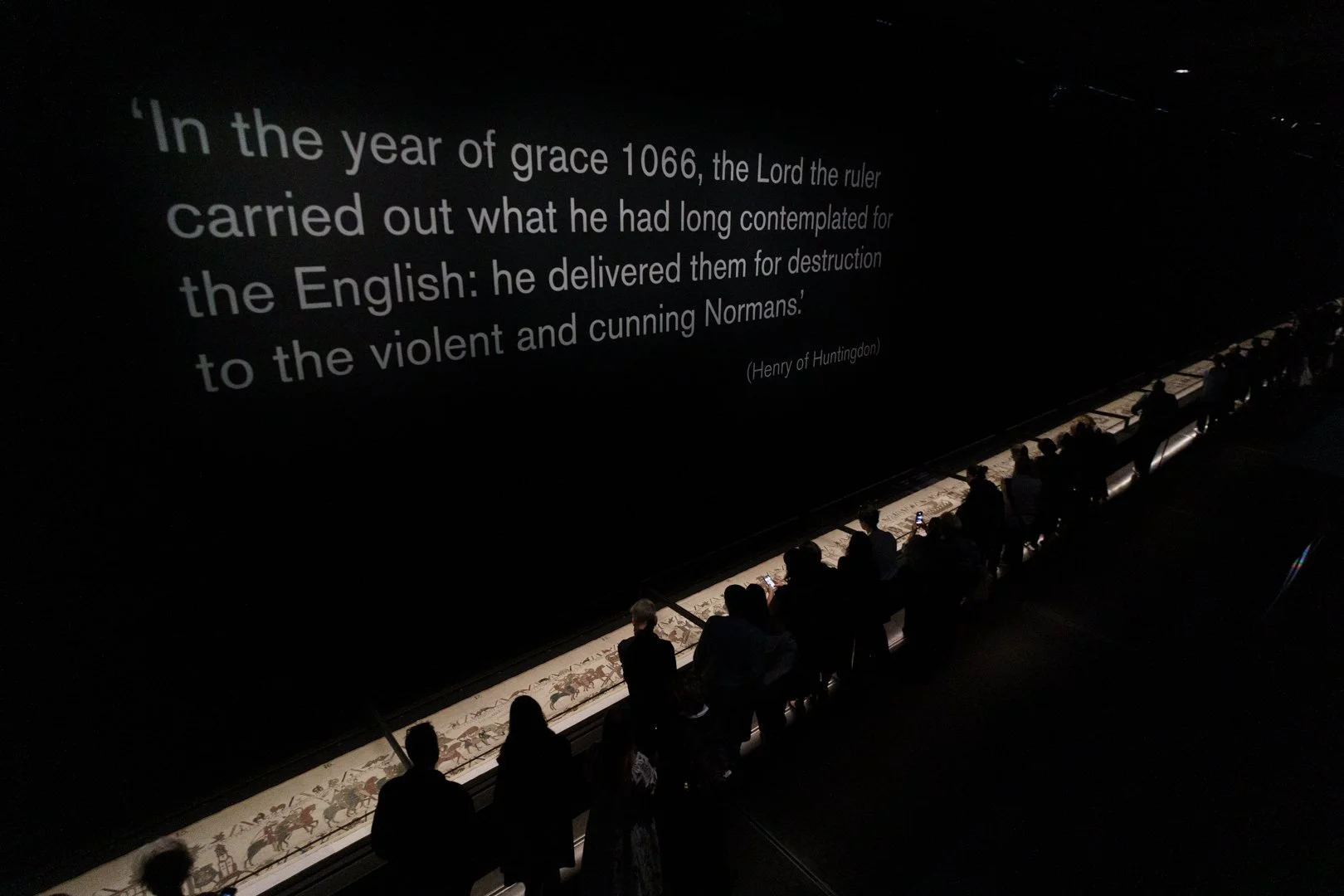
Installation view the Bayeux Tapestry, British Museum. Image credit Nigel lp
Setting the scene in the prelude are a small selection of objects that introduce us to the material and narrative context of the Tapestry, although their overall contribution is negligible. Near the entrance, 11th-century arms and armoury prepare us for the extensively illustrated attire of the English and Norman armies.
Meanwhile, on an elevated platform in the main space, acarved ivory head of a Tau crozier found in Alcester is linked to Bishop Odo’s own symbols of office. The so-called Caedmon manuscript also shows us the visual language and source material underpinning the Tapestry’s enduring aesthetic.
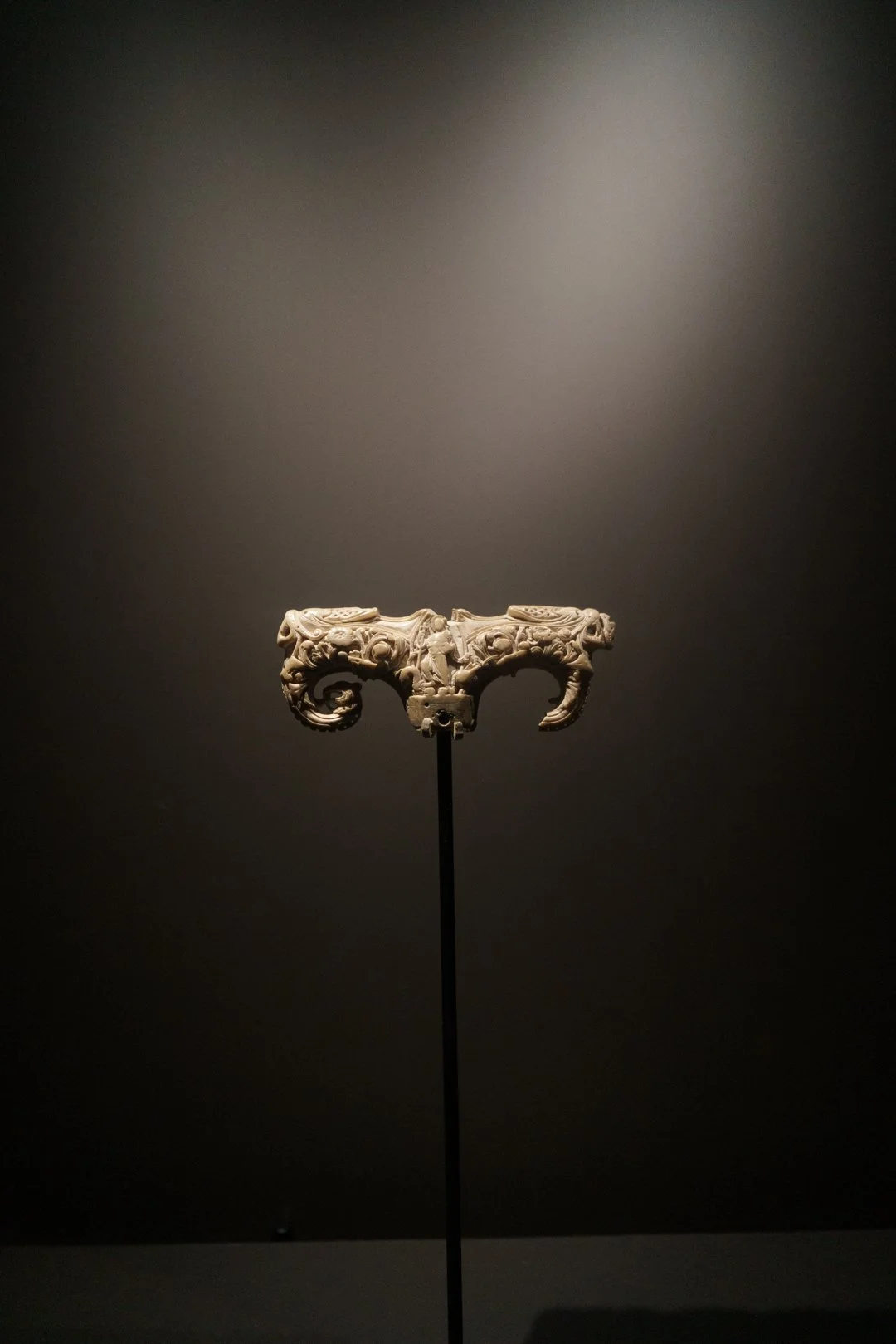
Ivory head of a Tau crozier, the Bayeux Tapestry, British Museum. Image credit Nigel lp
Much more pertinent to the characters in the embroidery, we can also see the Wheathampstead charter, which was issued by King Edward ‘the Confessor’ in 1060 to grant land in Hertfordshire to Westminster Abbey, with Earl Harold II ‘Godwinson’ and his sister Queen Edith as witnesses.
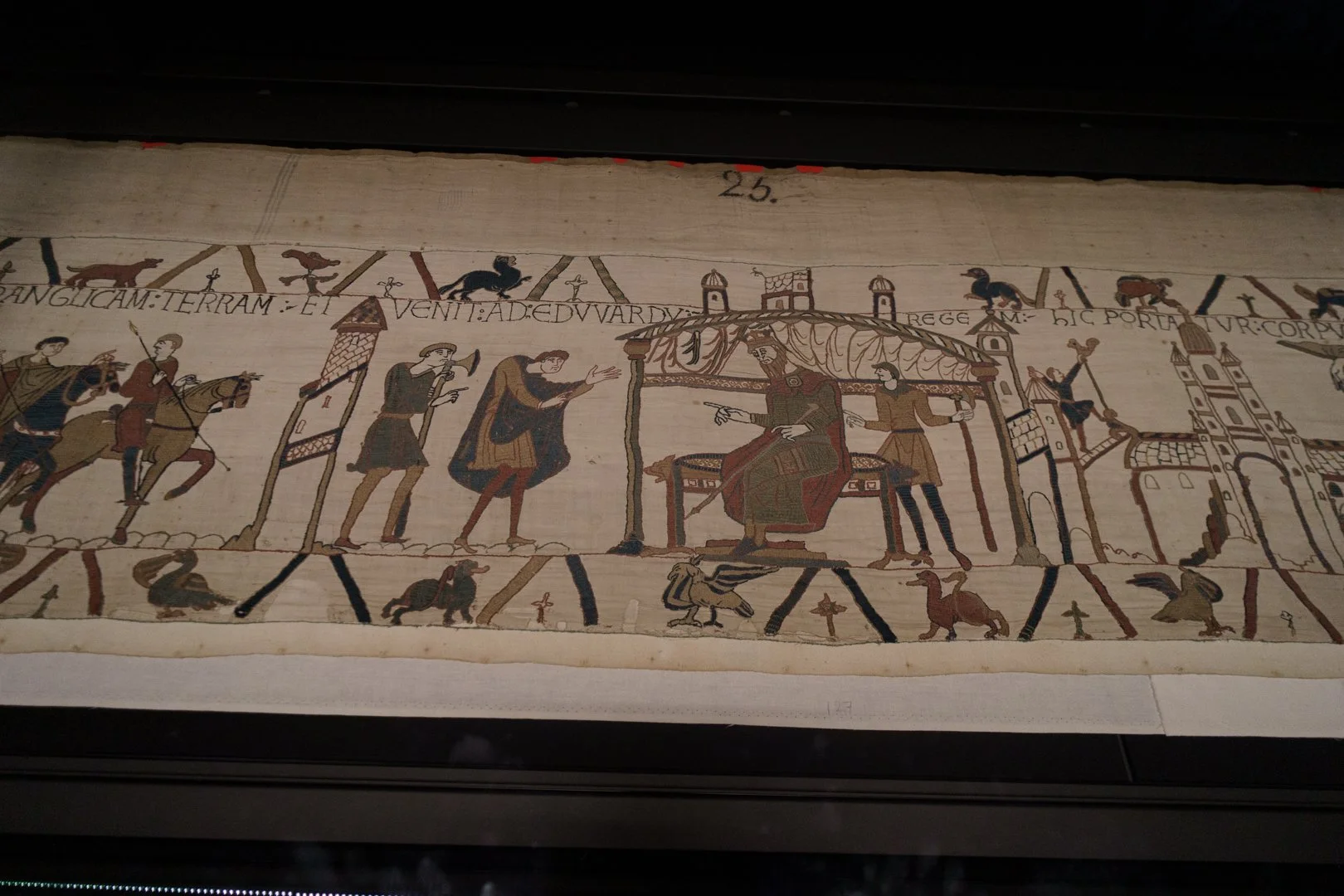
Section of the Bayeux Tapestry, British Museum. Image credit Nigel lp
From atop this generously spacious platform, visitors can take in the Tapestry’s sheer size and scale, measuring an impressive 68.3 metres, before diving into its details up close. Serving almost as a teaser to the Bayeaux Tapestry Museum’s renovation, the innovative display solution has enabled the embroidery to be shown completely flat from end to end. At Bayeaux, a new purpose-built gallery will offer the same experience but better, presenting it at a tilt for easier viewing. It is expected to reopen in 2027.
Starting from 1064, the Bayeux Tapestry recalls the events leading up to the Battle of Hastings on 14 October 1066 in 58 remarkably legible scenes. Besides surviving written accounts, the embroidery with its quirky interplay of text and image is the only visual testimony of the events that transpired at this time. It probably functioned as a wall hanging, commonly found in English homes in the 10th and 11th centuries.
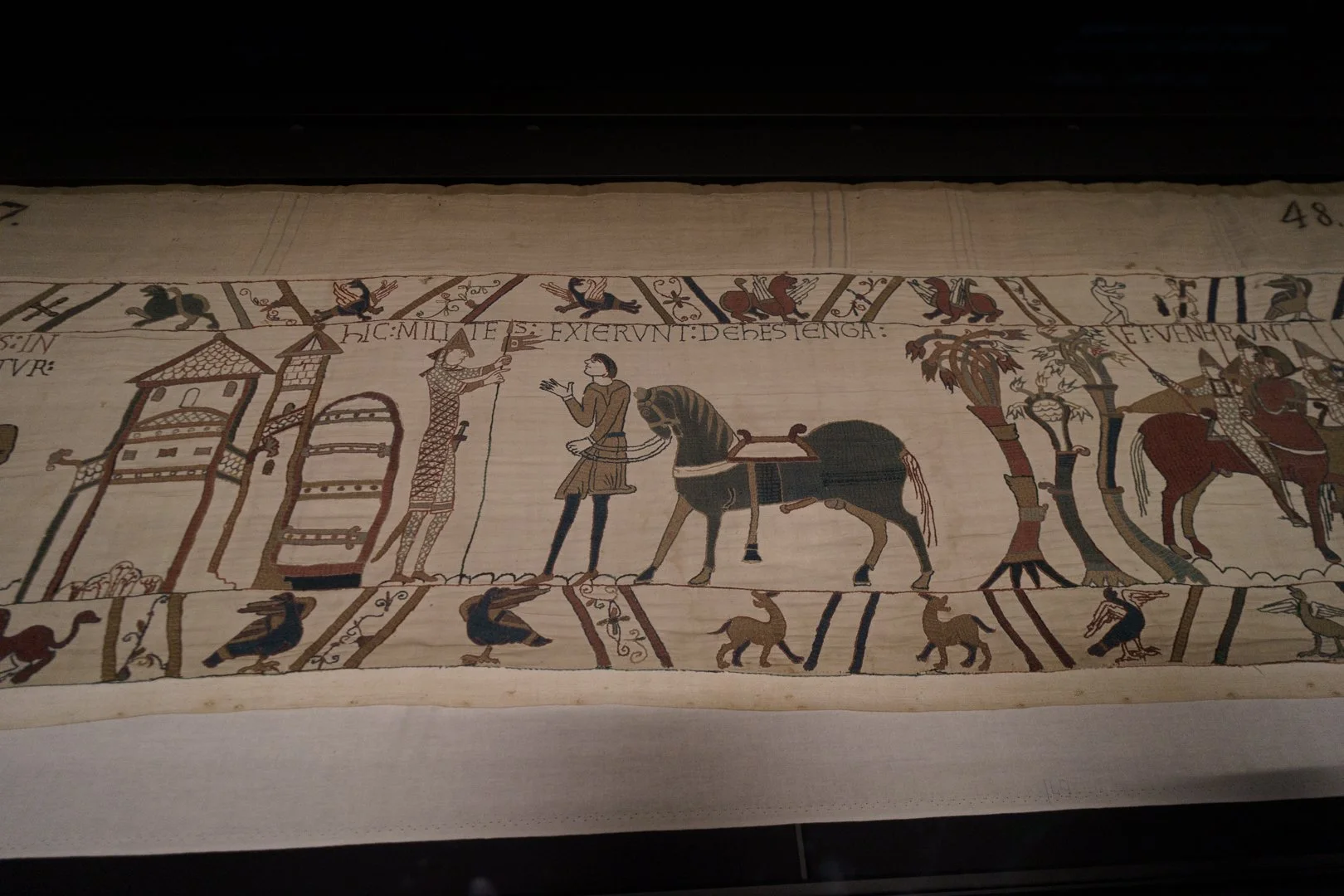
Section of the Bayeux Tapestry, British Museum. Image credit Nigel lp
After speaking to the ageing, childless King Edward, Harold journeys to the port of Bosham and crosses the English Channel to Normandy, before being captured by a local lord, Count Guy of Ponthieu, in 1065. William of Normandy finds out about this, and, after some persuading, Harold is released and eventually joins him on a victorious campaign against Duke Conan II of Brittany.
To show his admiration, William and Harold exchange armour, and at the former’s palace in Bayeux, Harold swears ‘a sacred oath to William’ between two holy reliquaries. Whatever this oath may have been, Harold’s return to the motherland coincides with Edward’s death and therefore his own coronation, which angers William and leads him to build an army and initiate the Norman invasion. Harold ultimately dies and the English soldiers are shown fleeing from Norman cavalry until the embroidery abruptly ends. Theories suggest the missing closing scene may have depicted the coronation of William ‘the Conqueror’ as king of England.
The exhibition closes with a charter issued by King William I to the City of London in 1067, as well as the changing faces of English silver pennies following Harold’s succession to the throne, and when William defeats Harold.
Viewing the Tapestry is a surprisingly cinematic experience comparable to modern-day adaptations of epics like The Odyssey, even incorporating flashbacks and elements of narrative foreshadowing, such as Edward’s funeral procession into Westminster Abbey and the boats beneath Harold’s coronation scene.
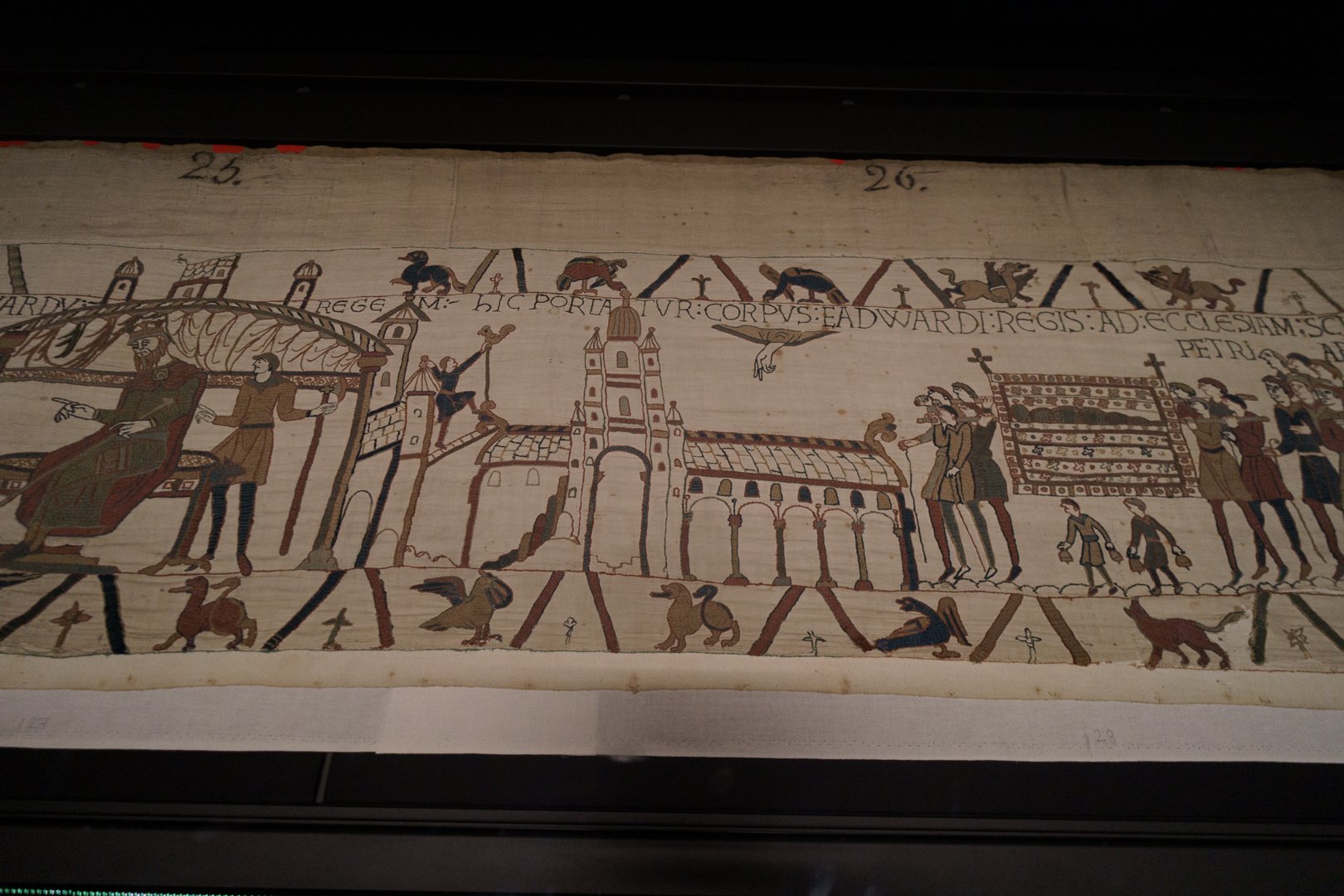
Section of the Bayeux Tapestry, British Museum. Image credit Nigel lp
In the last third, William’s invading ships break the frame and disrupt the upper border normally decorated with animals. Similarly, the tragic scenes from the Battle of Hastings are characterised by dead, even decapitated soldiers, in the lower border, extending the pictorial space and intruding into ours. This is a remarkably visceral experience, and its impact must have been felt by the women that made it, some of whom may have had husbands and sons among the unfortunate casualties.
What is fascinating about this landmark exhibition is the myriad ways of reframing the Bayeux Tapestry. Recently, much attention has been given to the fact only six women are depicted across the entire span of the embroidery – three in the central frieze, and three in the borders – as well as the identity of Aelfgyva who is seemingly being molested by a male cleric. As a result, academic discourse is reclaiming the voices of women related to the Tapestry, not only as silent subject matter but as capable makers meriting rediscovery.
Of course, one could also find enjoyment in discovering that 93 penises are rendered throughout – 88 equine and five human – or attempt to resolve the mystery behind Harold’s double portrayal in his famous death scene. Fun fact: the arrow through the first Harold’s eye is likely to have been added by 19th-century restorers, having originally held a spear.
As a first-time witness of the Tapestry, my favourite moment is seeing the earliest known depiction of Halley’s Comet, widely considered to be a bad omen that led to Harold’s downfall. But I was also equally giddy when I spotted the iconic oath scene, a distant memory from learning about it in primary school.
Whether one considers the Bayeux Tapestry exhibition good value for money or not, the impact of its current afterlife is clear. No one can deny that this loan was political courtesy at its finest, and perhaps it was for the better because it introduced new audiences to its existence, old audiences to untapped nostalgia and national pride, and it fostered discussions about the value of cultural artefacts in a society that increasingly devalues the importance of the humanities.
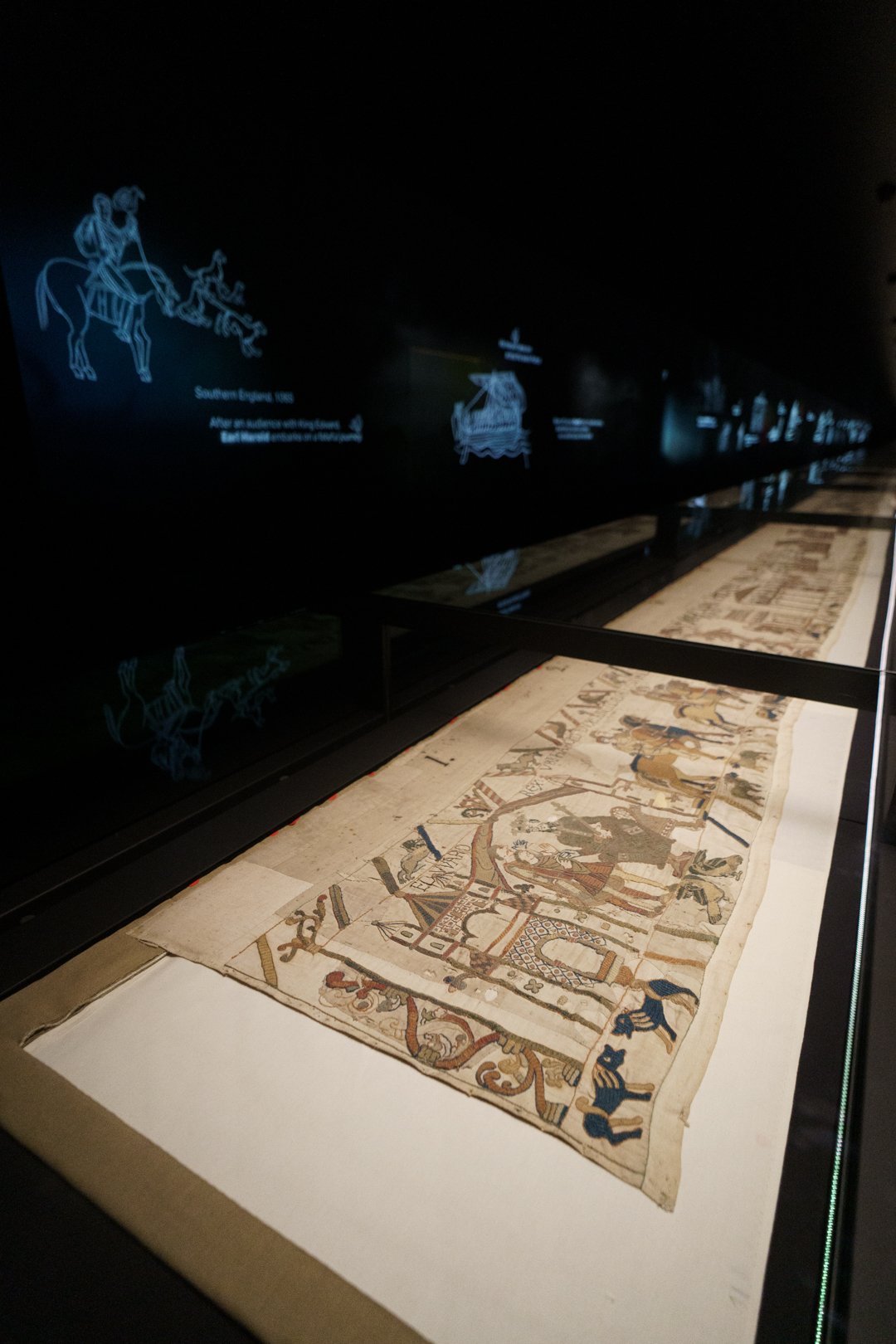
Section of the Bayeux Tapestry, British Museum. Image credit Nigel lp
The bottom line is this. If you can’t get tickets, you’re not missing much. It’s practically a one-woman show with side characters that barely contribute to an already high-stress viewing environment. In fact, it is heartbreaking that the Bayeux Tapestry’s precious status actively prevents the possibility of including it in a much broader exhibition devoted to the Norman Conquest, one that could more effectively contextualise its rich visual and material imagery.
Save your money and go to Bayeux next year. The demand is already high enough.
The Bayeux Tapestry is on display at the British Museum from 10 September 2026 to 11 July 2027. Tickets for 2026 dates are currently sold out, but the next release, on 21 October, will cover visits between January and March 2027. britishmuseum.org.
Review by Nigel lp














Handmade in Ghana, this beautiful green apron offers a unique design with a front pocket perfect for kitchen utensils or your phone and tie neck straps each made from recycled material. The perfect gift for any cooking enthusiasts!
Our aprons have been named after markets in Ghana. This apron has been named after Kintampo Market located in the Bono region of Ghana it is noted for their sales of yam tubers.