
Van Eyck: The Portraits at the National Gallery review
There are very few major artists quite as elusive as Jan van Eyck. We know practically nothing about his early life, including the date and location of his birth. His surviving artistic output numbers roughly 22, and any public collections that own them are hard-pressed to loan out these national treasures. Yet, the National Gallery has seemingly done the impossible, gathering all nine of van Eyck’s surviving independent portrait paintings and his only known fully autograph drawing in a three-room exhibition that celebrates the pioneering achievements of early Netherlandish portraiture.
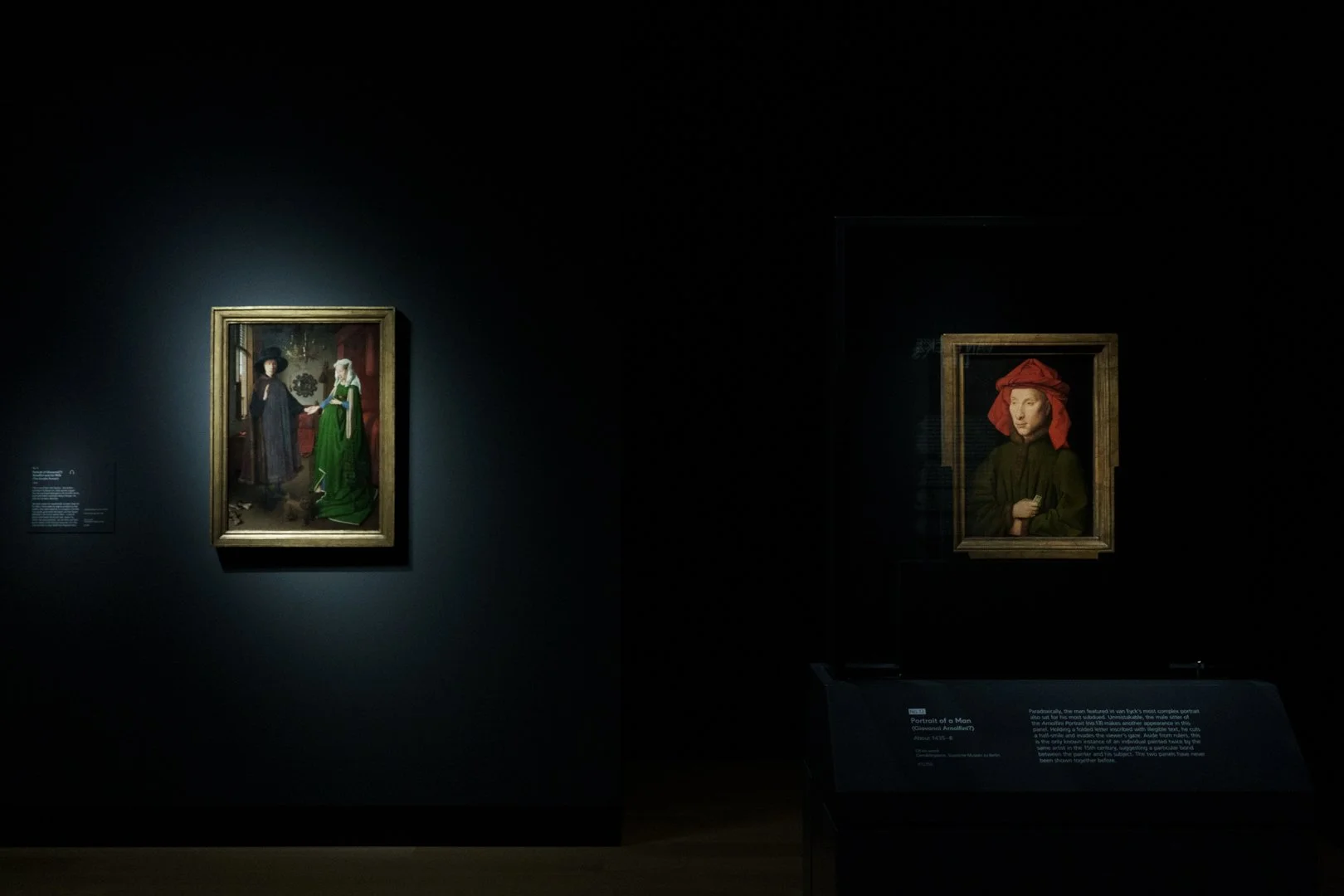
Installation view Van Eyck: The Portraits, National Gallery. Image credit Nigel lp.
We come face-to-face with the artist in the opening room. Donning a dramatic red headdress (chaperon) in three-quarter profile, van Eyck’s piercing eyes meet ours from as far back as the entrance to the exhibition. Or is he?
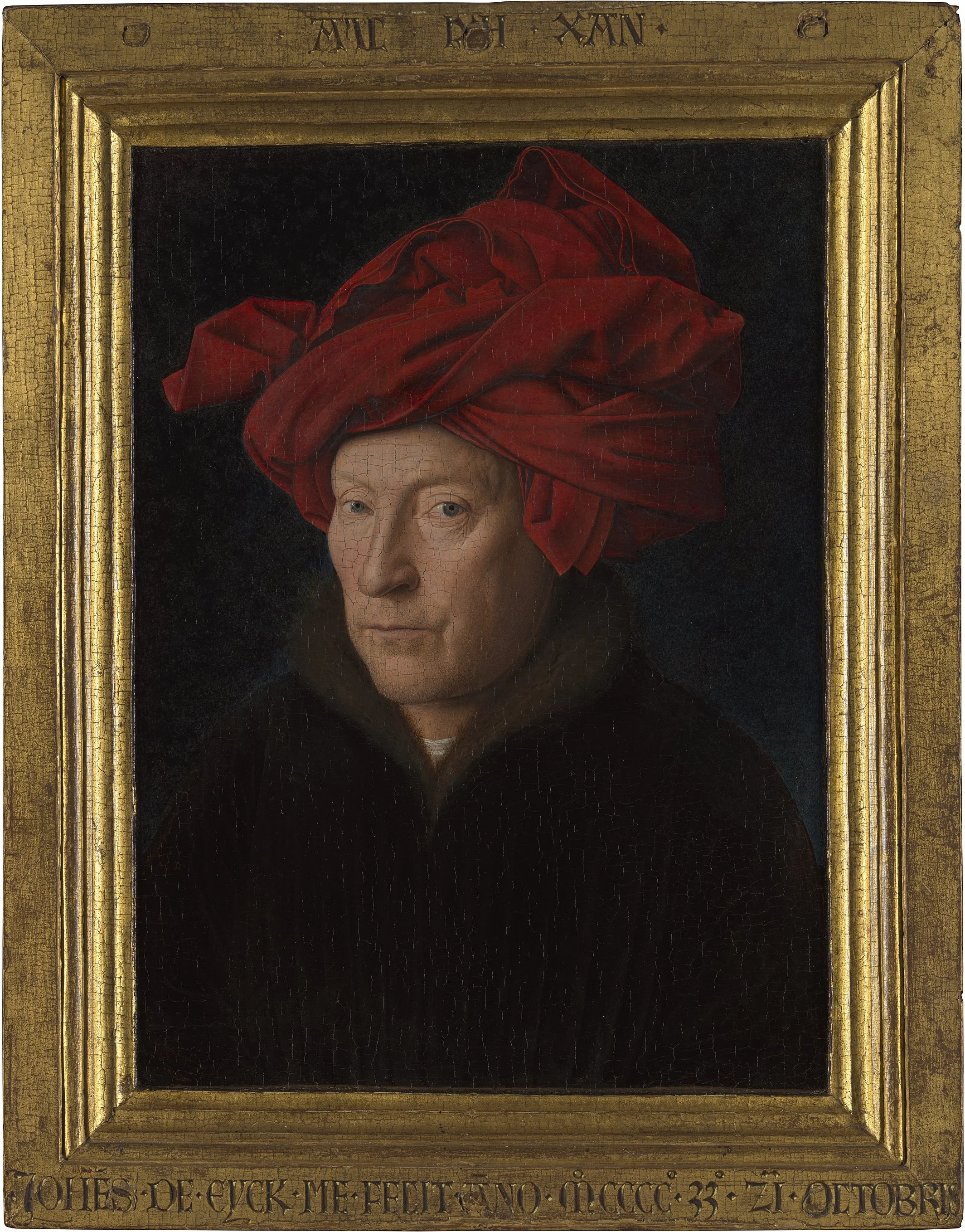
Jan van Eyck, Portrait of a Man (Self Portrait?),1433, oil on wood. 33.1 x 25.9cm (including original frame). © The National Gallery, London
Since 1655, in the inventory of Alathea Talbot, Countess of Arundel, the National Gallery painting was described as ‘a portrait of Jan van Eyck by his own hand’ and this identification has largely remained uncontested up to the present day. The artist’s famous ‘Als ich can’ (As I can) motto– a wordplay on his surname – is prominently inscribed on the upper moulding of the original painted frame, while the bottom is signed and dated 21 October 1433, one of just nine paintings in the world signed by van Eyck, according to the Closer to Van Eyck project website. All these features, including the eye contact with the viewer, strongly support the theory of a self-portrait.
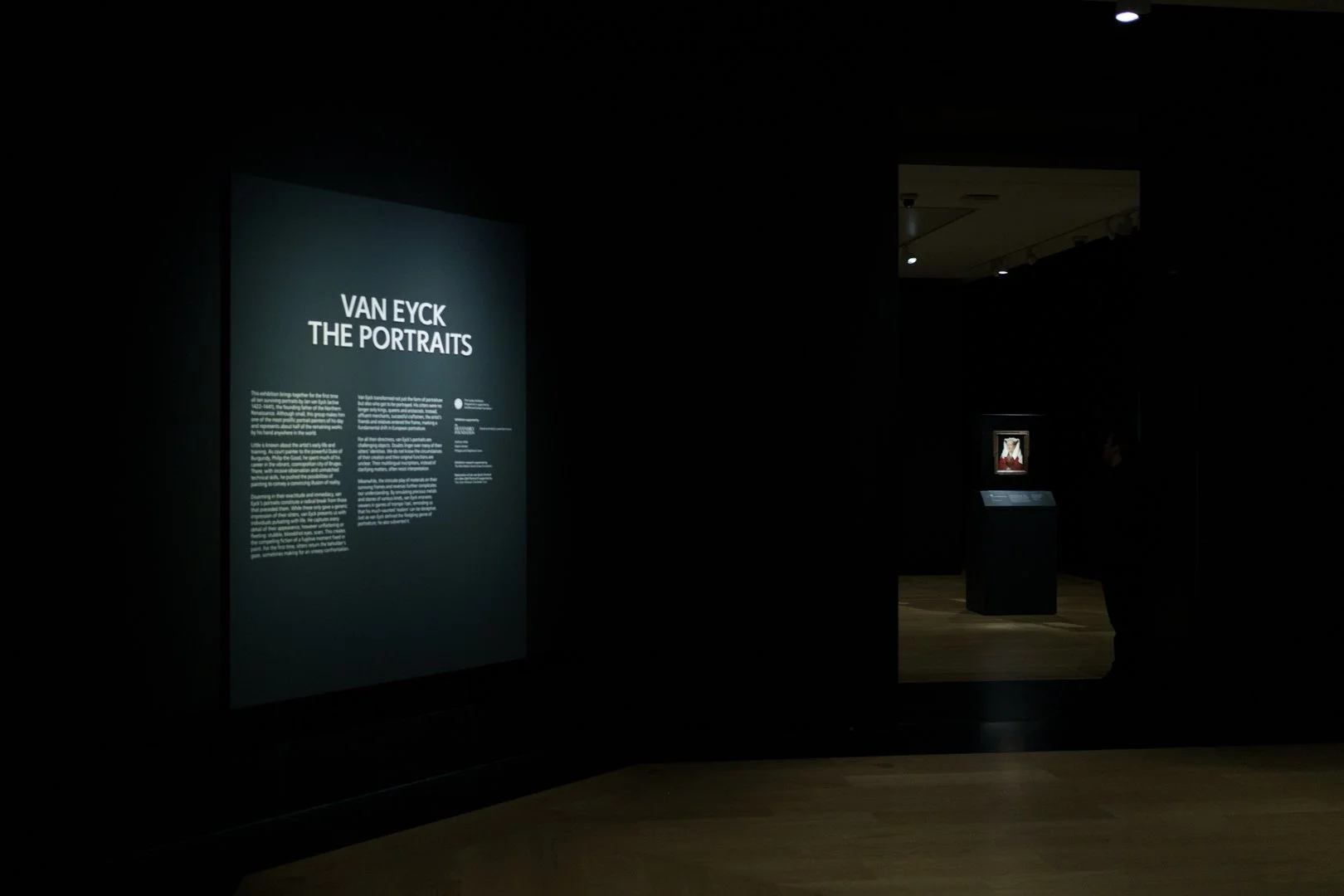
Installation view Van Eyck: The Portraits, National Gallery. Image credit Nigel lp.
But what if we’ve been wrong the entire time? The exhibition – or rather its catalogue – throws a spanner in the works by reviving an old suggestion made in 1847 by the Gallery’s first director, Sir Charles Eastlake, that the Arnolfini Portrait (1434) could be a double self-portrait of van Eyck and his wife Margaret, based on the Latin inscription above the concave mirror. However, the 16th-century inventories of Margaret of Austria contest this, referring twice to the sittersas ‘Hernoul le Fin’ and ‘Arnoult Fin’. Thankfully, the curators have displayed Portrait of a Man (Giovanni Arnolfini?)(about 1435-38) from Berlin’s Gemäldegalerie beside it, which almost certainly depicts the same sitter as the man in the double portrait. This is the first time the two paintings have been shown together in nearly 600 years.
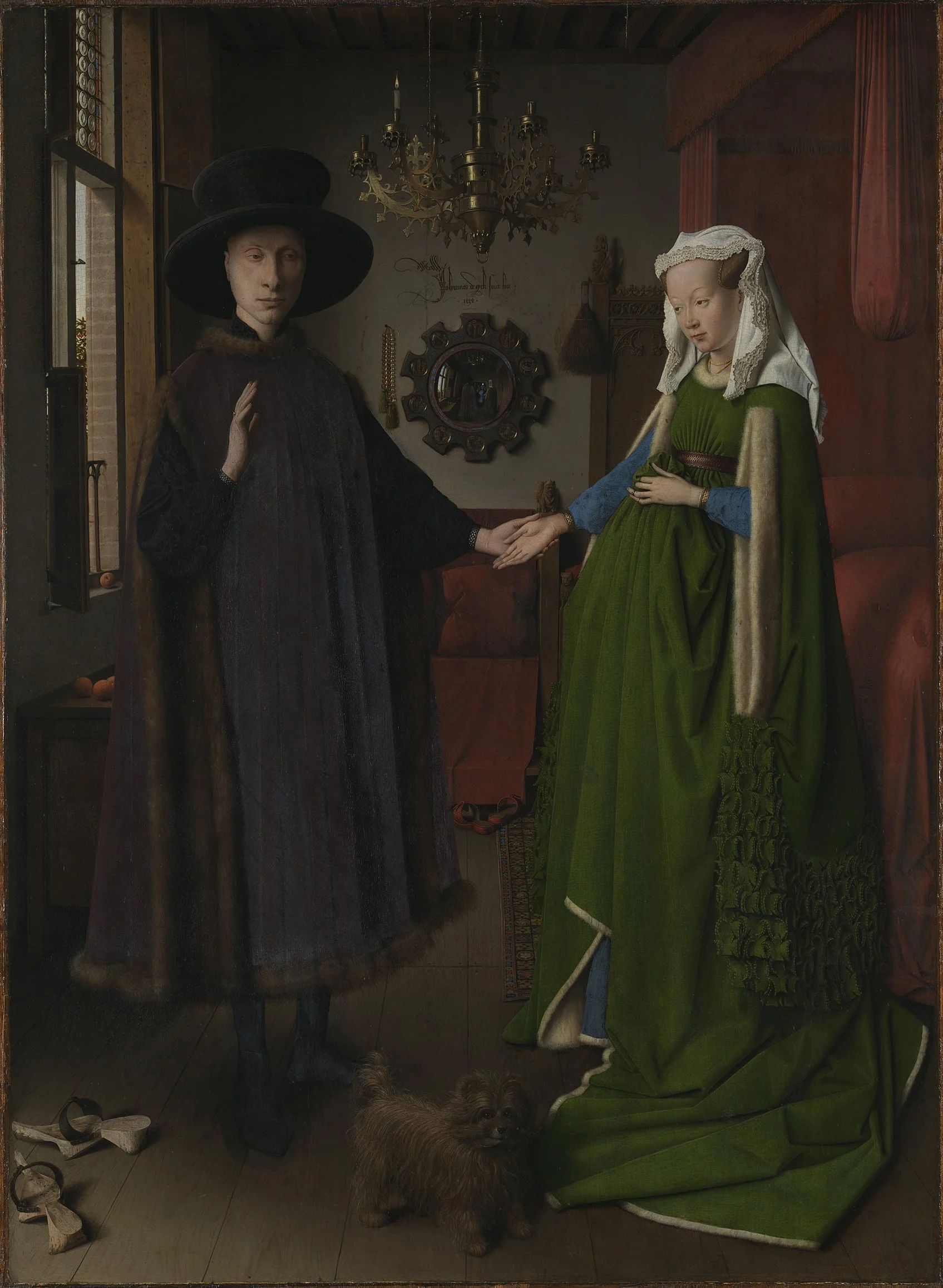
Jan van Eyck, Portrait of Giovanni(?) Arnolfini and his Wife, The Arnolfini Portrait,1434, oil on wood. 82.2 × 60 cm. © The National Gallery, London.
The theme of unknown sitters is a common thread throughout the exhibition, with only three portraits having secure identities. Portrait of a Man in a Blue Chaperon (about 1428-30) is the earliest one in the show, featuring a sitter with individuated stubble holding a ring that either denotes his profession as a probable goldsmith or alludes to the painting’s purpose for soliciting a bride. The use of ultramarine in the headdress also implies this was a costly painting to commission, indicating a certain level of wealth. In the top left corner, a later hand added an ‘AD’ monogram to suggest an authorship to Albrecht Dürer.
On the other hand, Portrait of a Man (‘L’éal Souvenir’)(1432) could have been painted to commemorate a deceased sitter with its inscription on a cracked stone parapet meaning ‘faithful memory’. It is the only French inscription on a surviving painting by van Eyck, in addition to its other writings in Greek and Latin. The folded piece of paper with illegible text in his hand has also done very little to identify the sitter’s identity and profession.
While this review could go on endlessly about the ramifications to the other portraits in the show if the identities in the Arnolfini Portrait were reconsidered, it is more useful to evaluate van Eyck’s groundbreaking innovations to the genre.
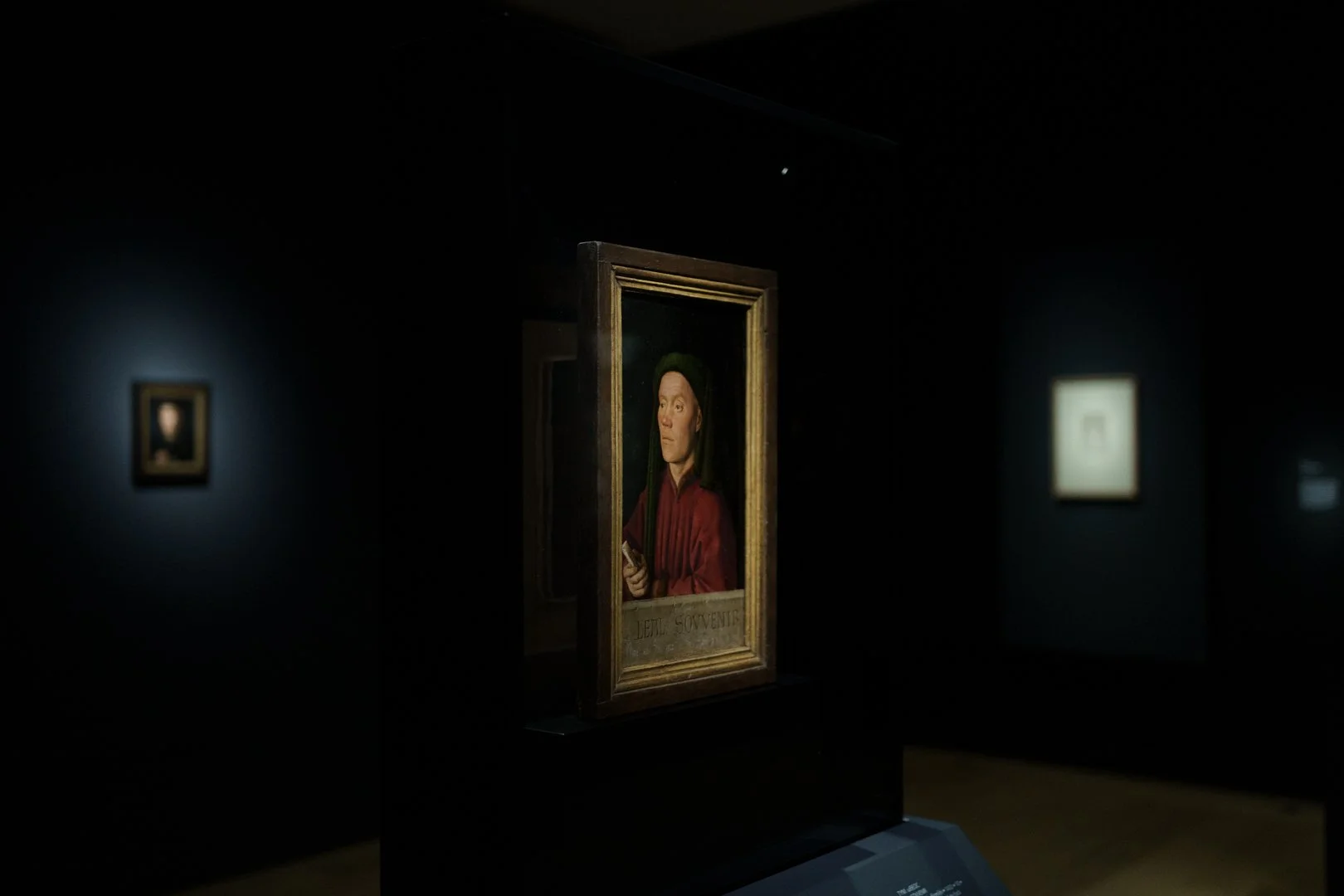
Installation view Van Eyck: The Portraits, National Gallery. Image credit Nigel lp.
Among his independent portraits, the Arnolfini Portrait is the only one showing his sitters at full length; everyone else in the exhibition is depicted bust length. This is very unusual for domestic portraits, since the full-length format was typically reserved for stately portraits of high officials. Even devotional paintings like the Madonna of Chancellor Rolin (1435) feature full-length donor portraits in a kneeling position, not standing. The same is true of the portraits of Joos Vijd and Elisabeth Borluut on the outer wing panels of the Ghent Altarpiece (1432). This unique format for the Arnolfini Portrait therefore suggests an air of importance on the two sitters, whatever that may be.
Although van Eyck didn’t invent oil painting like Giorgio Vasari claimed, he did pioneer the three-quarter profile in early Netherlandish painting, which we can see throughout the exhibition. Pre-Eyckian portraits tended to adopt the authoritative side profile preferred by Ancient Roman emperors, seen frequently on medals and currency, a tradition that remains unbroken throughout modern coinage. Yet even the Portrait of Baudouin de Lannoy (about 1435-40), an important chamberlain to Philip the Good, Duke of Burgundy, shows the sitter in van Eyck’s new format, decorated lavishly in a velvet robe, fur hat, and the chained collar of the Order of the Golden Fleece. He also has fabulous eyelashes. On a technical note, the panel derives from the same tree that was used for the Portrait of a Man (Giovanni Arnolfini?).
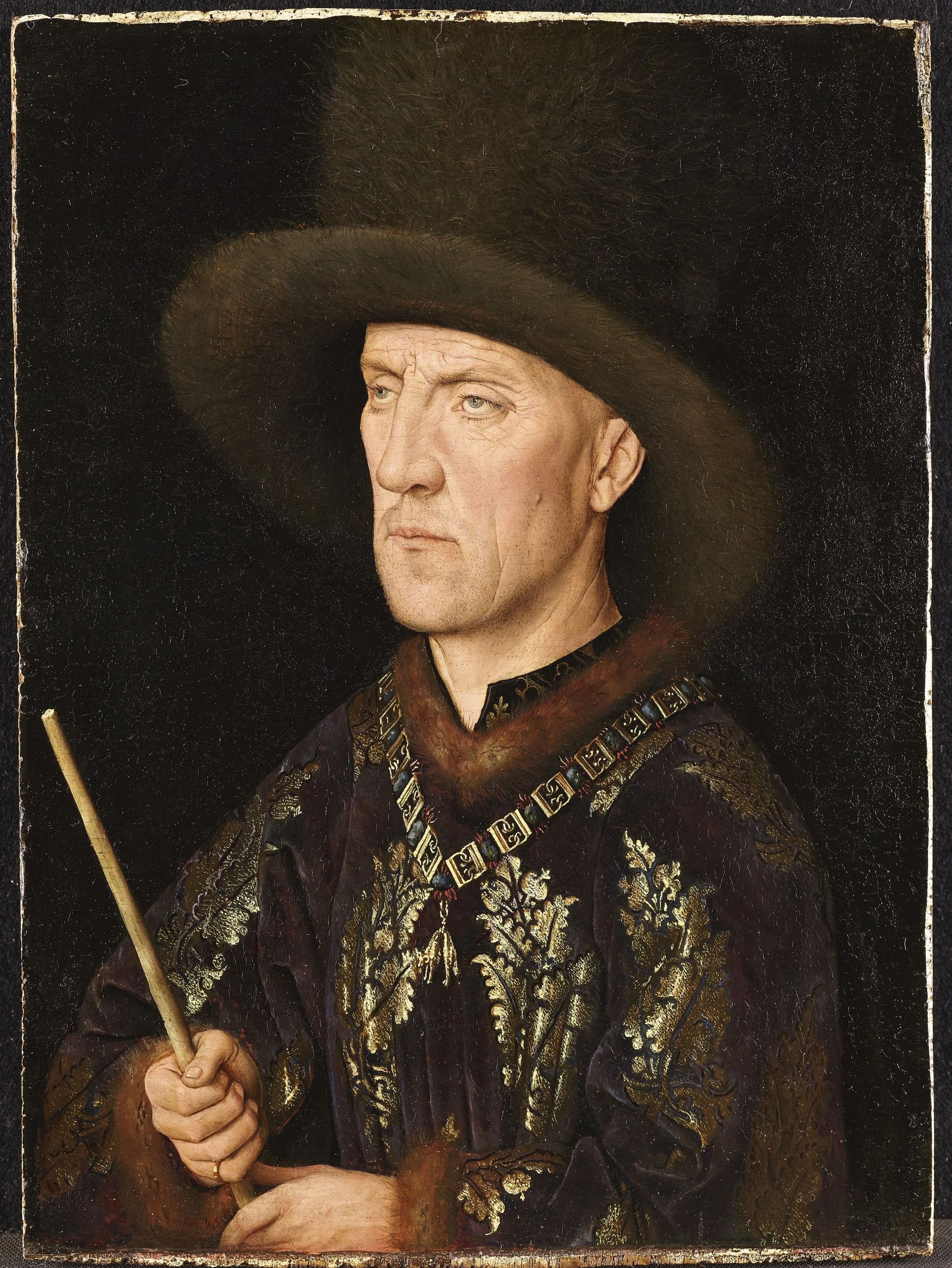
Jan van Eyck, Portrait of Baudoin de Lannoy, about 1435–40. Oil on wood, 26.6 × 19.5 cm, Gemäldegalerie, Staatliche Museen zu Berlin / Christoph Schmidt; Public Domain Mark 1.0.
The three-quarter profile offered numerous possibilities for the sitter to interact with its intended audience. Naturally, onecould see more of the sitter’s face, propelling their likenessinto real space and three-dimensional reality. With both eyes now visible, van Eyck forces his friends like the goldsmith Jan de Leeuw (1436) to look directly at the viewer, resulting in an intimate meeting of personalities across time and space.Inscribed around the original frame is the sitter’s date of birth, in addition to van Eyck’s signature and creation date.
In the same room is the Portrait of Margaret van Eyck (1439), the earliest dated portrait of a named woman who did not come from nobility, a significant milestone in the history of European painting. She too holds her gaze with the viewer. Its inscription on the frame tells us she was 33 years old when her husband painted her, and it shares the ‘Als ich can’ motto found on the so-called self-portrait. Curiously, infrared reflectography revealed a very close resemblance between the underdrawing of Margaret and the painted female sitter in the Arnolfini Portrait. Unfortunately, they have different coloured eyes, thus suggesting different identities.
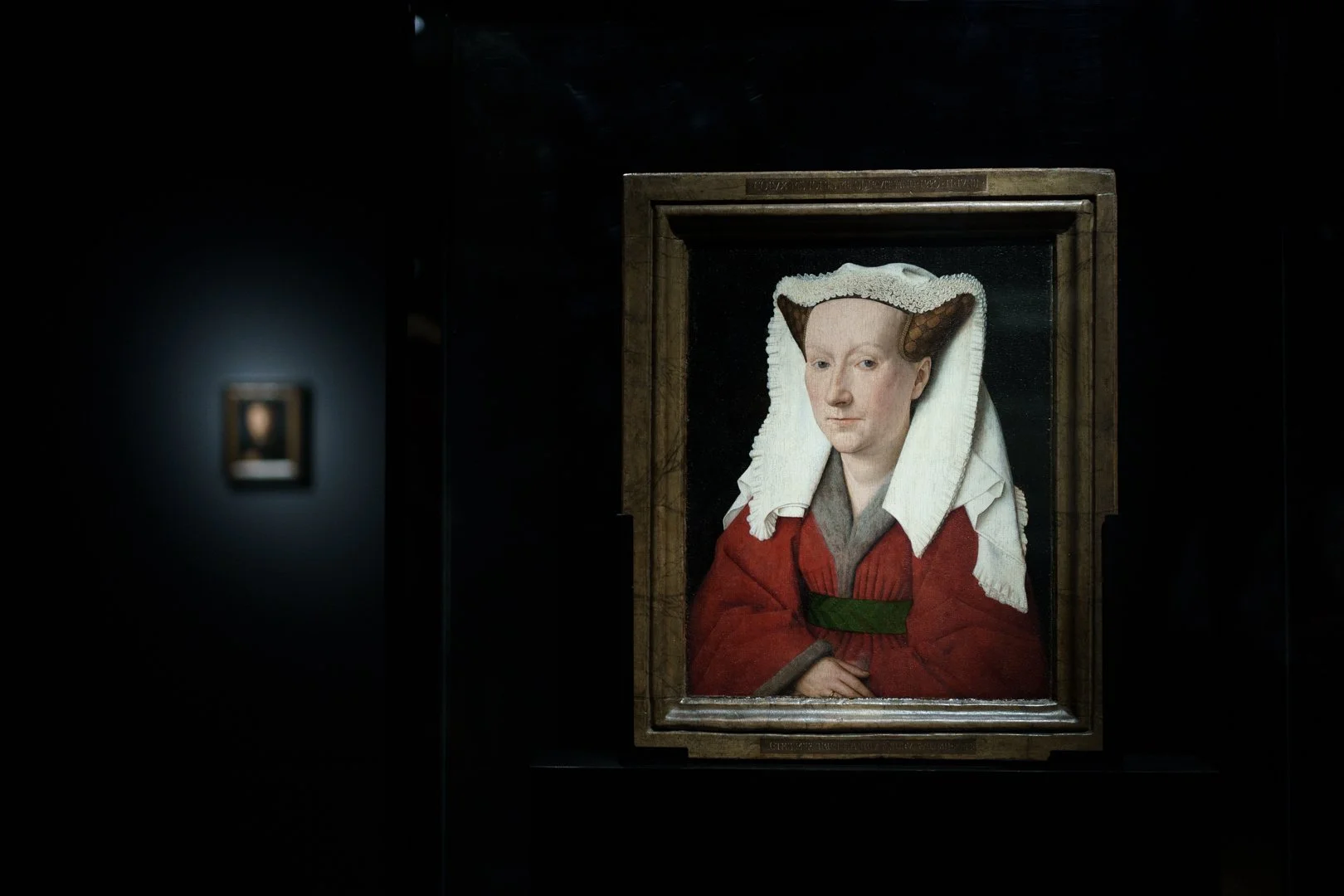
Portrait of Margaret van Eyck (1439). Installation view, Van Eyck: The Portraits, National Gallery. Image credit Nigel lp.
Margaret’s portrait is one of four paintings in the exhibition displayed ‘in the round’, allowing visitors to appreciate the back sides of each work. Portraits like these were not necessarily hung static on a wall; they were movable objects, intended to be held in the hand, and carried from place to place. As a result, van Eyck painted their frames and their backs to resemble fictive marble or stone, giving the illusion of holding a precious stone tablet. Across all four paintingsshown in the round, we can appreciate the different states of preservation, of which Margaret’s in the best preserved while others are marked with provenance notes and seals from past ownership.
The exhibition’s unsung hero, however, is not painting but drawing. Four metalpoint drawings – all incorporating silverpoint – are scattered around the show, each in dialogue with specific features found in van Eyck’s paintings. Rogier van der Weyden’s Portrait of a Young Woman (about 1440) – his only known drawing – reflects the female sitter in the Arnolfini Portrait. A Portrait of a Man (probably mid-15thcentury) by a follower of Jan van Eyck from Berlin’s Kupferstichkabinett highlights depictions of fur in the portraits of Baudouin de Lannoy and Jan de Leeuw.Meanwhile, the British Museum’s unattributed Portrait of a Man (about 1440-60) dons an elaborate, textured headdressakin to the Portrait of a Man in a Blue Chaperon.
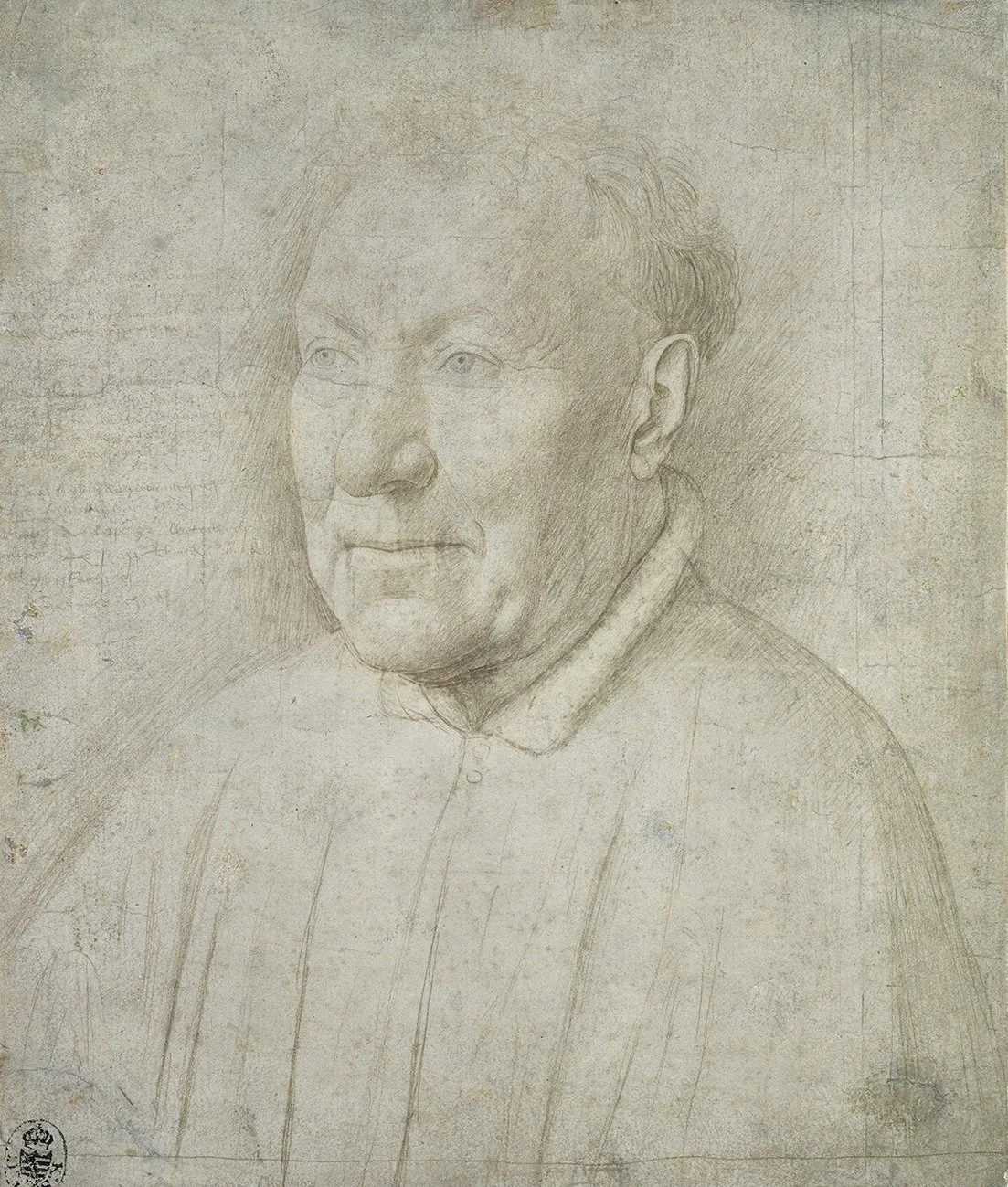
Jan van Eyck, Portrait of an Elderly Man, about 1438, gold- and silverpoint on prepared paper, 21.4 × 18 cm, Kupferstich-Kabinett, Staatliche Kunstsammlungen Dresden. © SKD Kupferstich-Kabinett Dresden C 775, Foto: Herbert Boswank.
But the real star is the gold- and silverpoint Portrait of an Elderly Man (about 1438) from the Dresden Kupferstich-Kabinett, the only undisputed drawing by Jan van Eyck in the world, and was last on public display at the Morgan Libraryand Museum in 2021-22. It is here reunited for the second time with the related painting in the Kunsthistorisches Museum, Vienna, which has been specially conserved for the exhibition. It is also the first time the Vienna institution has lent out both of their van Eyck paintings at the same time.
Metalpoint, a precursor to the modern graphite pencil, had the capacity to render precise details and subtle changes in light and shade due to its narrow tonal range. It was frequently used for creating small underdrawings for illuminated manuscripts, which van Eyck contributed to in the Turin-Milan Hours(about 1420 or 1435) for Duke Jean de Berry in France.
Inscriptions on the left of the sitter’s face, traditionally believed to be Cardinal Niccolò Albergati, contain notes for how to colour the oil painting, noting the eyes had ‘brown yellowish’ and ‘bluish’ hues, the nose was ‘brownish and blood red’, the lips were ‘very whitish / purple’, and how the stubble was ‘rather greyish’. This gives us insider knowledge into van Eyck’s working methods, unlocking the secrets for how all the portraits in the exhibition were conceived from a time-limited portrait drawing session using a monochrome medium. As a result, the Dresden drawing is also one of very few surviving preparatory studies for a Netherlandish painting of its period.
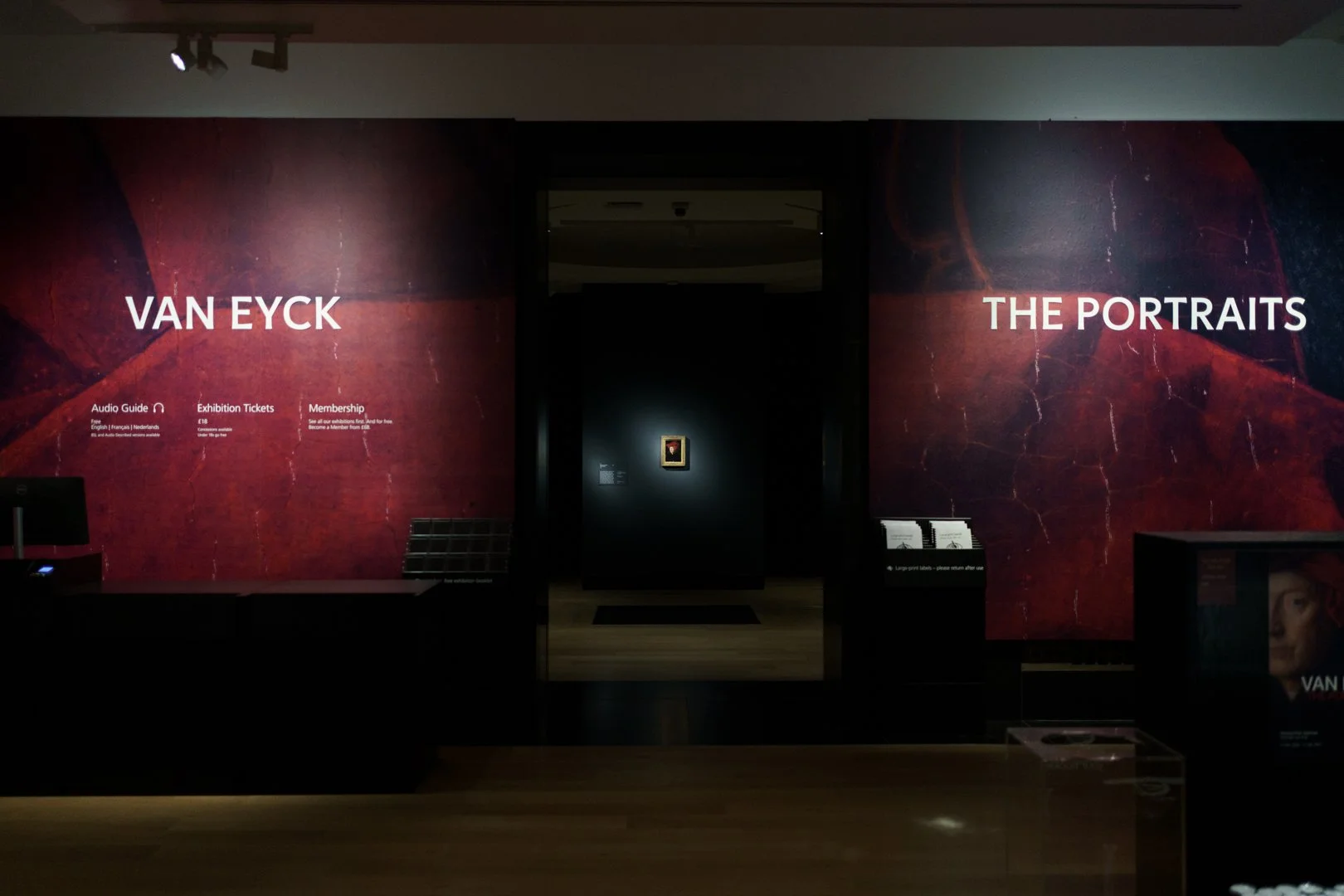
Installation view Van Eyck: The Portraits, National Gallery. Image credit Nigel lp.
Small and precious, this momentous exhibition dives straight into the genius of Jan van Eyck without unnecessary fluff and filler, while also highlighting the prevailing challenges facing academic scholarship. Its importance is on par with the 2020 Van Eyck: An Optical Revolution exhibition at the Museum voor Schone Kunsten in Ghent, which brought together the restored outer panels of the Ghent Altarpiece in dialogue with other works by van Eyck and his contemporaries, including five portraits that have now reappeared again in the National Gallery exhibition. Even with a rare gathering such as this, we seem no closer to discovering anything exceptionally new about van Eyck and the people he depicted.
If there was ever an opportunity to wipe the derogatory term ‘Flemish primitives’ from academic discourse since the 1800s, this would be the show to do that. Every painting and every drawing is a masterpiece in capturing humanity and the mortal experience, from the sensation of having direct eye contact with a historically living human being, to the landscape of a wrinkled face with all its unique specificities.
Aside from the Bayeux Tapestry experience at the British Museum, this is truly the most important exhibition of the year.
Van Eyck: The Portraits is on show at the National Gallery, 21 November 2026 - 11 April 2027. Discover more at nationalgallery.org.uk
Review by Nigel lp




Handmade in Ghana, this beautiful green apron offers a unique design with a front pocket perfect for kitchen utensils or your phone and tie neck straps each made from recycled material. The perfect gift for any cooking enthusiasts!
Our aprons have been named after markets in Ghana. This apron has been named after Kintampo Market located in the Bono region of Ghana it is noted for their sales of yam tubers.