
Seurat and the Sea, Courtauld Gallery review
Between 1885 and 1890, the French Neo-Impressionist painter Georges Seurat made annual summer trips from Paris to the Channel coast, visiting Grandcamp (1885), Honfleur (1886), Port-en-Bessin (1888), Le Crotoy (1889), and Gravelines (1890). Whilst there, he produced 24 seascapes, constituting over half of the 45 known paintings on canvas he made in his short lifetime, dying in 1891 at the age of 31 in his parents’ home.
Seurat and the Sea at the Courtauld Gallery is the first exhibition devoted to this category of his work, bringing together 17 canvases, six oil sketches on wood panels, and three preparatory drawings. In doing so, it provides a wider appreciation of his pointillist technique, which relied on placing dots and dashes of pure colour next to each other instead of mixing them. It also offers a unique contrast to his famous figural compositions, such as the Bathers at Asnières (1884) and A Sunday on La Grande Jatte (1884), highlighting his approach to painting en plein air instead of in the studio.
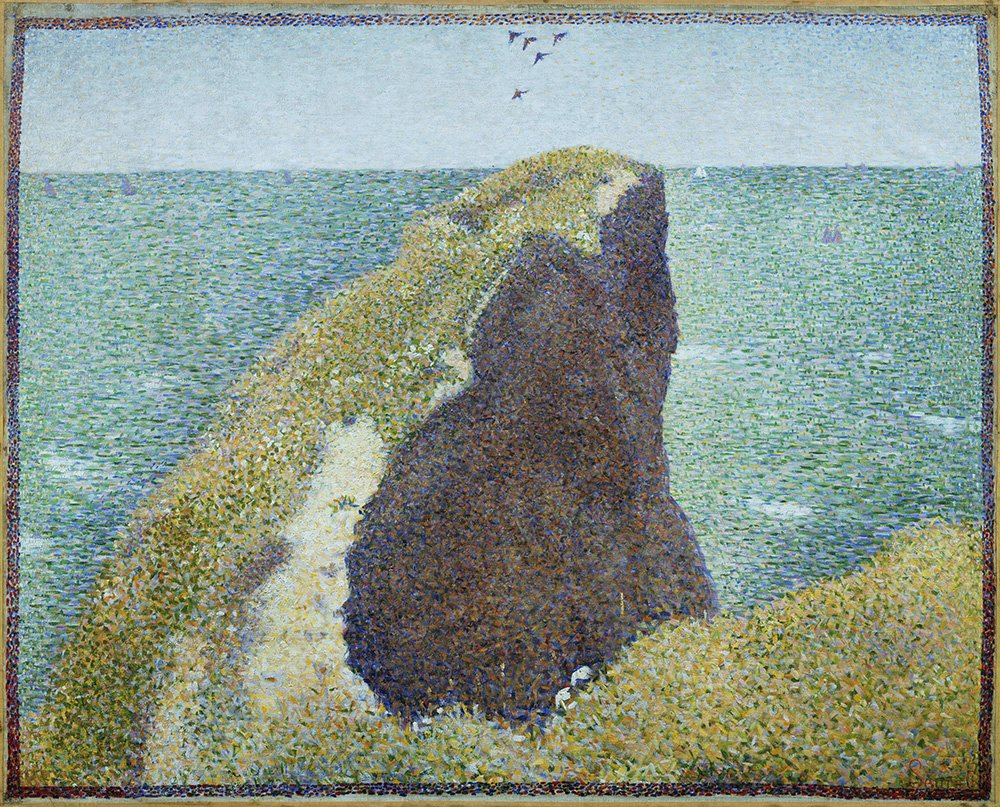
Seurat, Le Bec du Hoc, Grandcamp, 1885, Tate purchased 1952 © Tate
Seurat’s first summer painting campaign begins near the fishing village of Grandcamp, represented here by four paintings. Le Bec du Hoc (Grandcamp) (1885, reworked c. 1888-89) is joined by an oil study, both depicting the rocky formation’s iconic beak-like shape. Immediately noticeable is the illusion of depth within the scene, utilising broad, diagonal strokes in the foreground and thin, perpendicular ones for the background. We also bear witness to one of the many fictitious borders he added to his works several years later, their dotted composition sensitively responding to the colours in their vicinity.
Yet it is small oil sketches like Marine at Grandcamp (1885) that foreshadow Seurat’s refinement in this technique with its indiscriminate application of colour to render a semblance of the coastline. Such sketches were painted on site with the use of a boite à pouce, a small travel box where wood panels could be slotted into the inner lid, while the bottom compartment held an artist’s palette, tubes of paint, turpentine, and other equipment. Oftentimes, he would allow areas of the wood to show through, a habit he also transferred to his canvases.
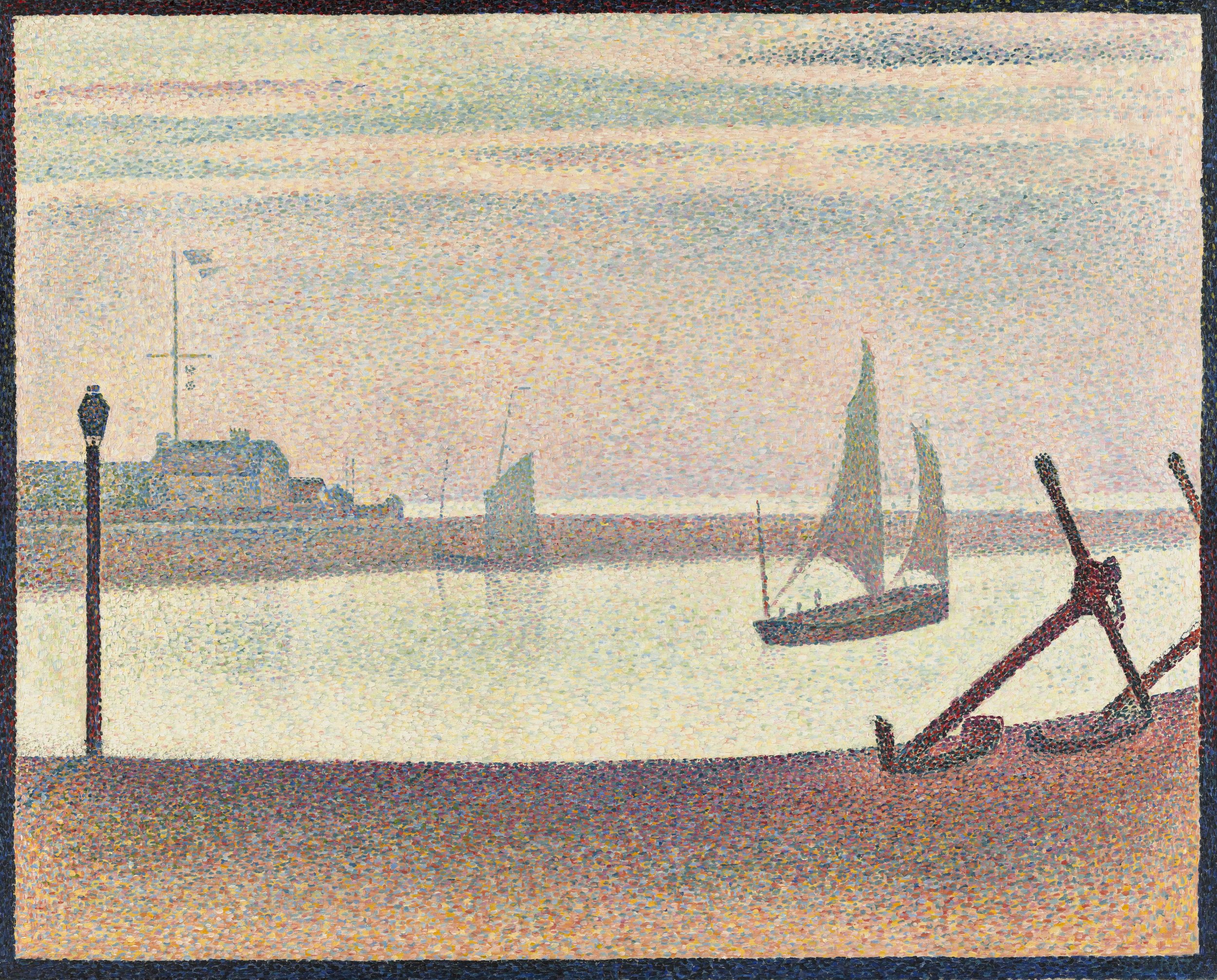
Seurat, The Channel at Gravelines, Evening, 1890, The Museum of Modern Art, New York. Gift of Mr. and Mrs. William A. M. Burden, 1963, Digital image, The Museum of Modern Art, New York, Scala, Florence.
Very soon, Seurat’s technique enabled him to master spatial depth without the use of variable mark-making, resulting in indistinguishable systems of dots across the whole picture plane. The Channel of Gravelines: Grand-Fort-Philippe (1890) is a good example of this years later with its limited palette and subtle gradations of tone in the vast expanses of sand and sky.
The Honfleur paintings from 1886 make up the rest of the first room and reveal Seurat’s picturesque approach to urban landscape. Last together in 1891 when the contents of the artist’s studio were dispersed, Entrance of the Port of Honfleur (1886, reworked c. 1890) has been reunited with its preparatory drawing in Conté crayon, showing how Seurat flattened the composition to emphasise geometry, narrowed the opening of the port, and filled it with extra boats, while firmly anchoring his composition with the bollard in front. The skipped crayon lines on textured paper is also reflective of his painting technique, producing monochrome criss-crosses akin to those rendered in colour. In the second room, one finds a more complete case study for how Seurat’s drawings and oil sketches assisted his creative process for The Channel of Gravelines: An Evening (1890).
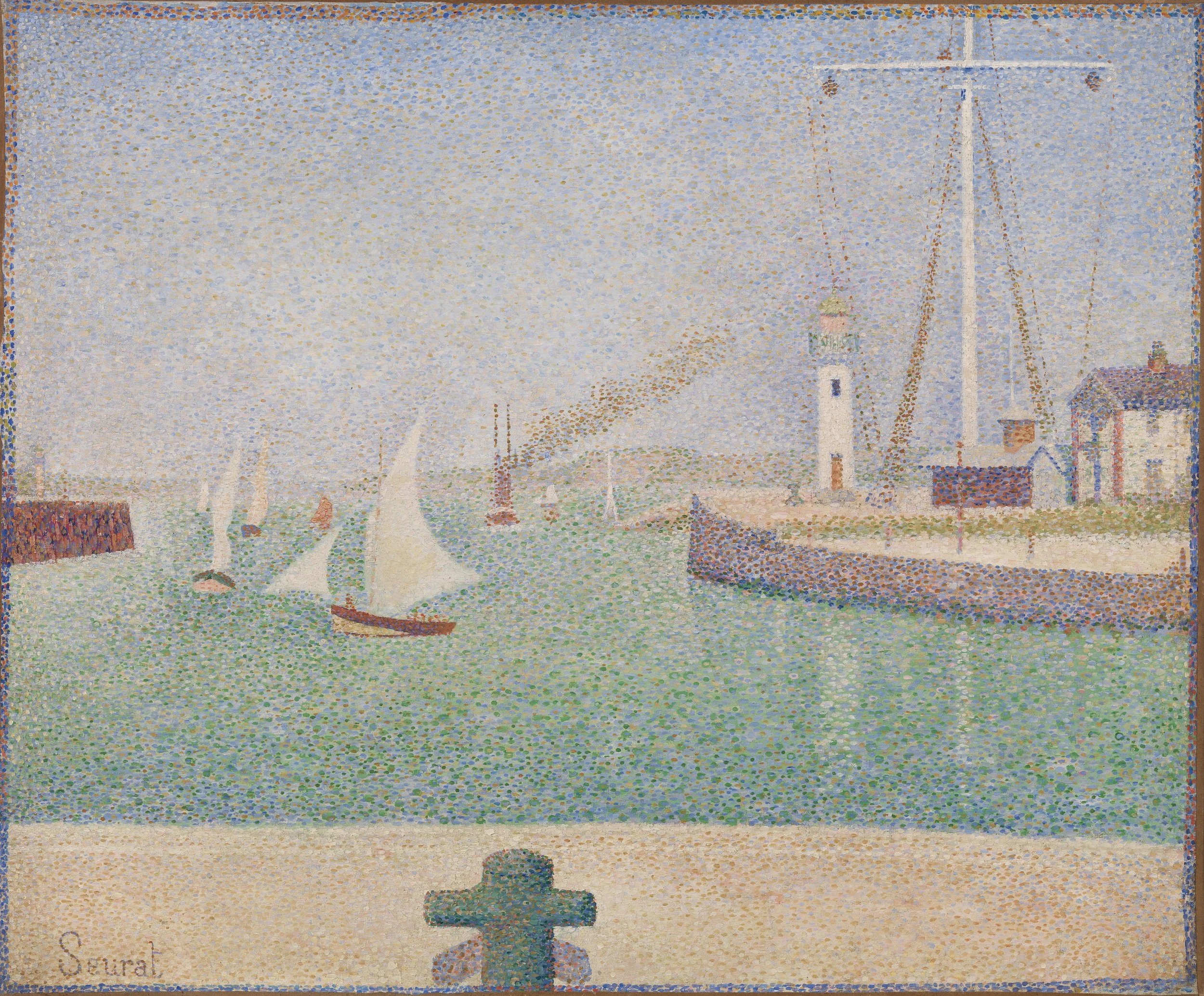
Seurat, Entrance to the Port of Honfleur, 1886, Barnes Foundation, Philadelphia. Photo © 2025 Barnes Foundation. All rights reserved.
One of the high points of this exhibition is the gathering of all six paintings of Port-en-Bessin, reunited for the first time since their unveiling in February 1889 at the Sixth Exhibition of Les XX in Brussels. Displayed in Seurat’s original hanging order, it creates a composite image of the port, highlighting the quays and the splendid views from the nearby cliffs. Unlike the earlier seascapes, this body of work also features people, adding dynamism to their sense of serenity. Reproductions of postcards accompany some of the captions, allowing visitors to appreciate the town’s 19th-century appearance and Seurat’s creative interventions.
Port-en-Bessin - The Bridge and the Quays (1888, reworked c. 1889) is a great example of how shadows are created in relation to Seurat’s optical method of painting. While the brightly lit ground is largely composed of yellow and white dots, shadows and dark areas are mostly blue, demonstrating how placing complementary colours from opposite sides of the colour wheel can mimic tonal effects while enhancing the properties of both colours.

Installation view, The Griffin Catalyst Exhibition, Seurat and the Sea, Courtauld Gallery. Photo © Fergus Carmichael.
Meanwhile, Port-en-Bessin - The Outer Harbour (High Tide) (1888, reworked c. 1889) introduces us to Seurat’s framing decisions. Throughout his life, he designed bold blue or purple frames to accompany his paintings, which are embellished with dots and specks of colours that contrast with those in the works themselves. Doubt has now been cast on the authenticity of the present frame for this painting, which was historically believed to be by Seurat himself. Similarly, the frame for The Channel of Gravelines: Petit-Fort-Philippe (1890) is a reconstruction from 1985 in an attempt torecapture the visual effect originally sought by Seurat. Many of his bespoke coloured frames have since been lost, probably destroyed.
This exhibition is a remarkable analysis of this overshadowed genre in Seurat’s late work, embarking visitors on a sightseeing journey through the artist’s methodology and vision for art. Every single work on display is a stunning demonstration of Seurat’s mastery of paint and optical theory, making it one of the best opportunities to see his work at the peak of his abilities.
Date: 13 February – 17 May 2026. Location: The Courtauld Gallery, Somerset House, Strand, London WC2R 0RN. Price: from £18. Concessions available. Book now
Review by Nigel lp












Handmade in Ghana, this beautiful green apron offers a unique design with a front pocket perfect for kitchen utensils or your phone and tie neck straps each made from recycled material. The perfect gift for any cooking enthusiasts!
Our aprons have been named after markets in Ghana. This apron has been named after Kintampo Market located in the Bono region of Ghana it is noted for their sales of yam tubers.