
Indie Night at the Southbank Centre review
On February 25th the Southbank Centre launched the new Indie Night series, dedicated to the championing and celebrating of independent publishers and authors. The series arrives at a significant time as we crave human stories and voices that stand aside from those produced and reproduce by multinational companies. Writer and associate artist at the Southbank Centre, Max Porter, introduced the evening, admitting that it was cliché to talk of the publishing world as an “ecosystem” but went on with the metaphor. He mentioned the predators within the industry, the reading crisis that signals its decay, and how independent publishers are the “progressive vanguard” that are a force of light and life within it.
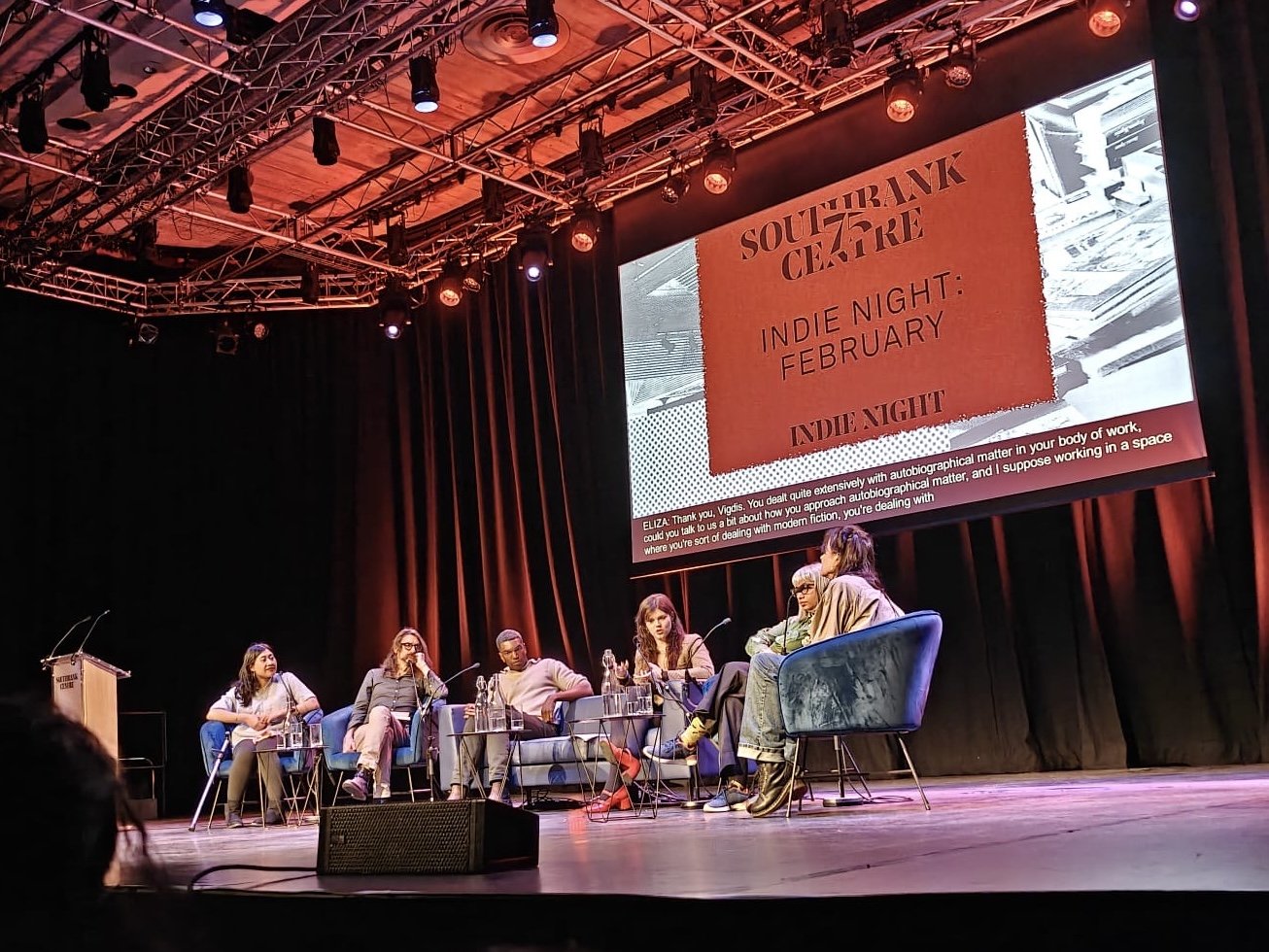
L-R is Khairani Barokka, Tim MacGabhann, hosts Okechukwu Nzelu and Eliza Clark, Deepa Anappara, Vigdis Hjorth. Indie Night February, Southbank Centre. Image credit Angelo Amikhaeil.
Without a doubt, it is an important time for stories and storytellers. In the year of 2026, it isn’t just narrators that are unreliable – we have begun questioning the structures above them, too. Porter hailed the indie press and their publishing as “counter-cultural gestures that hold the world to account and together” – something that is certainly desirable in an age of corporations that tend to value profit over principles, purpose, and people. The commercialised mechanics of big publishing can often obscure indie writers and the landscape that they must make their place in, but, once you find them through the malaise, their raw sincerity and earnestness shines through with a vital spirit.
Before the event, I spoke with Ted Hodgkinson, Southbank Centre’s Head of Literature and Spoken Word, who promised that the series would be a “wonder box” of writers. It would be the literary equivalent of a stand-up comedy night, he told me. Indeed, it was an eclectic range of authors on the stage, and it was clear from how they spoke about their books that they had been motivated by a deep and intimate passion rather than being influenced by the commercial impulse of mainstream publishing.
In a time where out-dated narratives are crumbling, old stories are waiting to be retold in new ways. The authors Deepa Anappara and Khairani Barokka embodied this on the night: Anappara spoke of her 19th century style adventure novel, The Last of Earth, which is something of a response to Rudyard Kipling’s writing. Kipling, an icon of British literature, suffered and still suffers from his vehemently imperialist imagination and worldview. Anappara expands on our literary and real history by filling in what was redacted by those like Kipling who wrote it, pointing out that history can be (and often is) only speculative non-fiction.
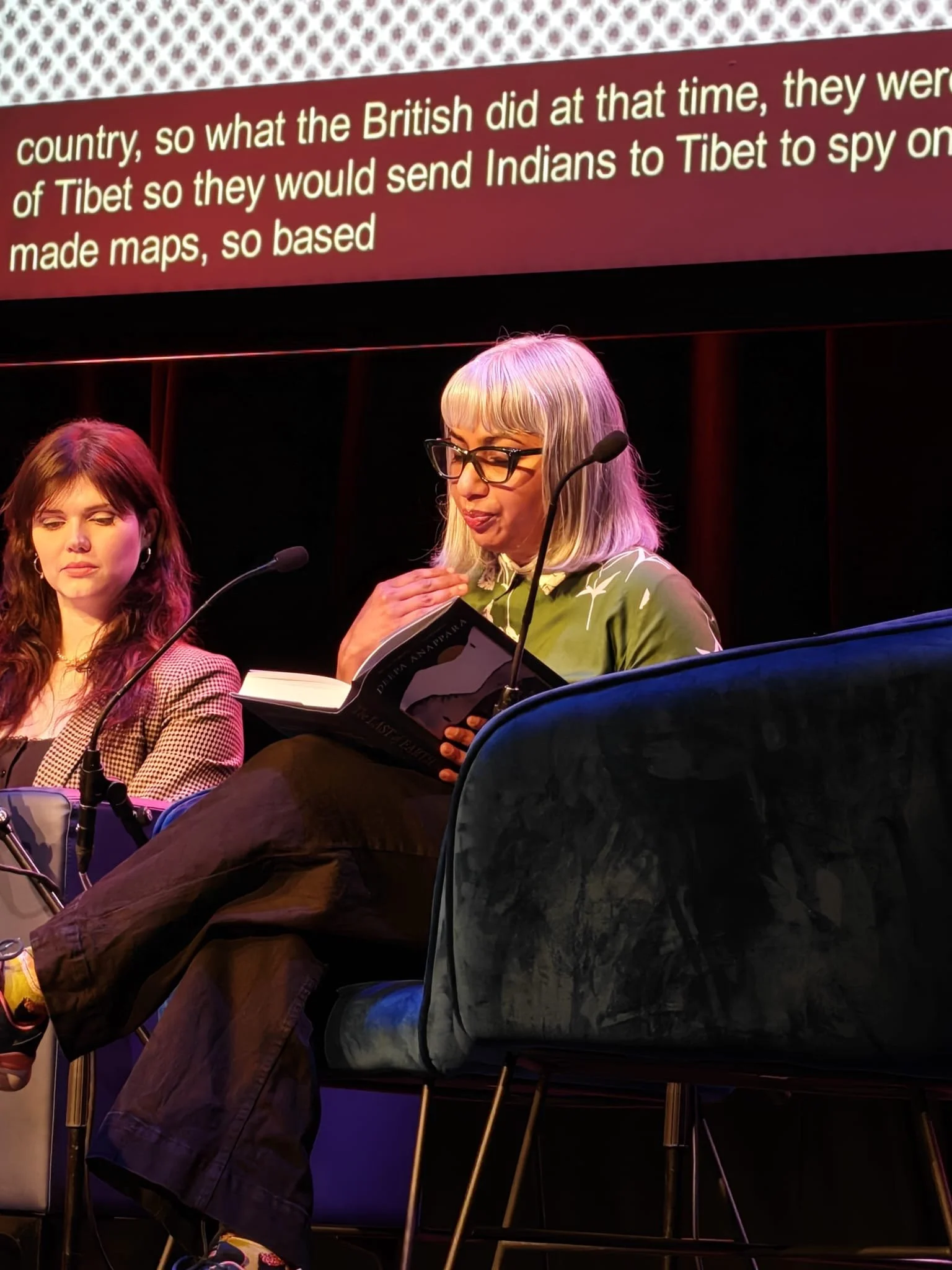
Host Eliza Clark and Deepa Anappara, Indie Night February, Southbank Centre, Image credit Angelo Amikhaeil.
Barokka was moved by a similar sentiment, which inspired over a decade’s worth of research to write Annah, Infinite. The book imagines the subject of Annah la Javanaise by renowned artist Paul Gauguin in her own infinite possibilities, rather than through the accounts of her by Gauguin and the art historians throughout the years. If arts establishments really want to help to shift prevalent narratives, it is essential for them to make space for artists and organisations who are doing so through their work.
The first Indie Night event and the featured authors offered a timely reminder that stories are the best way in which we can re-imagine our world, our past, present, and future. For those who are seeking fresh perspectives and bold voices, this series offers a potent point of discovery and a home for crucial and invigorating conversation about art, storytelling, and how independent artists and organisations can challenge the status quo.
Yet, despite all its talk of imagination and possibility, the literary world can still feel like a closed room. It struggles to make itself accessible to those who aren’t “book people” and that sense was present with me on the night. Granted, the industry might have a handicap in today’s climate, with books and writers often being a bit too quiet and considered to break through the noise of today’s culture. You could argue that addressing this issue falls primarily to commercial publishers, but everyone within the world of literature can play a part in making books accessible to all. With that in mind, at future events in the series I’d hope to see more forms represented: indie comics, magazines and zines, photojournalism, and whatever else might be out there besides prose and poetry. Nevertheless, I woke up the next morning with a few new ideas, a longer reading list, and very much looking forward to seeing what the future holds for the Indie Night series.
Indie Night is a quarterly literary series and will return to Southbank Centre in June 2026. Click here to discover more.
Words by Angelo Mikhaeil





Stand out this summer with this gorgeous Nsubra beach bag! Handmade in Ghana, this large tote bag is the perfect size for your sun cream, beach towel, purse and your latest book.